RBSE Class 6 English Chapter 11 Question Answer The Winner
PracticingRBSE Solutions Class 6 EnglishPoorvi Chapter 11 The Winner Question Answer will help you achieve better results in your studies.
The Winner Class 6 Question Answer
The Winner Question Answer
Class 6 English The Winner Question Answer
Let us do these activities before we read.
1. Look at this picture.
इस तस्वीर की ओर देखें।
(a) What are these children doing?
ये बच्चे क्या कर रहे हैं?
Answer:
These children are playing.
ये बच्चे खेल रहे हैं।
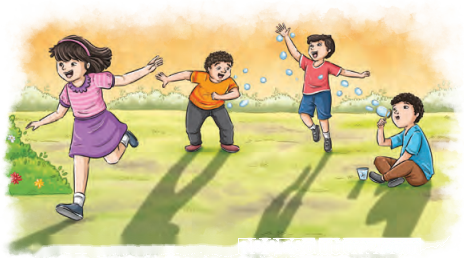
(b) Where do you think they are?
आपको क्या लगता है वे कहाँ हैं?
Answer:
I think they are in a public park.
मुझे लगता है कि वे किसी सार्वजनिक उद्यान में हैं।
(c) What is the time of the day?
दिन का समय क्या है?
Answer:
It is evening time of the day.
यह दिन का सांध्यकालीन समय है।
2. Discuss the given questions with your classmates and teacher. You may begin your sentences with —
दिए गए प्रश्नों पर अपने सहपाठियों और शिक्षक के साथ चर्चा करें। आप अपने वाक्यों की शुरुआत इस प्रकार कर सकते हैं-
I go to …
1 play with …
The place I go to for playing …
I like playing……
Sometimes I come back …
(a) When do you go to play after school?
आप स्कूल के बाद खेलने कब जाते हो?
Answer:
I go to play in the evening. मैं शाम को खेलने जाता हूँ।
(b) Who do you play with? आप किसके साथ खेलते हो?
Answer:
I play with my friends, brothers and sisters.
मैं अपने दोस्तों, भाइयों और बहनों के साथ खेलता हूँ।
(c) Where do you go to play in the evening?
आप शाम को खेलने कहाँ जाते हो?
Answer:
I go to the public park near my home to play in the evening.
मैं शाम को खेलने के लिए अपने घर के पास के सार्वजनिक पार्क में जाता हूँ।
(d) Which games do you like playing?
आपको कौनसे खेल खेलना पसंद हैं?
Answer:
I like to play badminton and hide and seek.
मुझे बैडमिंटन और लुका-छिपी खेलना पसंद हैं।
(e) When do you come back home?
आप घर वापस कब आते हो?
Answer:
I come back before it gets dark.
मैं अँधेरा होने से पहले वापस आ जाता हूँ।
Let us discuss (आओ चर्चा करें)
Question 1.
Read the given lines from the poem. Write the meaning of the lines by identifying the words/expressions in them.
कविता से दी गई पंक्तियाँ पढ़ें। उनमें प्रयुक्त शब्दों / अभिव्यक्तियों की पहचान करके पंक्तियों का अर्थ लिखें।
Answer:
Lines from the poem | Meaning |
1. next to the creekClue: a small body of water. | Close to a small river or a stream. |
2. I can’t even catch my breathClue: the child has been running. | The child is breathless. |
3. When blue dark turns to blackClue: the colour of the sky changes from blue to black.What does it mean? | The twilight changes into the night. |
4. trees creep closeClue: it is evening time.Why do you think the trees seem close? | The trees seem close because of the increasing darkness. |
Question 2.
Read the poem. Complete the following based on the poem.
The children play (1) _________ in the (2) _________ in the neighbour’s (3) _________. They run so (4) _________ that they run out of breath. They continue to play till the evening when the blue sky turns (5) _________, and the trees are not clearly visible. They can feel their feet (6) _________, now that it is cold. Finally, they stop (7) _________ and go home as it is night.
Answer:
(1) ball (2) evening (3) field (4) fast (5) black (6) ache (7) playing
The Winner Class 6 Questions and Answers
Let us think and reflect (आइये सोचें और चिंतन करें) –
Question 1.
Read the given lines and answer the questions that follow.
दी गई पंक्तियों को पढ़ें और नीचे दिए गए प्रश्नों के उत्तर दें।
(a) We run so fast
I
can’t
even
catch
my
breath.
(i) Complete the sentence given below with the correct option.
नीचे दिए गए वाक्य को सही विकल्प से पूरा करें।
The speaker needs to catch her breath because _________.
(a) everyone decides to walk
(b) all the friends wish to go home
(c) running fast results in being breathless
(d) they need to do breathing exercises
Answer:
(c) running fast results in being breathless
(ii) Is the speaker alone? Why do you say so?
क्या वक्ता अकेला है? आप ऐसा क्यों कहते हैं?
Answer:
No, the speaker is not alone. The use of first person plural pronoun ‘we’ in the poem indicates it.
नहीं, वक्ता अकेला नहीं है। कविता में प्रथम पुरुष बहुवचन सर्वनाम ‘we’ (हम) का प्रयोग इसका संकेत देता है।
(iii) What does the pattern in the lines tell us?
पंक्तियों का स्वरूप हमें क्या बताता है?
Answer:
The pattern is the lines tells us that the speaker is breathless and therefore is unable to say the complete sentence in one go.
पंक्तियों का स्वरूप हमें बताता है कि वक्ता की सांस फूल रही है और वह एक बार में पूरा वाक्य बोलने में असमर्थ है।
(b) When blue dark turns to black,
cold grass aches our feet,
trees creep close-
game’s over.
Night wins!
(i) Give one reason why the grass is cold.
घास ठंडी क्यों है, इसका एक कारण बताओ?
Answer:
The grass is cold because dew drops start falling on the blades of grass with the approaching night.
घास ठंडी है क्योंकि रात होने के साथ ओस की बूँदें घास के पत्तों पर गिरने लगती हैं।
(ii) Complete the sentence suitably.
वाक्य को उचित रूप से पूरा करें।
The children’s feet are aching because _________ .
Answer:
they are tired after running and playing and are feeling the coldness of the grass.
(iii) Why does ‘Night’ win?
Night wins because the _________ .
(a) time for play has ended
(b) children are tired
(c) time to play at home begins
(d) night follows day
Answer:
(a) time for play has ended.
Let us learn (आओ सीखें) –
Question 1.
Do yourself.
Question 2.
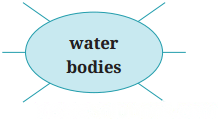
The poet has talked about a creek in the poem. You now know that creek is a water body. Complete the word web given below by writing which other water bodies you can think of. Discuss with your teacher.
कवि ने कविता में एक छोटी नदी या धारा के बारे में बात की है। अब आप जानते हैं कि छोटी नदी या धारा एक जल निकाय है। नीचे दिए गए शब्द जाल को पूरा करें और लिखें कि आप किन अन्य जल निकायों के बारे में सोच सकते हैं। अपने शिक्षक के साथ चर्चा करें। Answer:
river, pond, sea, ocean, stream, lake.
SEEN PASSAGE
Read the following extract carefully and answer the questions that follow :
Extract-1
Evenings,
we play ball
next to the creek
in our neighbour’s field.
Question 1.
Choose the correct alternative –
What do the children play?
(a) Marbles
(b) Ball
(c) Cricket
(d) Hide and seek
2. When do the children play?
बच्चे कब खेलते हैं?
3. Where do they play?
वे कहाँ खेलते हैं?
4. Where is neighbour’s field?
पड़ोसी का खेत कहाँ है?
5. Find the plural form of the following word from the extract- ‘Evening’.
6. Write the opposite word of the following from the extract- ‘previous’.
Answer:
1. (b) Ball
2. Children play in the evening.
बच्चे शाम के समय में खेलते हैं।
3. They play in their neighbour’s field.
वे अपने पड़ोसी के खेत में खेलते हैं।
4. Neighbour’s field is next to a creek.
पड़ोसी का खेत एक छोटी नदी / धारा के पास है।
5. ‘Evenings’
6. ‘next’
RBSE Class 6 English Chapter 11 Hindi Translation
Let us read (आओ पढ़ें) –
कठिन शब्दार्थ एवं हिन्दी अनुवाद
Evenings, …………………………………………… field. (page 116)
कठिन शब्दार्थ Next (नेक्स्ट) = अगला सबसे पास, निकटतम Creek (क्रीक्) = छोटी नदी धारा। Neighbour (बर्)) = पड़ोसी Field (फ़ील्ड) = खेत।
हिन्दी अनुवाद – शाम के समय में, हम हमारे पड़ोसी के खेत में नदी या धारा के किनारे गेंद (बॉल) खेलते हैं। (कविता में बच्चों को घर के बाहर सांध्यकालीन समय में खेलते हुए दिखाया गया है व प्राकृतिक परिवेश में खेलने के महत्त्व को रेखांकित किया गया है।)
We run so fast …………………………………………… Night wins! (page 116)
कठिन शब्दार्थ – Breath (ब्रेथ्) = साँस, श्वास Blue dark turns to black = यहाँ अर्थ है कि सांध्यकाल गहराकर रात्रि में बदल जाता है। Cold (कोल्ड्) = ठंडा, शीत। Grass (ग्रास्) = घास। Ache (एक्) = लगातार दर्द का अनुभव होना । Feet (फ़ीट्) = पैर, पाँव Creep (क्रीप्) = चुपके से खिसकना, धीरे-धीरे आगे बढ़ना । Over (ओवृ ( र् )) = समाप्त।
हिन्दी अनुवाद – इन पंक्तियों में कहा गया है कि बच्चे इतनी तेज दौड़ते हैं कि उनकी सांसें फूल जाती हैं। जब नीला अँधेरा काले में बदल जाता है अर्थात् सांध्यकालीन अँधेरा गहराकर रात्रि में बदल जाता है, ठंडी घास हमारे पैरों को दर्द देने लगती है और वृक्ष अंधकार के कारण पास खिसकते हुए प्रतीत होते हैं तब खेल समाप्त होता है। कविता इस वाक्यांश से समाप्त होती है कि ‘रात्रि जीतती है’ अर्थात् रात्रिकालीन शांति उनके कोलाहलपूर्ण खेल पर हावी हो जाती है।