RBSE Class 6 English Chapter 15 Question Answer Ila Sachani: Embroidering Dreams with her Feet
PracticingRBSE Solutions Class 6 EnglishPoorvi Chapter 15 Ila Sachani: Embroidering Dreams with her Feet Question Answer will help you achieve better results in your studies.
Ila Sachani: Embroidering Dreams with her Feet Class 6 Question Answer
Ila Sachani: Embroidering Dreams with her Feet Question Answer
Class 6 English Ila Sachani: Embroidering Dreams with her Feet Question Answer
Let us do these activities before we read.
Question 1.
Look at the given picture and information. Discuss the questions with your teacher and classmates.
Pranav M. Balasubramaniam is from Palakkad in Kerala. Though he was born without both hands, he has excelled as an artist, a singer, and a para-sportsperson.
दिए गए चित्र और जानकारी को देखिए। अपने शिक्षक और सहपाठियों के साथ प्रश्नों पर चर्चा कीजिए।
(a) Do you think Pranav’s task is simple? Why or why not?
क्या आपको लगता है कि प्रणव का कार्य सरल है? क्यों या क्यों नहीं?
Answer:
I don’t think Pranav’s task is simple because he has to adapt to life without hands, which requires unique techniques.
मुझे नहीं लगता कि प्रणव का कार्य सरल है, क्योंकि उसे बिना हाथों के जीवन जीना होगा, जिसके लिए अनोखी तकनीकों की आवश्यकता होती हैं।
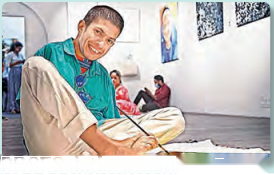
(b) How does Pranav’s special ability make you feel?
प्रणव की विशेष योग्यता से आपको कैसा महसूस होता है?
Answer:
Pranav’s special ability inspires admiration and respect. His achievements demonstrate incredible resilence and creativity. They show that obstacles can be overcome with determination and passion.
प्रणव की विशेष योग्यता प्रशंसा और सम्मान को प्रेरित करती है। उनकी उपलब्धियाँ आघात व परिवर्तन आदि से संभलने के अविश्वसनीय सामर्थ्य और रचनात्मकता को प्रदर्शित करती हैं। वे यह दर्शाती है कि दृढ़ संकल्प और जुनून के साथ बाधाओं को दूर किया जा सकता है।
(c) What qualities do you think were important for Pranav to become successful?
आपके अनुसार प्रणव के सफल होने के लिए कौन से गुण महत्त्वपूर्ण थे?
Answer:
The following qualities, I think, were important for Pranav’s success : Resilience, creativity, determination, adaptability, passion, courage. These qualities together have helped him achieve remarkable success.
मुझे लगता है कि प्रणव की सफलता के लिए निम्नलिखित गुण महत्त्वपूर्ण थे : लचीलापन, रचनात्मकता, दृढ़ संकल्प, अनुकूलनशीलता, जुनून, साहस। इन गुणों ने मिलकर उसे उल्लेखनीय सफलता हासिल करने में मदद की है।
(d) What message does Pranav’s story give us?
प्रणव की कहानी हमें क्या संदेश देती है?
Answer:
Pranav’s story gives us several messages. It tells us that overcoming obstacles is possible with determination and hard work. Everyone has the potential to succeed, regardless of physical limitations. Finding unique ways to express oneself can lead to success and fulfilment. Understanding and supporting individuals with disabilities fosters a more inclusive society.
प्रणव की कहानी हमें कई संदेश देती है। यह हमें बताती है कि दृढ़ संकल्प और कड़ी मेहनत से बाधाओं पर काबू पाना संभव है। शारीरिक सीमाओं के बावजूद, हर किसी में सफल होने की क्षमता होती है। खुद को अभिव्यक्त करने के अनूठे तरीके खोजने से सफलता और संतुष्टि मिल सकती है। विकलांग व्यक्तियों को समझना और उनका समर्थन करना एक अधिक समावेशी समाज को बढ़ावा देता है।
Question 2.
Look at the picture of Kathiawar embroidery. Discuss in pairs.
काठियावाड़ कढ़ाई का चित्र देखिए। जोड़ियों में चर्चा कीजिए।
(a) List the steps you think are needed to create this embroidery.
इस कढ़ाई को बनाने के लिए आपके विचार में जिन चरणों की आवश्यकता है, उनकी सूची बनाएं।
Answer:
To create Kathiawar embroidery gather materials, design patterns, choose stitch types, embroider, add embellishments. finish edges, and assemble into a final product.
काठियावाड़ कढ़ाई बनाने के लिए सामग्री इकट्ठा करें, पैटर्न डिजाइन करें, सिलाई के प्रकार, कढ़ाई और अलंकरण चुनें, किनारों को परिष्कृत करें, और अंतिम उत्पाद के रूप में तैयार करें।
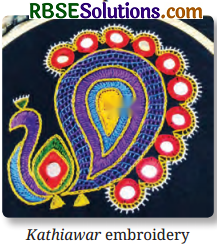
(b) Discuss if these steps can be done with feet, instead of hands.
चर्चा करें कि क्या ये कदम हाथों के बजाय पैरों से किए जा सकते हैं?
Answer:
Yes, these steps can be done with feet, instead of hands, though it would require significant adaptability and practice.
हाँ, ये कदम हाथों के बजाय पैरों से भी उठाए जा सकते हैं, हालांकि इसके लिए काफी अनुकूलनशीलता और अभ्यास की आवश्यकता होगी।
(c) What efforts would be needed if someone has to embroider with their feet? Do you think it is possible?
अगर किसी को अपने पैरों से कढ़ाई करनी पड़े तो उसे कितनी मेहनत करनी पड़ेगी? क्या आपको लगता है। कि यह संभव है?
Answer:
Yes, embroidering with feet is possible. It requires building toe dexterity, using adaptive tools, practicing patience, and creating unique techniques for fine control. Determination and creativity are essential.
हाँ, पैरों से कढ़ाई करना संभव है। इसके लिए पैरों की निपुणता विकसित करने, अनुकूल उपकरणों का उपयोग करने, धैर्य रखने और बारीक नियंत्रण के लिए अनूठी तकनीक बनाने की आवश्यकता होती है। दृढ़ संकल्प और रचनात्मकता आवश्यक है।
Let us discuss (आओ चर्चा करें)
Read the paragraphs and write the main idea for each. Then, match the main idea with two supporting details.
पैराग्राफ़ पढ़ें और प्रत्येक के लिए मुख्य विचार लिखें। फिर मुख्य विचार को दो सहायक विवरणों से मिलाएं।
Answer:
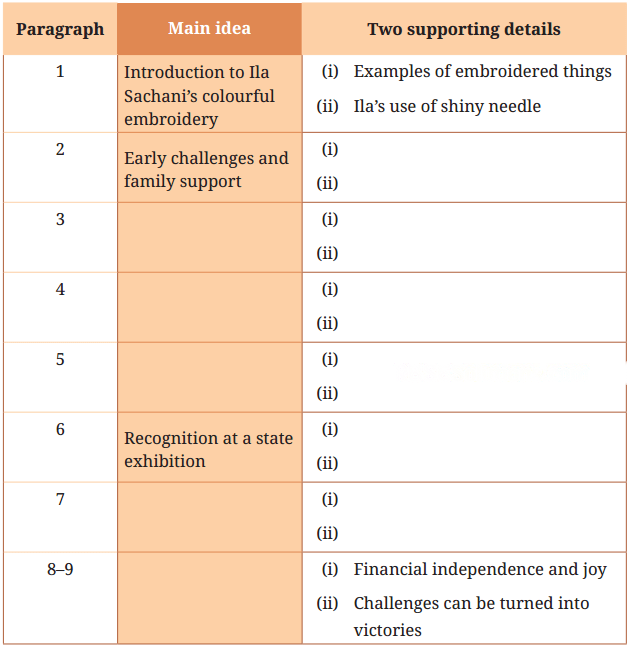
Paragraph | Main idea | Two supporting details |
1. | Introduction to Ila Sachani’s colourful embroidery | (i) Examples of embroidered things(ii) Ila’s use of shiny needle |
2. | Early challenges and family support | (i) Ila was born with her hands hanging loose by her sides.(ii) Her mother and grandmother taught her embroidery. |
3. | Determination, embroidery style | (i) She was determined to face her challenges.(ii) She learnt many styles of embroidery. |
4. | Became an expert | (i) Ila did not give up and became an expert.(ii) Her brother and sister helped her. |
5. | Got recognition | (i) The people in the village discovered Ila’s skill.(ii) The admiration for her work began to spread. |
6. | Recognition at a state exhibition | (i) Samples of her embroidery were displayed at a state exhibition.(ii) People purchased her creations. |
7. | President’s award national level. | (i) Participated in exhibitions at(ii) Received President’s Medal. |
8-9. | Financial independence | (i) Financial independence and joy.(ii) Challenges can be turned into victories. |
Ila Sachani: Embroidering Dreams with her Feet Class 6 Questions and Answers
Let us think and reflect (आइये सोचें और चिन्तन करें)
Question 1.
Read the following lines and answer the questions that follow.
निम्नलिखित पंक्तियों को पढ़ें और नीचे दिए गए प्रश्नों के उत्तर दें।
Unlike other children, she could not use her hands in the usual way. While other small hands drew figures in the sand or plucked wild flowers, she wondered why she could not join them. She too wanted to hold a chalk in her hands and draw figures on a slate.
(a) Choose the correct option to fill in the blank.
रिक्त स्थान को भरने के लिए सही विकल्प का चुनाव करें।
‘Unlike other children’ means that Ila was _________. (unaware/different/simple)
Answer:
different
(b) What could Ila have felt when she could not join others in things they did?
इला को कैसा महसूस हुआ होगा जब वह दूसरों के कामों में शामिल नहीं हो सकी?
Answer:
Ila must have felt sad.
इला ने अवश्य दुःखी महसूस किया होगा।
(c) Complete the following with a suitable reason.
निम्नलिखित को उचित कारण से पूर्ण कीजिए।
Ila could not draw figures on the slate because _________.
Answer:
she could not use her hands in the usual way.
Question 2.
What creative ways did Ila and her family use to overcome the challenges she faced?
जिन चुनौतियों का इला ने सामना किया उन पर काबू पाने के लिए इला और उसके परिवार ने कौनसी रचनात्मक विधियों का प्रयोग किया?
Answer:
Her parents taught her to create many beautiful patterns using her feet. They also helped her learn to do things with her legs, like eating and combing her hair.
उसके माता-पिता ने उसे उसके पैरों का उपयोग करके अनेक सुन्दर पैटर्न बनाने सिखाए। उन्होंने उसकी उसके पैरों से कार्य करना सीखने में भी मदद की। जैसे-खाना व बाल कंघी करना।
Question 3.
How did ‘new independence’ help lla?
‘नयी स्वाधीनता’ ने इला की कैसे मदद की?
Answer:
Her new independence’ helped her by allowing her to earn a regular income and finding joy in doing what she loved.
उसकी ‘नई स्वाधीनता’ ने उसकी नियमित आय कमाने में और जिस कार्य को वह प्रेम करती थी उसमें आनन्द पाने में सक्षम बनाकर मदद की।
Question 4.
Why was the first state exhibition an important event in Ila’s life?
प्रथम राज्य स्तरीय प्रदर्शनी इला के जीवन में एक महत्त्वपूर्ण घटना क्यों थी?
Answer:
The first state exhibition opened new doors for Ila. People observed the beauty woven by her feet. They readily purchased the creations. She was no more a hidden talent, but famous.
प्रथम राज्य स्तरीय प्रदर्शनी ने इला के लिए नये रास्ते खोल दिए। लोगों ने उसके पैरों द्वारा बुनी गई सुन्दर वस्तुओं को ध्यानपूर्वक देखा। उन्होंने तत्परता से उसके द्वारा रचित वस्तुओं को खरीद लिया। वह अब एक छिपी हुई प्रतिभा नहीं बल्कि विख्यात हो गई थी।
Question 5.
What does the sentence, ‘art has the power to rise above physical boundaries and touch the soul’, tell us about the power of art?
यह वाक्य कि ‘कला में भौतिक सीमाओं से ऊपर उठने व आत्मा को छूने की शक्ति होती है’ हमें कला की शक्ति के बारे में क्या बताता है?
Answer:
This sentence tells us that art can help people do things which are beyond their physical capabilities and move and inspire people.
यह वाक्य हमें बताता है कि कला लोगों की वो कार्य करने में भी मदद कर सकती है जो उनकी शारीरिक क्षमताओं से परे होते हैं और लोगों को भावनात्मक रूप से प्रभावित व प्रेरित कर सकती है।
Question 6.
How can we be helpful and encouraging like Ila’s family and friends when someone faces challenges?
हम इला के परिवार वालों व मित्रों की तरह किसी ऐसे व्यक्ति के लिए मददगार व प्रेरक कैसे बन सकते हैं जो चुनौतियों का सामना कर रहा हो?
Answer:
We can help such person by motivating him/her and providing necessary support. हम उसे प्रेरित करके व आवश्यक सहायता उपलब्ध कराकर ऐसे व्यक्ति की मदद कर सकते हैं।
Question 7.
How can lla’s story help others to overcome challenges in their lives?
इला की कहानी अन्य लोगों की उनके जीवन में आई चुनौतियों पर काबू पाने में कैसे मदद कर सकती है?
Answer:
Ila’s story can help others overcome challenges in their lives by teaching them that by their will power and creativity in their work. they can overcome their challenges and turn them into victories with focus, hard work, positivity and never giving up.
इला की कहानी दूसरों को उनके जीवन में चुनौतियों पर काबू पाने में मदद कर सकती है, क्योंकि इससे उन्हें यह सीख मिलती है कि अपने काम में इच्छा शक्ति और रचनात्मकता के द्वारा, वे अपनी चुनौतियों पर काबू पा सकते हैं और उन्हें ध्यान कड़ी मेहनत, सकारात्मकता से और कभी हार न मानकर जीत में बदल सकते हैं।
Let us learn (आइये सीखें)
Question 1.
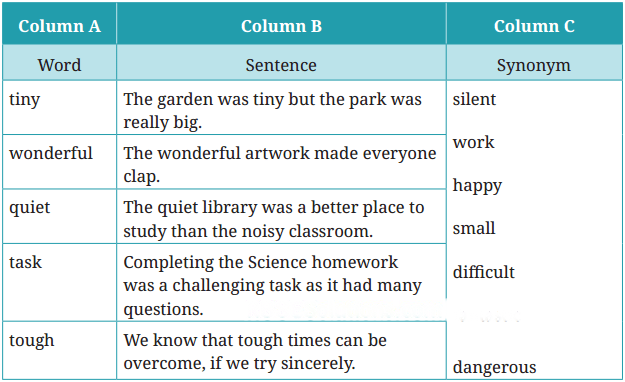
Read the words from the text given in Column A. Then, try to understand what they mean by reading the sentences in Column B. Now, match the word to its correct synonym in Column C. There are two extra synonyms given. You may refer to the dictionary.
कॉलम A में दिए गए पाठ से शब्दों को पढ़ें। फिर, कॉलम B में दिए गए वाक्यों को पढ़कर उनका अर्थ समझने की कोशिश करें। अब, कॉलम C में दिए गए शब्दों को उसके सही समानार्थी शब्द से मिलाएँ। दो अतिरिक्त समानार्थी शब्द दिए गए हैं। आप शब्दकोश देख सकते हैं।
Answer:
1. small 2. fantastic 3. silent 4. work 5. difficult
Question 2.
Unscramble the antonyms of the words in Column A. An example has been given for you.
कॉलम A में दिए गये शब्दों के विपरीतार्थक शब्दों को क्रम से जमायें। एक उदाहरण आपके लिए दिया गया है।
Example: display
-EDIH (HIDE)
(a) tiny E GHU (H _ _ _)
(b) wonderful –
REE BLITR (T_R_ _B_E)
(c) quiet I Y NSO (N_ _ _)
(d) task – SIA EMTP (P_ST_ _E)
(e) tough – SEYA (E_ _ _)
Answer:
(a) HUGE(b) TERRIBLE (c) NOISY(d) PASTIME (e) EASY
Use these antonyms in sentences of your own.
इन विपरीतार्थक शब्दों का अपने स्वयं के वाक्यों में प्रयोग करें।
Answer:
(a) There was ahugetree in our school.
(b) The sandwich made by me wasterriblein taste.
(c) In the absence of the teacher, the classroom was verynoisy.
(d) Gardening is my favouritepastime.
(e) Driving a car is aneasyjob for me.
Question 3.
Read the sentences from the text and focus on the highlighted words.
पाठ से दिए गए वाक्यों को पढ़िए और गहरे अंकित शब्दों पर ध्यान दीजिए।
- You will see lots of bright colours.
- There are many lovely things like cushions and bedcovers.
- They taught her to create many beautiful patterns using her feet!
- She learned many styles.
- She received many awards.
(a) The highlighted words tell us about the quantity. Choose what the words show.
गहरे अंकित शब्द हमें मात्रा के बारे में बताते हैं। चुनिये ये शब्द क्या प्रदर्शित करते हैं।
(i) Unmentioned quantity
(ii) Large quantity
Answer:
Large quantity
(b) Let us now understand what words of quantity tell us.
आइये अब हम समझें कि मात्रात्मक शब्द हमें क्या बताते हैं।
Fill in the blanks to complete an example for each word of quantity. Hints are given in the brackets.
प्रत्येक मात्रात्मक शब्द के लिए दिए गए उदाहरण को पूर्ण करने हेतु रिक्त स्थान की पूर्ति कीजिए। कोष्ठक में संकेत दिए गए हैं।
(i) We saw _________ buses on the road. (countable noun)
(ii) How _________ milk do you want? (uncountable noun)
(iii) There is _________ milk needed. (uncountable noun)
(iv) I need _________ examples. (countable noun)
(v) I have _________ energy left. She picked _________ flowers. (countable and uncountable nouns)
(vi) I ate _________ rice. (uncountable noun)
Answer:
(i) many (ii) much (iii) much (iv) some (v) little, some (vi) some
Now, create two sentences for each word of quantity (i-vi), and share them with your teacher and classmates.
अब प्रत्येक मात्रात्मक शब्द के लिए दो वाक्यों की रचना कीजिए (i-vi) तथा उन्हें अपने शिक्षक व सहपाठियों के साथ साझा कीजिए ।
Answer:
Do it yourself.
SEEN PASSAGES
Read the following passages and answer the questions that follow :
Passage-1
They taught her to create many beautiful patterns using her feet! It was certainly not an easy task, but Ila accepted the challenge with determination. Her parents also helped her learn to do things with her legs, like eating and combing her hair.
Threading a needle was hard, but Ila did not give up and became an expert at a young age. Her younger brother and sister helped her too.
Question 1.
Choose the correct alternative- What was hard?
(a) Challenge
(b) Patterns
(c) Threading a needle
(d) None of these
2. Who taught her to create many beautiful patterns?
उसे अनेक सुन्दर पैटर्न की रचना करना किसने सिखाया?
3. How did Ila accept the challenge?
इला ने चुनौती को कैसे स्वीकारा?
4. What other things did her parents help her learn?
उसके माता-पिता ने कौनसे अन्य कार्य सीखने में उसकी मदद की?
5. Find the plural form of the following word from the passage – ‘pattern’.
6. Write the opposite of the following word from the passage – ‘old’.
Answer:
1. (c) Threading a needle
2. Her parents taught her to create many beautiful patterns.
उसके माता-पिता ने उसे अनेक सुन्दर पैटर्न की रचना करना सिखाया।
3. Ila accepted the challenge with determination.
इला ने दृढ़ संकल्प के साथ चुनौती को स्वीकार किया।
4. Her parents also helped her learn to do things with her legs, like eating and combing her hair.
उसके माता-पिता ने उसकी पैरों से खाना खाने व बाल बनाने जैसे कार्य सीखने में भी मदद की।
5. ‘patterns’
6. ‘young’
Passage-2
The most important change for Ila was the new independence. Through her skill, she not only earned a regular income but also found joy in doing what she loved. She proved, through her creations, that challenges can be turned into victories with focus, hard work, positivity and never giving up.
Her embroidery created with her feet, reminds us that art has the power to rise above physical boundaries and touch the soul.
Question 1.
Choose the correct alternative –
What was the most important change for Ila?
(a) Focus
(b) Skill
(c) The new independence
(d) Income
2. How did her skill help her?
उसके कौशल ने उसकी सहायता किस प्रकार की?
3. What did she prove?
उसने क्या सिद्ध किया?
4. What does her embroidery remind us?
उसकी कढ़ाई हमें क्या स्मरण कराती है?
5. Find the word from the passage which means— ‘happiness’.
6. Write the opposite of the following word from the passage— ‘defeats’.
Answer:
1. (c) The new independence
2. Her skill helped her earn a regular income and find joy in doing what she loved.
उसके कौशल ने उसकी नियमित आय कमाने व जो वह पसन्द करती थी वह कार्य करने में आनन्द प्राप्त करने में मदद की।
3. She proved that challenges can be turned into victories with focus, hard work. positivity and never giving up.
उसने सिद्ध किया कि चुनौतियों को ध्यान, कठिन परिश्रम, सकारात्मक व हिम्मत ना हारकर विजयों में बदला जा सकता है।
4. Her embroidery reminds us that art has the power to rise above physical boundaries and touch the soul.
उसकी कढ़ाई हमें स्मरण कराती है कि कला में शारीरिक सीमाओं से ऊपर उठने व आत्मा को छूने की शक्ति होती है।
5. ‘joy’
6. ‘victories’
RBSE Class 6 English Chapter 15 Hindi Translation
Let us read (आइये पढ़ें)
कठिन शब्दार्थ एवं हिन्दी अनुवाद
When you enter …………………………………………… on a slate. (Page 152)
कठिन शब्दार्थ – Tiny (टाइनि) = बहुत छोटा Bright (ब्राइट्) = चमकीला। Cushion (कुशन) = गद्दी Pillow (पिलो) = तकिया। Shiny (शाइनि) = चमकदार। Needle (नीड्ल्) = सूई। Create (क्रिएट्) = बनाना, रचना करना। Style (स्टाइल्) = शैली। Skill (स्किल्) = कुशलता। Journey (‘जनि) = यात्रा। Quiet (क्वाइअट्) = शांत, ख़ामोश। Setting (सेटिङ्) = पृष्ठभूमि Challenge (चैलिन्ज्) = चुनौती। Hang (हैन्ङ्) = किसी वस्तु का लटकना। Unlike (अन् ‘लाइक्) = के विपरीत। Usual (यूशुअल्) हमेशा वाला।
हिन्दी अनुवाद – 1. जब आप गुजरात के भावनगर के मोती वावड़ी गाँव में एक छोटे से कमरे में प्रवेश करेंगे, तो आपको बहुत सारे चमकीले रंग दिखाई देंगे। कुशन, बेड कवर, तकिए और बहुत कुछ जैसी कई प्यारी चीजें हैं, जिन पर खूबसूरत डिजाइन हैं। इला सचानी, एक बड़ी मुस्कान वाली एक अद्भुत महिला, इन सभी डिजाइनों को बनाने के लिए एक चमकदार सुई का उपयोग करती हैं। वह काठियावाड़ कढ़ाई में बहुत अच्छी हैं- एक ऐसी शैली जिसके लिए बहुत कौशल की आवश्यकता होती है।
2. इला सचानी की यात्रा अमरेली, गुजरात के शांत वातावरण में शुरू हुई, जहाँ उनका जन्म एक किसान परिवार में हुआ था। शुरू से ही जीवन ने अपनी चुनौतियाँ पेश कीं, क्योंकि इला का जन्म उसके दोनों हाथ ढीले होकर उसके बगलों में लटकते हुए हुआ था! अन्य बच्चों के विपरीत, वह अपने हाथों का सामान्य तरीके से उपयोग नहीं कर सकती थी। जब अन्य छोटे हाथ रेत पर आकृतियाँ बना रहे थे या जंगली फूल तोड़ रहे थे, उसे आश्चर्य हुआ कि वह उनके साथ शामिल क्यों नहीं हो सकती। वह भी अपने हाथों में एक चॉक पकड़ना चाहती थी और एक स्लेट पर आकृतियाँ बनाना चाहती थी।
Ila’s mother …………………………………………… and others. (Pages 152-153)
कठिन शब्दार्थ – Single-minded (सिङ्ग्ल् – माइन्डिङ्) = एकनिष्ठ, अनन्य Overcome (ओव ‘कम्) : व्यक्ति या वस्तु को पराजित या नियंत्रित कर लेना। Traditional (ट्र ‘डिशन्ल्) = पारंपरिक। Embroidery (इम्ब्रॉइडरि) कढ़ाई। Share (शेअ (र्)) = दूसरों के साथ किसी बात में हिस्सेदारी करना। Create (क्रिएट्) = कुछ नया रचना, बनाना। Pattern (पैट्न्) = रीति, तरीक़ा Certainly (सट्नलि) = निश्चित रूप से। Task (टास्क्) C नियत कार्य। Determination (डि, टमि ‘नेश्न) = = दृढ़ निश्चय। Learn (लन्) सीखना। Threading (थ्रेडिङ्) = धागा डालना। Expert (एक्स्पट्) = विषय का विशेषज्ञ । Style (स्टाइल) रीति, शैली।
हिन्दी अनुवाद- 3. इला की माँ और दादी ने छोटी लड़की को प्रोत्साहित किया और वे उसकी चुनौती को पार करने में उसकी मदद करने के लिए एकनिष्ठ थीं। वे काठियावाड़ कढ़ाई की पारंपरिक कला में कुशल थीं और उन्होंने इला के साथ इस कला को साझा करने का फैसला किया। उन्होंने उसे अपने पैरों का उपयोग करके कई खूबसूरत पैटर्न बनाना सिखाया। यह निश्चित रूप से एक आसान काम नहीं था, लेकिन इला ने दृढ़ संकल्प के साथ चुनौती स्वीकार की। उसके माता-पिता ने भी उसे अपने पैरों से काम करना सीखने में मदद की, जैसे-खाना खाना और बालों में कंघी करना।
4. सुई में धागा डालना कठिन था, लेकिन इला ने हार नहीं मानी और कम उम्र में ही विशेषज्ञ बन गई। उसके छोटे भाई और बहन ने भी उसकी मदद की। उसने कई शैलियाँ सीखी, यहाँ तक कि गुजरात के बाहर की भी – कच्छी, कश्मीरी, लखनवी और अन्य।
For Ila, embroidery …………………………………………… but famous! (Page 153)
कठिन शब्दार्थ – Express (इक् स्प्रेस्) = भाव या विचारों को शब्दों से अभिव्यक्त करना। Awestruck (आस्ट्रक) = अवाक, आश्चर्यचकित। Talent (टैलन्ट्) = प्रतिभा। Admiration (‘ऐड्म ‘रेश्न्) = प्रशंसा। Impressed (इम्प्रेस्ड्) = प्रभावित किया। Display (डिस्प्ले) = प्रदर्शन करना Sample (साम्प्ल्) नमूना Exhibition (एक्सिबिशन्) = प्रदर्शनी Experience (इक् ‘स्पिअरिअन्स्) = अनुभव। Observe (अब् ‘जव्) = ध्यानपूर्वक निरीक्षण करना। Readily (रेडिलि) = बेहिचक; स्वेच्छा से। Creation (क्रिएशन्) : नई रचना, नवनिर्माण।
हिन्दी अनुवाद – 5. इला के लिए कढ़ाई खुद को अभिव्यक्त करने का एक तरीका बन गई। पहले तो वह सिर्फ़ अपने परिवार और दोस्तों के लिए ही बेहतरीन डिज़ाइन बनाती थी, जो उसकी प्रतिभा से अचंभित थे । वे उन डिज़ाइनों के बारे में दूसरों से बात करते थे। जल्द ही गाँव के लोगों को भी इला के विशेष कौशल का पता चल गया और उसके काम की प्रशंसा फैलने लगी।
6. सूरत में सरकारी दफ़्तर तक बात पहुँची। वे इला की कहानी से बहुत भावुक हुए और उसके काम से प्रभावित हुए। उन्होंने राज्य प्रदर्शनी में उसकी कढ़ाई के कुछ नमूने प्रदर्शित करने का फ़ैसला किया। इस अनुभव ने इलाके लिए नए दरवाजे खोले। लोगों ने उसके पैरों से बुनी गई खूबसूरती को देखा और खुशी-खुशी उसकी कृतियाँ खरीद लीं। इला अब एक छिपी हुई प्रतिभा नहीं थी, बल्कि मशहूर हो गई थी।
Encouraged by this …………………………………………… the soul. (Page 154)
कठिन शब्दार्थ – Popularity (पॉप्यु ‘लैरटि) = लोकप्रियता। Participate (पा ‘टिसिपेट्) = भाग लेना। Receive (रिसीव़) = प्राप्त या स्वीकार करना। Will power (विल् ‘पाउअ (र्)) = इच्छाशक्ति Creativity (क्रीएटिवटि) = सृजन क्षमता Celebrated (सेलिब्रेटिड्) = प्रसिद्ध, प्रख्यात Receiver (रिसीव (र्)) प्राप्तकर्ता।Positivity (पॉज़टिविटि) = सकारात्मकता। Remind (रि’ माइन्ड्) = किसी को कुछ याद दिलाना। Rise (राइज़्) = उत्थान और अभ्युदय। Physical (फ़िजिक्ल्) = भौतिक Boundary (बाउड्रि) = सीमा रेखा Soul (सोल्) = आत्मा।
हिन्दी अनुवाद – 7. इस लोकप्रियता से उत्साहित होकर इला ने न केवल राज्य के भीतर बल्कि राष्ट्रीय स्तर पर भी कई प्रदर्शनियों में भाग लिया। उसे न केवल उसकी कला के लिए बल्कि उसके काम में दिखाई देने वाली इच्छाशक्ति और रचनात्मकता के लिए भी कई पुरस्कार और सम्मान मिले। कभी किसान की बेटी रही इला सचानी ने कड़ी चुनौतियों का सामना करते हुए कड़ी मेहनत की और एक प्रसिद्ध कलाकार बनी और राष्ट्रपति पदक प्राप्त किया।
8. इला के लिए सबसे महत्त्वपूर्ण बदलाव नई आजादी थी। अपने कौशल के माध्यम से, उसने न सिर्फ नियमित आय अर्जित की, बल्कि वह काम करने में भी आनन्द पाया जो उसे पसन्द था। उसने अपनी रचनाओं के माध्यम से साबित किया कि चुनौतियों को ध्यान कड़ी मेहनत, सकारात्मकता और कभी हार न मानने से जीत में बदला जा सकता है।
9. उसके पैरों से बनाई गई उसकी कढ़ाई हमें याद दिलाती है कि कला में भौतिक सीमाओं से ऊपर उठने और आत्मा को छूने की शक्ति है।