RBSE Class 6 Maths Chapter 2 Lines and Angles Solutions
PracticingRBSE Class 6 Maths Solutionsand Class 6 Maths Chapter 2 Lines and Angles Solutions Question Answer helps develop logical thinking and accuracy.
Lines and Angles Class 6 Solutions
Ganita Prakash Class 6 Chapter 2 Solutions Lines and Angles
Figure it Out (Page 15)
Question 1.
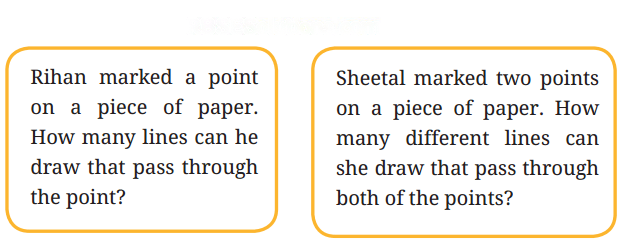
Can you help Rihan and Sheetal find their answers?
Solution:
Infinite lines can pass through a single point in a plane, Rohan can draw infinite lines from that point.
Only one unique line can be drawn through points. Sheetal can draw only one line passing through both those points.
Question 2.
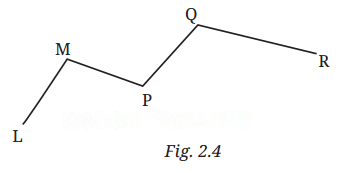
Name the line segments in given figure. Which of the five marked points are on exactly one of the line segments? Which are on two of the line segments?
Solution:
Line segments : , , , Points L and R are on exactly one of the line segments. Points M, P and Q are on two of the line segments.
Question 3.
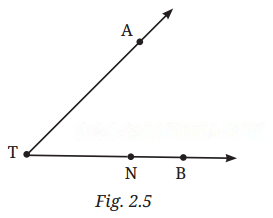
Name the rays shown in given figure.
Is T the starting point of each of these rays?
Solution:
Rays : , or
Yes; T is the starting point of each of these rays ( and )
Question 4.
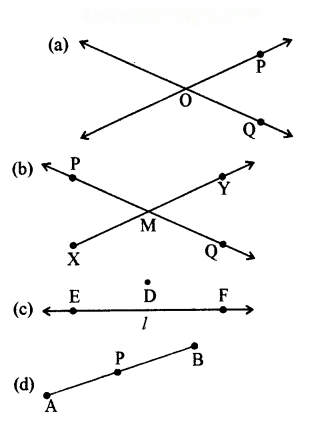
Draw a rough figure and write labels appropriately to illustrate each of the following :
(a) and meet at O.
(b) and intersect at point M.
(c) Line l contains points E and F but not point D.
(d) Point P lies on AB.
Solution:
Question 5.
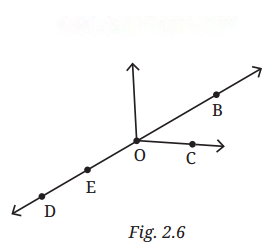
In given figure, name :
(a) Five points
(b) A line
(c) Four rays
(d) Five line segments
Solution:
(a) Five points : B, C, D, E, O
(b) A line :
(c) Four rays : , , ,
(d) Five line segments : DE, EO, OC, OB, EB.
Question 6.
Here is a ray (Fig.). It starts at O and passes through the point A. It also passes through the point B.
(a) Can you also name it as ? Why?
(b) Can we write as ? Why or why not?
Solution:
(a) Yes, we can also name it because both have the same starting point and direction,
(b) No, we cannot write as because starting point of is O while starting point of is A.
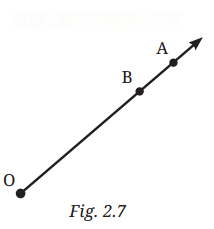
Figure it Out (Page 19)
Question 1.
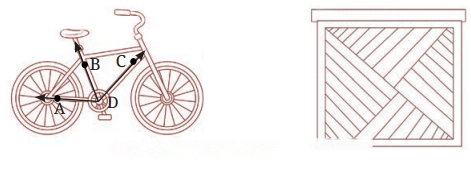
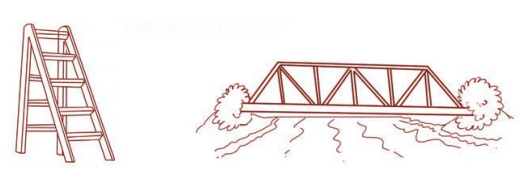
Can you find the angles in the given pictures? Draw the rays forming any one of the angles and name the vertex of the angle.
Solution:
(a) ∠BDA or ∠ADB
∠BDC or ∠CDB
Vertex = D
(b) ∠ABC, Vertex = B
(c) ∠PQR, Vertex = Q
(d) ∠LMN, Vertex = M
Question 2.
Draw and label an angle with arms ST and SR.
Solution:
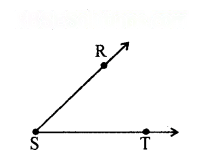
Question 3.
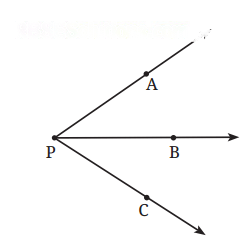
Explain why ∠APC cannot be labelled as ∠P.
Solution:
∠APC cannot be labelled as ∠P because three angles are formed at P. The meaning of ∠P can be ∠BPC, ∠APB or ∠APC.
Question 4.
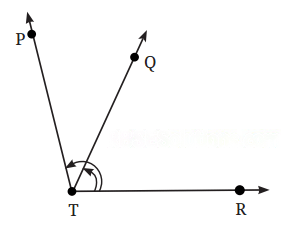
Name the angles marked in the given figure.
Solution:
∠RTP and ∠RTQ
Question 5.
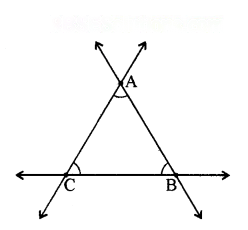
Mark any three points on your paper that are not on one line. Label them A, B, C. Draw all possible lines going through pairs of these points. How many lines do you get? Name them. How many angles can you name using A, B, C ? Write them down, and mark each of them with a curve Fig.
Solution:
There are three lines in the given figure which are , and .
Here, three angles are : ∠ABC, ∠BCA and ∠CAB.
Question 6.
Now mark any four points on your paper so that no three of them are on one line. Label them A, B, C, D. Draw all possible lines going through pairs of these points. How many lines do you get? Name them. How many angles can you name using A, B, C, D? Write them all down, and mark each of them with a curve as in given Fig.
Solution:
Here, we get total 6 lines : , , , , and
Here, we get total 12 angles : ∠BAC, ∠CAD, ∠BAD, ∠CBD, ∠DBA, ∠CBA, ∠DCA, ∠ACB, ∠DCB, ∠ADB, ∠BDC, ∠ADC
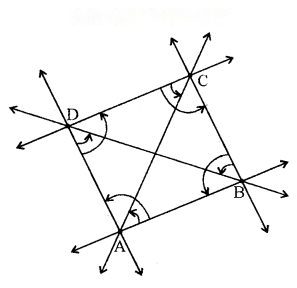
Figure it Out (Page 23)
Question 1.
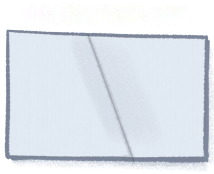
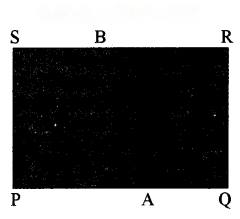
Fold a rectangular sheet of paper, then draw a line along the fold created. Name and compare the angles formed between the fold and the sides of the paper. Make different angles by folding a rectangular sheet of paper and compare the angles. Which is the largest and smallest angle you made?
Solution:
Angles formed between the fold and the sides of the paper are ∠1, ∠2, ∠3 and ∠4.
Comparing these angles,
∠1 < ∠2, ∠4 < ∠3, ∠2 = ∠3, ∠1 = ∠4
Here, ∠2 and ∠3 are largest angles and ∠1 and ∠4 are smallest angles.
Question 2.
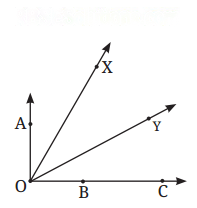
In each case, determine which angle is greater and why.
(a) ∠AOB or ∠XOY
(b) ∠AOB or ∠XOB
(c) ∠XOB or ∠XOC
Discuss with your friends on how you decided which one is greater.
Solution:
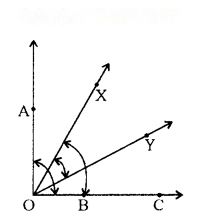
(a) ∠AOB is greater than ∠XOY because ∠AOB is more extended than ∠XOY.
(b) ∠AOB is greater than ∠XOB because ∠AOB is more extended than ∠XOB.
(c) ∠XOB = ∠XOC because point B and C lie on the same ray and the sides and vertices of both angles are equal.
Question 3.
Which angle is greater : ∠XOY or ∠AOB? Give reasons.
Solution:
∠XOA is more extended than ∠YOB, so ∠XOA > ∠YOB
or ∠XOA + ∠AOY > ∠YOB + ∠AOY
or ∠XOY > ∠AOB
i. e. ∠XOY is greater than ∠AOB.
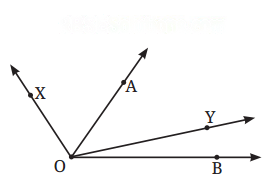
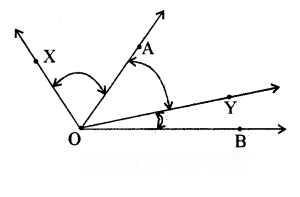
Figure it Out (Page 29)
Question 1.
How many right angles do the windows of your classroom contain? Do you see other right angles in your classroom?
Solution:
Windows of our classroom are in rectangular shape, therefore there are 4 right angles in rectangular window. Similarly we can see 4 right angles in the door of classroom and blackboard.
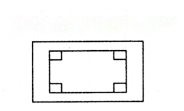
Question 2.
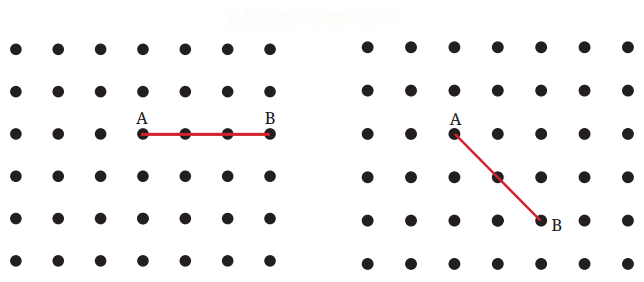
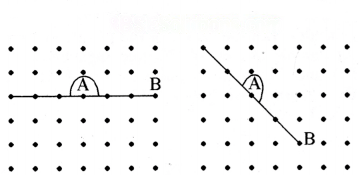
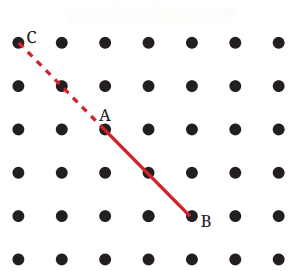
Join A to other grid points in the figure by a straight line to get a straight angle. What are all the different ways of doing it?
Solution:
Question 3.
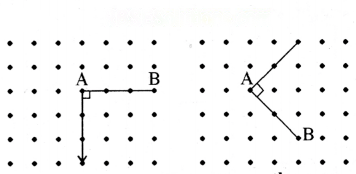
Now join A to other gird points in the figure by a straight line to get a right angle. What are all the different ways of doing it?
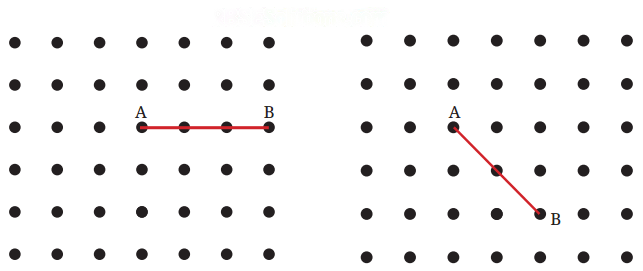
Hint : Extend the line further as shown in the figure below. To get a right angle at A, we need to draw a line through it that divides the straight angle CAB into two equal parts.
Solution:
Question 4.
Get a slanting crease on the paper. Now, try to get another crease that is perpendicular to the slanting crease.
(a) How many right angles do you have now? Justify why the angles are exact right angles.
(b) Describe how you folded the paper so that any other person who doesn’t know the process can simply follow your description to get the right angle.
Solution:
(a) We get total four right angles according to question. Let the point of interaction of both creases be O. Both creases are perpendicular to each other at O. Hence all four angles are right angles.
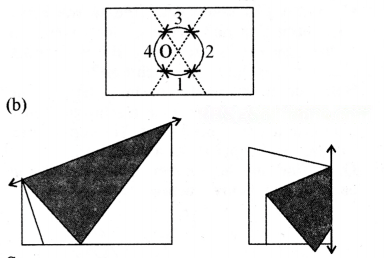
Steps—
- Take a sheet of paper and fold it.
- Fold again.
- Now fold the paper again so that both folds meet each other.
- Fold again.
- Open both creases.Hence, we get two perpendicular lines and four right angles.
Figure it Out (Page 31)
Question 1.
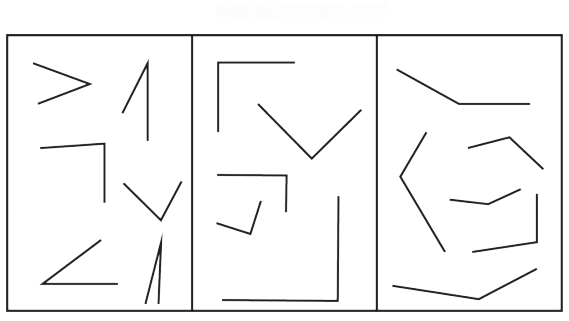
Identify acute, right, obtuse and straight angles in the given figures.
Solution:
(a) All the angles are acute angles.
(b) All the angles are right angles.
(c) All the angles are obtuse angles.
Question 2.
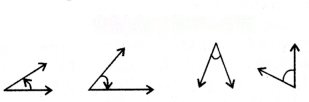
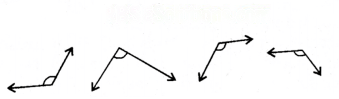
Make a few acute angles and a few obtuse angles. Draw them in different orientations.
Solution:
Acute Angle :
Obtuse Angle :
Question 3.
Do you know what the words acute and obtuse mean? Acute means sharp and obtuse means blunt. Why do you think these words have been chosen?
Solution:
The word ‘acute’ means ‘sharp’. The vertex of an angle appears as a sharp tip, hence the word ‘acute’ is used for it. The vertex of an ‘obtuse’ angle appears as a blunt tip.
Question 4.
Find out the number of acute angles in each of the figures below.
What will be the next figure and how many acute angles will it have? Do you notice any pattern in the numbers?
Solution:
3 + 9 = 12
12 + 9 = 21
The number of angles in each term is increasing by 9, this is the pattern. The next figure will have 21 + 9 = 30 angles.
The required pattern : 3, 12, 21, 30, 39, …………………..
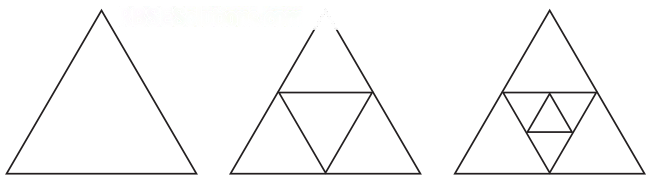
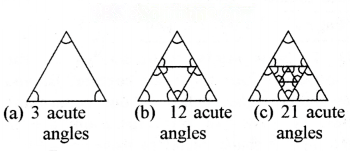
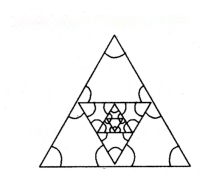
Figure it Out (Page 35)
Question 1.
Write the measures of the following angles :
(a) ∠KAL
Notice that the vertex of this angle coincides with the centre of the protractor. So the number of units of 1 degree angle between KA and AL gives the measure of ∠KAL. By counting, we get—
∠KAL = 30°
Making use of the medium sized and large sized marks, is it possible to count the number of units in 5s or 10s?
(b) ∠WAL
(c) ∠TAK
Solution:
(a) ∠KAL = 30°
(b) ∠WAL = 50°
(c) ∠TAK = 120°
Yes, it is possible to count the number of units in 5s or 10s by making use of the medium sized and large sized marks.
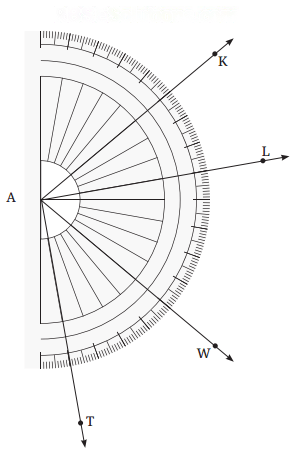
Figure it Out (Page 40)
Question 1.
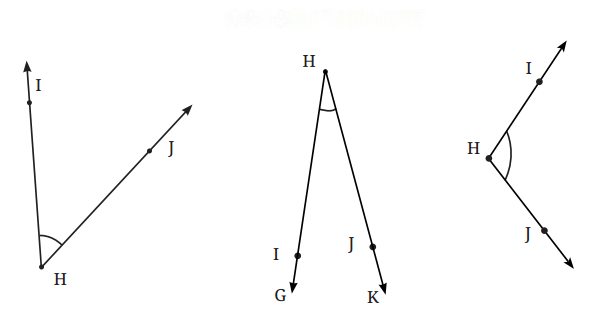
Find the degree measures of the following angles using your protractor.
Solution:
(a) ∠IHJ = 47°
(b) ∠IHJ = 24°
(c) ∠IHJ = 110°
Question 2.
Find the degree measures of different angles in your classroom using your protractor.
Solution:
(a) Angle at one comer of blackboard = 90°
(b) Angle at one comer of a table = 90°
(c) Angle at one comer of door = 90°
Similarly, more angles can be found.
Question 3.
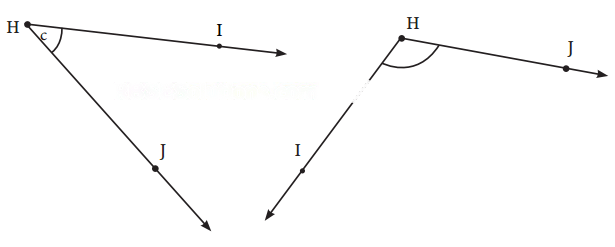
Find the degree measures for the angles given below. Check if your paper protractor can be used here!
Solution:
(a) ∠IHJ = 42°
(b) ∠IHJ = 116°
Question 4.
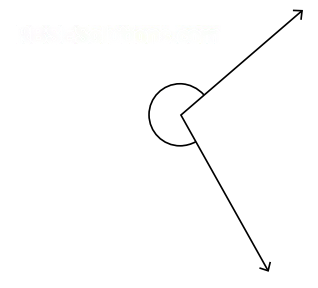
How can you find the degree meausre of the angle given below using a protractor?
Solution:
We need to find the reflex angle ∠AOB. We find first acute angle ∠AOB. Then we find reflex angle by 360° – ∠AOB.
Question 5.
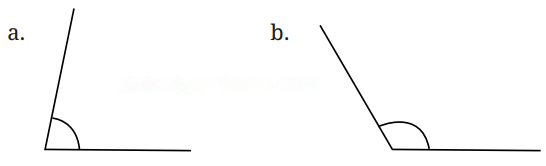
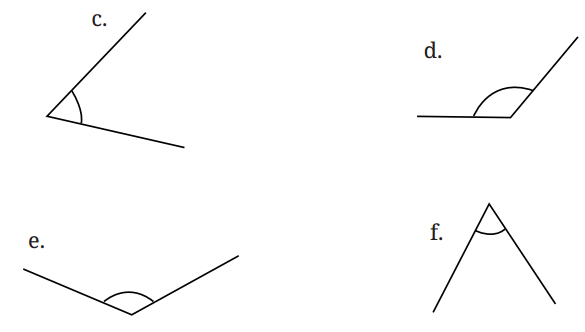
Measure and write the degree measures for each of the following angles :
Solution:
(a) 80°
(b) 120°
(c) 60°
(d) 130°
(e) 130°
(f) 60°
Question 6.
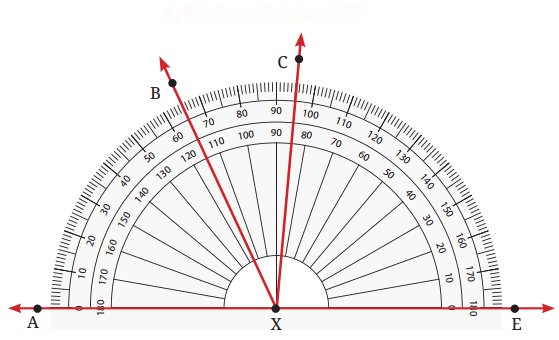
Find the degree measures of ∠BXE, ∠CXE, ∠AXB and ∠BXC.
Solution:
(a) ∠BXE = 115°
(b) ∠CXE = 85°
(c) ∠AXB = 65°
(d) ∠BXC = 30°
Question 7.
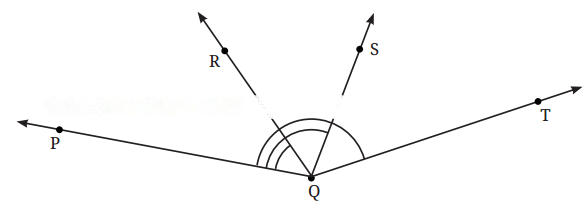
Find the degree measures of ∠PQR, ∠PQS and ∠PQT.
Solution:
∠PQR = 45°
∠PQS = 105°
∠PQT = 150°
Question 8.
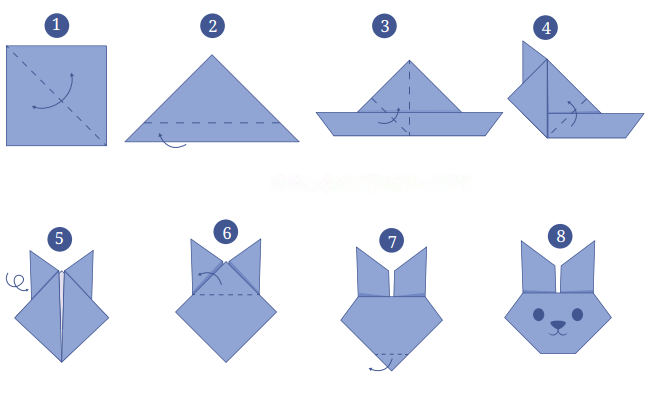
Make the paper craft as per the given instructions. Then, unfold and open the paper fully. Draw lines on the creases made and measure the angles formed.
Solution:
Do yourself.
Question 9.
Measure all three angles of the triangle shown in given Fig. (a), and write the measures down near the respective angles. Now add up the three measures. What do you get? Do the same for the triangles in given Fig. (b) and (c). Try it for other triangles as well, and then make a conjecture for what happens in general! We will come back to why this happens in a later year.
Solution:
(a) ∠A = 40°
∠B = 60°
∠C = 80°
∠A + ∠B + ∠C = 40° + 60° + 80° = 180°
In (b) and (c), we get ∠A + ∠B + ∠C = 180° (Students can find ∠A, ∠B and ∠C in both figure)
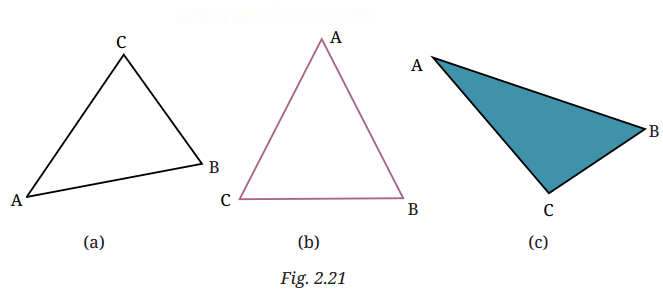
Figure it Out (Page 45)
Where are the angles?
Question 1.
Angles in a clock :
(a) The hands of a clock make different angles at different times. At 1 o’clock, the angle between the hands is 30°. Why?
(b) What will be the angle at 2 o’clock? And at 4 o’clock? 6 o’clock?
(c) Explore other angles made by the hands of a clock.
Solution:
(a) The numbers 1 to 12 are written at equal distances on the circumference of the clock, then 360 ÷ 12 = 30
Hence angle between two numbers = 30°
Therefore, at 1 o’clock, the angle between the hands is 30°.
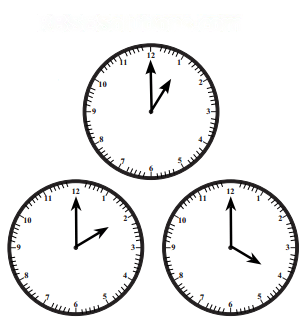
(b) The angle at 2 o’clock = 60° (2 × 30°)
The angle at 4 o’clock = 120° (4 × 30°)
The angle at 6 o’clock = 180° (6 × 30°)
(c) The angle at 3 o’clock = 3 × 30° = 90°
The angle at 5 o’clock = 5 × 30° = 150°
The angle at 7 o’clock = 7 × 30° = 210°
The angle at 8 o’clock = 8 × 30° = 240°
Question 2.
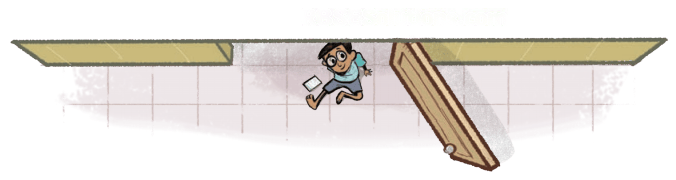
The angle of a door :
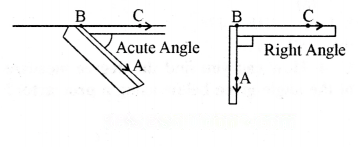
Is it possible to express the amount by which a door is opened using an angle? What will be the vertex of the angle and what will be the arms of the angle?
Solution:
Yes, it is possible to express amount by which a door is opened using an angle.
Here, the vertex of the angle is B and AB and BC are the arms of the angle.
Question 3.
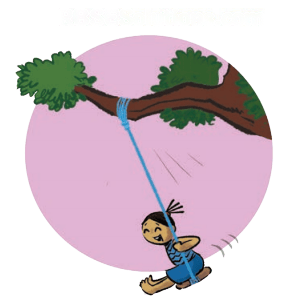
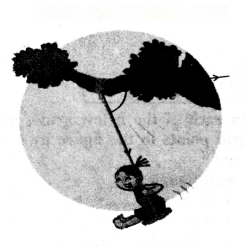
Vidya is enjoying her time on the swing. She notices that the greater the angle with which she starts the swinging, the greater is the speed she achieves on her swing. But where is the angle? Are you able to see any angle?
Solution:
Yes. we are able to see an angle.
Question 4.
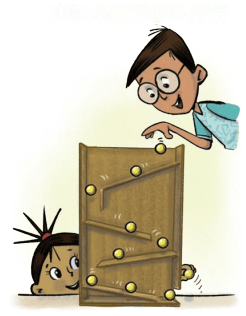
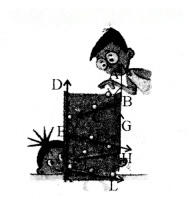
Here is a toy with slanting slabs attached to its sides; the greater the angles or slopes of the slabs, the faster the balls roll. Can angles be used to describe the slopes of the slabs? What are the arms of each angle? Which arm is visible and which is not?
Solution:
The greater the amount of angle, the more the slab will tilt.
(i) The arms of ∠ABC are AB and BC and arm BC is visible.
(ii) The arms of ∠DEF are DE and EF and arm EF is visible.
(iii) The arms of ∠GHI are GH and HI and arm HI is visible.
(iv) The arms of ∠JKL are JK and KL and the side KL will be visible.
Question 5.
Observe the images below where there is an insect and its rotated version. Can angles be used to describe the amount of rotation? How? What will be the arms of the angle and the vertex?
Hint : Observe the horizontal line touching the insects.
Solution:
Yes, angles can be used to describe the rotation. ∠ABC and ∠PQR are right angles because first the insect started moving towards the horizontal line, and later towards the vertical line.
Vertex = B and Q
Arms of angle = BA, BC, QR, QP.
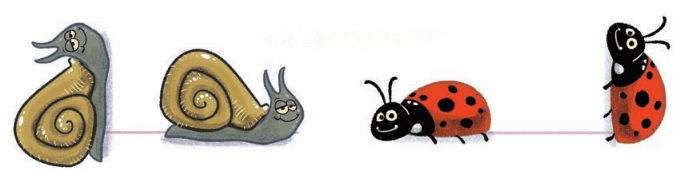
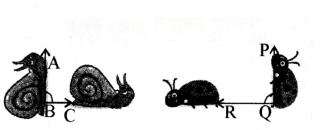
Figure it Out (Page 49 )
Question 1.
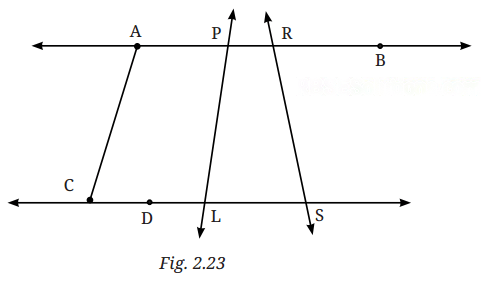
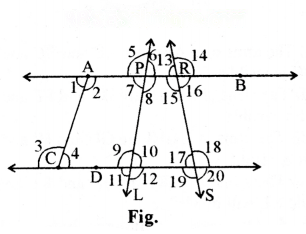
In Fig., list all the angles possible. Did you find them all? Now, guess the measures of all the angles. Then, measure the angles with a protractor. Record all your numbers in a table. See how close your guesses are to the actual measures.
Solution:
We were able to find a total of 20 angles in the given figure which are represented by numbers from 1 to 20. Angles ∠1 and ∠4 we estimated to be 65°. Whereas in reality it is 70° when measured with the help of a protractor. Angles ∠2 and ∠3 we estimated to be 120°. Whereas in reality it is 110° when measured with the help of a protractor.
In this way, students should estimate the angles themselves and find the measurement using a protractor.
Question 2.
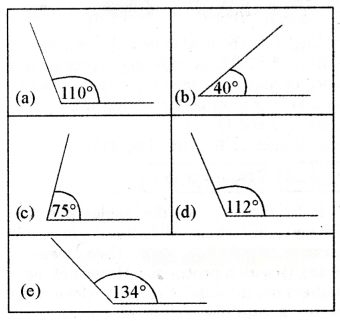
Use a protractor to draw angles having the following degree measures :
(a) 110°
(b) 40°
(c) 75°
(d) 112°
(e) 134°
Solution:
Question 3.
Draw an angle whose degree measure is the same as the angle given below :
Also, write down the steps you followed to draw the angle.
Solution:
The value of ∠IHJ = 120°
Making of ∠IHJ by using protractor.
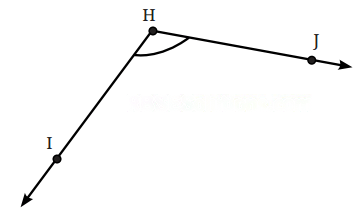
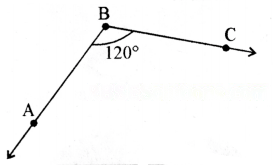
Figure it Out (Page 51)
Question 1.
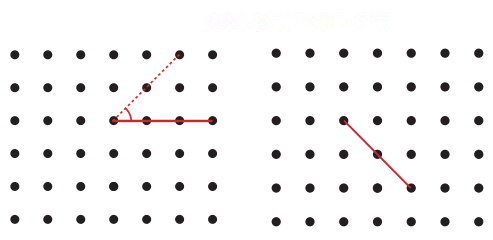
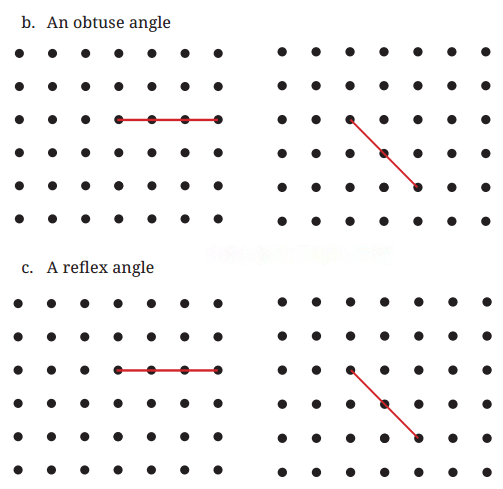
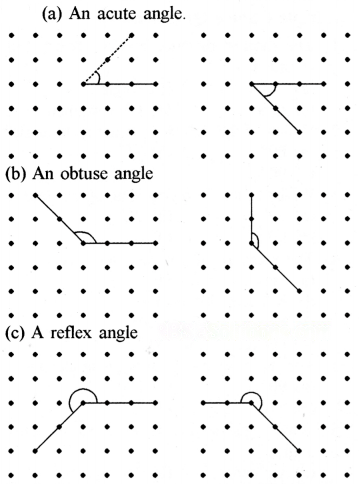
In each of the below grids, join A to other grid points in the figure by a straight line to get :
Mark the intended angles with curves to specify the angles. One has been done for you.
Solution:
Question 2.
Use a protractor to find the measure of each angle. Then classify each angle as acute, obtuse, right, or reflex.
(a) ∠PTR
(b) ∠PTQ
(c) ∠PTW
(d) ∠WTP
Solution:
(a) ∠PTR = 30° (acute angle)
(b) ∠PTQ = 60° (acute angle)
(c) ∠PTW = 105° (obtuse angle)
(d) ∠WTP = 225° (reflex angle)
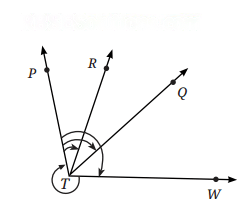
Figure it Out (Page 53)
Question 1.
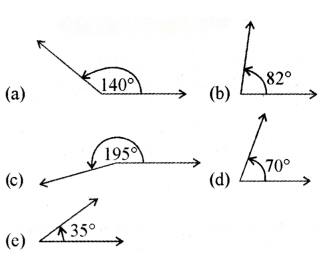
Draw angles with the following degree measures :
(a) 140°
(b) 82°
(c) 195°
(d) 70°
(e) 35°
Solution:
Question 2.
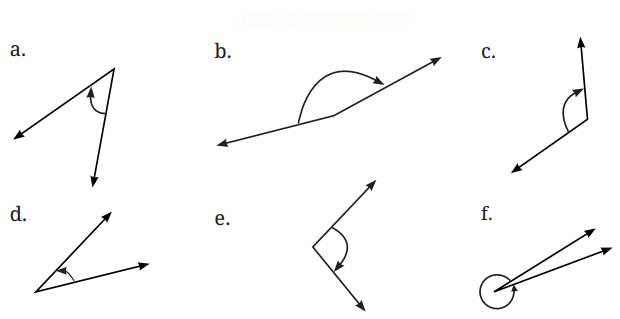
Estimate the size of each angle and then meaure it with a protractor :
Classify these angles as acute, right, obtuse or relfex angles.
Solution:
(a) 45° (an acute angle)
(b) 150° (an obtuse angle)
(c) 120° (an obtuse angle)
(d) 30° (an acute angle)
(e) 95° (an obtuse angle)
(f) 350° (a reflex angle)
Question 3.
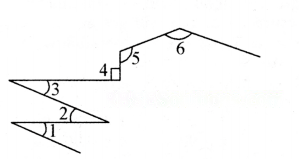
Make any figure with three acute angles, one right angle and two obtuse angles.
Solution:
∠1, ∠2 and ∠3 are acute angles, ∠4 is a right angle and ∠5 and ∠6 are obtuse angles.
Question 4.
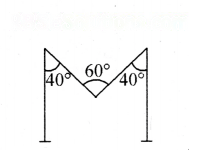
Draw the letter ‘M’ such that the angles on the sides are 40° each and the angles in the middle is 60°.
Solution:
Question 5.
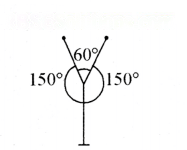
Draw the letter ‘Y’ such that the three angle formed are 150°, 60° and 150°.
Solution:
Question 6.
The Ashok Chakra has 24 spokes. What is the degree measure of the angle between two spokes next to each other? What is the largest acute angle formed between two spokes?
Solution:
Angle between two spokes = 360 ÷ 24 = 15
The largest acute angle formed between two spokes
= 5 × 15° = 75°
(because 6 × 15° = 90° i.e. right angle)

Question 7.
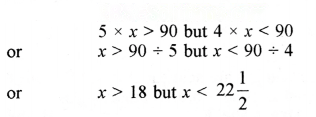
Puzzle : I am an acute angle. If you double my measure, you get an acute angle. If you triple my measure, you will get an acute angle again. If you quadruple (four times) my measure, you will get an acute angle yet again! But if you multiply my measure by 5, you will get an obtuse angle measure. What are the possibilities for my measure?
Solution:
Let the measure of angle be x.
Then according to question
Hence, the possibilities for my measure arc 19° or 20° or 21° or 22°.
Lines and Angles Class 6 Question Answer
Lines and Angles Class 6 Extra Questions
Multiple Choice Questions—
Question 1.
The shortest distance between two points is called—
(a) Point
(b) Angle
(c) Line
(d) Line segment
Answer:
(d) Line segment
Question 2.
Which of the following is an acute angle?
(a) 89°
(b) 91°
(c) 90°
(d) 180°
Answer:
(a) 89°
Question 3.
Which of the following is an obtuse angle?
(a) 89°
(b) 91°
(c) 90°
(d) 0°
Answer:
(b) 91°
Question 4.
The measure of a reflex angle is—
(a) between 0° to 90°
(b) between 90° to 180°
(c) between 180° to 360°
(d) between 0° to 180°
Answer:
(c) between 180° to 360°
Question 5.
The measure of the straight angle is—
(a) 90°
(b) 180°
(c) 270°
(d) 360°
Answer:
(b) 180°
Question 6.
Which instrument is used to measure angles?
(a) Compasses
(b) Triangle scale
(c) Protractor
(d) Scale
Answer:
(c) Protractor
Question 7.
Which of the following measurements makes a right angle?
(a) 45°
(b) 90°
(c) 180°
(d) 240°
Answer:
(b) 90°
Question 8.
What is the measure of the angle for one complete rotation?
(a) 180°
(b) 270°
(c) 90°
(d) 360°
Answer:
(d) 360°
Question 9.
What will be the angle between the hour and minute hands of the clock at 11 : 15?
(a) 165°
(b) 112.5°
(c) 180°
(d) 187.5°
Answer:
(b) 112.5°
Question 10.
In a triangle, if one angle is 90°, then what will be the sum of other two angles?
(a) 45°
(b) 60°
(c) 90°
(d) 180°
Answer:
(c) 90°
Fill in the blanks—
1. When two lines are perpendicular then the angle between them is ………………………… .
Answer:
90°
2. At 6:00 o’ clock the angle between the hour and minute hands of a clock is ………………………… .
Answer:
180°
3. Two lines meeting at a point and making a right angle are ………………………… to each other.
Answer:
perpendicular
4. In any clock, the angle between the hour and minute hands at 12:00 is ………………………… .
Answer:
0°
5. In a triangle two angles are of 60°, then the third angle is of ………………………… .
Answer:
60°
6. The sum of two right angles is ………………………… .
Answer:
180°
Write True/False for the following statements—
1. Any two points determine a unique line that passes through both of these points. (True/False)
2. This angle is a right angle when it is exactly half of a reflex angle. (True/False)
3. 360 is the smallest number which is divisible by all numbers up to 10 except 7. (True/False)
4. A full turn is considered 180 degrees. (True/False)
Answer:
1. True
2. False
3. True
4. False
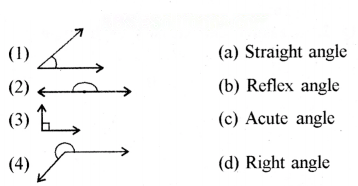
Make the right match—
Answer:
(1) – (c), (2) – (a), (3) – (d), (4) – (b).
Very Short Answer Type Questions—
Question 1.
Define the point.
Solution:
A point is a fundamental concept which has no shape, width or depth. A point represents only a position or location.
Question 2.
Define the line segment.
Solution:
A line segment corresponds to the shortest distance between two points. It has two end points.
Question 3.
What is an obtuse angle called?
Solution:
If an angle is larger than a right angle and smaller than a straight angle then it is called an obtuse angle.
Question 4.
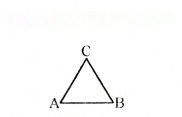
Name the angles and vertices of given figure.
Solution:
Angles : ∠A ∠B and ∠C
Vertices : A. B, C
Question 5.
How many obtuse angles can a triangle have?
Solution:
One
Question 6.
What is the maximum number of right angles a triangle can have?
Solution:
One
Question 7.
If an angle is more than 90° and less than 180°. what is such an angle called?
Solution:
Obtuse angle.
Question 8.
Can an obtuse angle triangle be an equilateral triangle?
Solution:
No. an obtuse angle triangle cannot be an equilateral triangle.
Question 9.
When the hand of a clock makes three- fourth of a revolution, how many degrees angle does it make in making this revolution?
Solution:
270°
Question 10.
What is ray?
Solution:
A ray is a portion of a line starting at a point and going in one direction indefinitely.
Short Answer Type Questions—
Question 1.
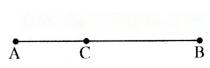
Draw a line segment AB. Take a point C lying between A and B. Measure the length of AB, BC and CA. Is AB = AC + CB?
(Note : If points A, B, C are located on a line such that AC + CB = AB, then point C definitely lies between point A and point B.)
Solution:
Length of the line segments AB. BC and AC is measured with a ruler is—
AB = 4.0 cm, BC = 2.5 cm and AC = 1.5 cm.
Now, AC + BC = 1.5 cm + 2.5 cm = 4.0 cm = AB
∴ AB = AC + BC
Question 2.
Points A, B and C are located on a line such that AB = 5 cm, BC = 3 cm and AC = 8 cm. Which of these points lies between the other two points?
Solution:
Since AB + BC = 5cm + 3cm = 8cm = AC
∵ A, B and C are collinear points and point E lies between point A and point C.
Question 3.
Find the number of right angles turned by the hour hand of a clock when it
(a) reaches from 3 to 6
(b) reaches from 2 to 8.
Solution:
The clock hand completes one rotation in 4 right angles in 12 numbers.
(a) 3 reaches 6 = 3 – 4, 4 – 5 and 5 – 6 i.e. 3 numbers.
∴ Number of right angles when the clock hand goes from 3 to 6 = ( × 3) right
angles = 1 right angle
(b) When the clock hand goes from 2 to 8 = 2 – 3, 3 – 4, 4 – 5, 5 – 6, 6 – 7, 7 – 8, i.e., 6 numbers.
∴ Number of right angles when the clock hand reaches from 2 to 8 = ( × 6) right angles = 2 right angles.
Question 4.
Where will the hour hand of a clock stop, if it starts
(a) 6 turns through 1 right angle?
(b) 8 turns through 2 right angles?
Solution:
(a) If the hour hand of a clock starts at 6
and moves at right angle to 1, then the hour hand will stop at (6 + 3) = 9.
(b) If the hour hand of a clock starts at 8 and moves at right angles to 2, then the hour hand will stop at (8 + 2 × 3) = 14. i.e., 14 – 12 = 2
Question 5.
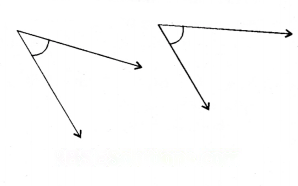
Which of the following two angles has a larger measure? First estimate and then verify the measurement.
Solution:
According to the estimation, the measure of the other angle is larger.
First angle = 43°
Second angle = 57°
Long Answer Type Questions—
Question 1.
Progress : Find the measure of each angle in the following figure. (First estimate by looking at it and then measure with a protractor.)
Solution:
Angle of each figure by estimation—
(a) 45°
(b) 125°
(c) 60°
(d) 135°
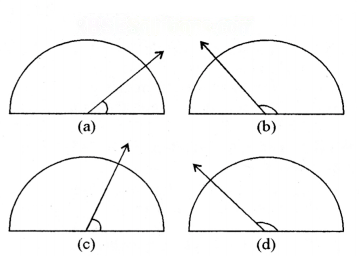
(b) The measure of angles when measured with a protractor is—
(a) 40°
(b) 130°
(c) 65°
(d) 135°
Question 2.
Measure and classify each angle—
Solution:
The measure and ripe of each angle is given in the following table—
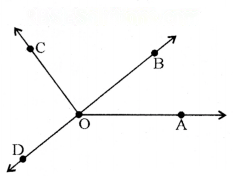
Angle | Measure | Type |
∠AOB | 40° | Acute angle |
∠AOC | 120° | Obtuse angle |
∠BOC | 80° | Acute angle |
∠DOC | 100° | Obtuse angle |
∠DOA | 140° | Obtuse angle |
∠DOB | 180° | Straight angle |