RBSE Class 6 Maths Chapter 3 Number Play Solutions
PracticingRBSE Class 6 Maths Solutionsand Class 6 Maths Chapter 3 Number Play Solutions Question Answer helps develop logical thinking and accuracy.
Number Play Class 6 Solutions
Ganita Prakash Class 6 Chapter 3 Solutions Number Play
Figure it Out (Page 57)
Question 1.
Colour or mark the supercells in the table below:
Solution:


Question 2.
Fill the table below with only 4-digit numbers such that the supercells are exactly the coloured cells.
Solution:


Question 3.
Fill the table below such that we get as many supercells as possible. Use numbers between 100 and 1000 without repetitions.
Solution:


Question 4.
Out of the 9 numbers, how many supercells are there in the table above? ______________
Solution:
Out of the 9 numbers, 5 supercells are there in the table above.
Question 5.
Find out how many supercells are possible for different numbers of cells.
Do you notice any pattern? What is the method to fill a given table to get the maximum number of supercells? Explore and share your strategy.
Solution:
If there are n odd cells, then the possible number of supercells =
If there are n even cells then number of supercells =
Yes, we see a pattern in it. Alternate cells can be supercells. The way to get the largest cell is that first cell should be made the largest cell. After that, leaving one cell at a time, one cell should be made into a supercell.
Except in the case of four cells, no two consecutive cells can form a supercell.
Question 6.
Can you fill a supercell table without repeating numbers such that there are no supercells? Why or why not?
Solution:
No, it is not possible to fill a blank supercell table without repeating the numbers in such a way that it does not have supercells, because if we arrange the cells in decreasing order of numbers than the first cell will be a supercell and if we arrange the cells in increasing order of numbers than the last cell will be a supercell.
Question 7.
Will the cell having the largest number in a table always be a supercell? Can the cell having the smallest number in a table be a supercell? Why or why not?
Solution:
Yes, the cell with the largest number in a table will always be a supercell because if it is at the first or the end of the table than the number adjacent to it will be smaller than it. Even if it is in the middle, both the numbers adjacent to it will be smaller than it.
No, the cell with the smallest number in a table will not be a supercell because the number next to it is greater than that.
Question 8.
Fill a table such that the cell having the second largest number is not a supercell.
Solution:
Here, the second largest number is 800 and it is not even a super cell

Question 9.
Fill a table such that the cell having the second largest number is not a supercell but the second smallest number is a supercell. Is it possible?
Solution:
Here, the second largest number is 800 whose cell is not a supercell while the second smallest number is 100 whose cell is a supercell.

Question 10.
Make other variations of this puzzle and challenge your classmates.
Solution:
- Fill in a table in such a way that only odd numbers are in the supercell.
- Fill in a table in such a way that only prime numbers are in the supercell.
Figure it Out (Page 59)
Question 1.
Identify the numbers marked on the number lines below, and label the remaining positions.
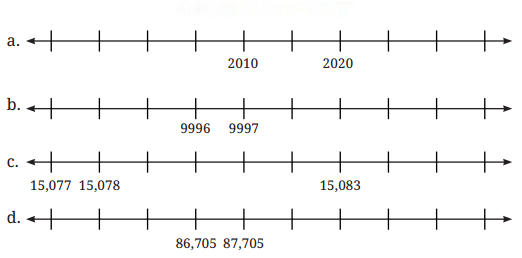
Put a circle around the smallest number and a box around the largest number in each of the sequences above.
Solution:
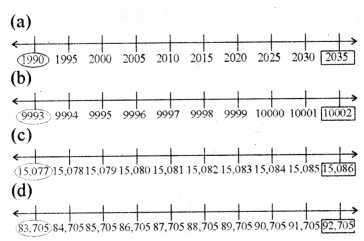
Figure it Out (Page 60)
Question 1.
Digit sum 14
(a) Write other numbers whose digits add up to 14.
(b) What is the smallest number whose digit sum is 14?
(c) What is the largest 5-digit whose digit sum is 14?
(d) How big a number can you form having the digit sum of 14? Can you make an even bigger number?
Solution:
(a) 59, 68, 77, 86, 95, 149, 158, 167, 176, 185, 194, 239, 248, 257, 266, 275, 284, 293, 329, 428, 923, 842, 824 etc.
(b) 59 is the smallest number whose digit sum is 14.
(c) 95000 is the largest 5-digit number whose digit sum is 14.
(d) 9500000000000 …………………… is the largest number having the digit sum of 14.
Question 2.
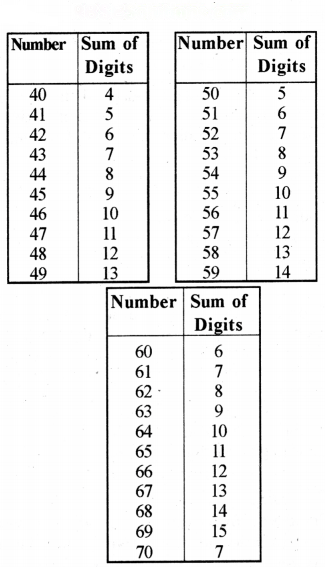
Find out the digit sums of all the numbers from 40 to 70.
Share your observations with the class.
Solution:
Question 3.
Calculate the digit sums of 3-digit numbers whose digits are consecutive (for example, 345). Do you see a pattern? Will this pattern continue?
Solution:
Yes, here we can see a pattern.
6, 9, 12, 15, 18, 21, 24
So,
9 – 6 = 3
12 – 9 = 3
15 – 12 = 3
18 – 15 = 3
21 – 18 = 3
24 – 21 = 3
Common Difference is 3.
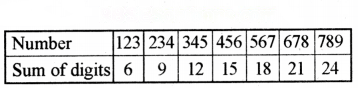
Figure it Out (Page 64)
Question 1.
Pratibha uses the digits ‘4’, ‘7’, ‘3’ and ‘2’, and makes the smallest and largest 4-digit numbers with them: 2347 and 7432. The difference between these two numbers is 7432 – 2347 = 5085. The sum of these two numbers is 9779. Choose 4-digits to make:
(a) The difference between the largest and smallest numbers greater than 5085.
(b) The difference between the largest and smallest numbers less than 5085.
(c) The sum of the largest and smallest numbers greater than 9779.
(d) The sum of the largest and smallest numbers less than 9779.
Solution:
(a) Digits = 4, 3, 7 and 9
Largest Number = 9743
Smallest Number = 3479
Difference = 9743 – 3479 = 6264
6264 > 5085
(b) Digits = 8, 7, 6, 5
Largest Number = 8765
Smallest Number = 5678
Difference = 8765 – 5678 = 3087
3087 < 5085
(c) Digits = 8, 7, 6, 5
Largest Number = 8765
Smallest Number = 5678
Sum = 8765 + 5678 = 14443
14443 > 9779
(d) Digits = 1, 2, 3, 8
Largest Number = 8321
Smallest Number = 1238
Sum = 8321 + 1238 = 9559
9559 < 9779
Question 2.
What is the spin of the smallest and largest 5-digit palindrome? What is their difference?
Solution:
(i) Smallest 5-digit palindrome (All digits are different) = 12321
Largest 5-digit palindrome (All digits are different) = 98789
Sum = 12321 + 98789 = 111110
Difference = 98789 – 12321 = 86468
(ii) Smallest 5-digits palindrome (All digits are same) = 11111
Largest 5-digits palindrome (All digits are same) = 99999
Sum= 11111 + 99999= 111110
Difference = 99999 – 11111 = 88888
Question 3.
The time now is 10:01. How many minutes until the clock shows the next palindromic time? What about the one after that?
Solution:
Time in clock = 10:01
Next palindrome in clock = 11:11
Difference = 11:11 – 10:01 = 70 minutes
Next palindromic time =12:12
Question 4.
How many rounds does the number 5683 take to reach the Kaprekar constant?
Solution:
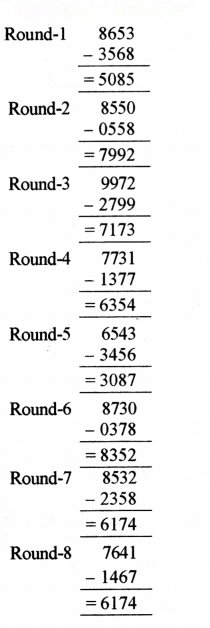
Figure it Out (Page 66)
Question 1.
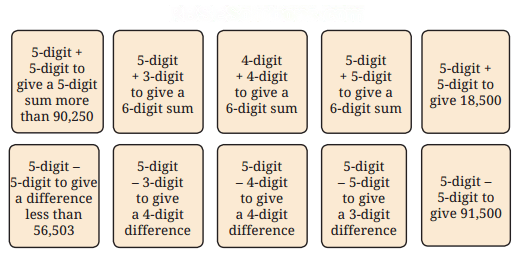
Write an example for each of the below scenarios whenever possible.
Could you find examples for all the cases? If not, think and discuss what could be the reason. Make other such questions and challenge your classmates.
Solution:
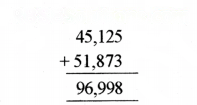
(i) Dividing 90250 by 2 = 90250 ÷ 2 = 45125 To get a number greater than 90250, atleast one of the two numbers must be greater than 45125.
For example
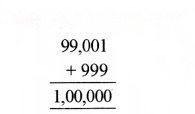
(ii) To get a 6-digit number which is greater than 5-digit number 99000 from the sum of 5-digit number and 3-digit number is
(iii) The largest 4-digit number is 9999.
9999 + 9999 = 19998 (5-digit number)
Hence, it is impossible to get a 6-digit number from 4-digit + 4-digit number.
(iv) 5-digit number + 5-digit number
= 65891 + 66782
= 132673 (6-digit number)
(v) Smallest 5-digit number = 10000
then 10000 + 10000 = 20000
20000 > 18500
Hence, it is impossible to get 18500 from 5-digit number + 5-digit number.
(vi) 5-digit number – 5-digit number
= 63721 – 48537 = 15184
= 15184 < 56503
(vii) 5-digit number – 3-digit number
= 10287 – 926
= 9361 (4-digit number)
(viii) 5-digit number – 4-digit number
= 13767 – 8763 = 5004 (4-digit number)
(ix) 5-digit number – 5-digit number
= 86552 – 86012
= 540 (3-digit number)
(x) Largest 5-digit number = 99999
Smallest 5-digit number = 10000
99999 – 10000 = 89999
We can not get 91500 from 5-digit number – 5-digit number.
Question 2.
Always, Sometimes, Never?
Below are some statements. Think, explore and find out if each of the statement is ‘Always true’, ‘Only sometimes true’ or ‘Never true’. Why do you think so? Write your reasoning and discuss this with the class.
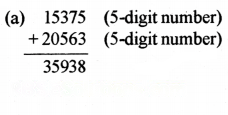
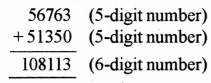
(a) 5-digit number + 5-digit number gives a 5-digit number
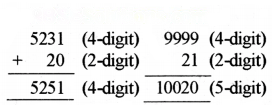
(b) 4-digit number + 2-digit number gives a 4- digit number
(c) 4-digit number + 2-digit number gives a 6-digit number
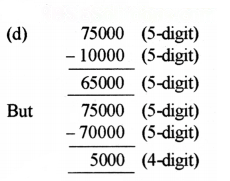
(d) 5-digit number – 5-digit number gives a 5-digit number
(e) 5-digit number – 2-digit number gives a 3-digit number
Solution:
So, it is sometimes true to get a 5-digit number from 5-digit number + 5-digit number.
So, it is sometimes true to get a 4-digit number from 4-digit number + 2-digit number.
(c) Largest 4-digit number = 9999
Largest 2-digit number = 99
Now, 9999 + 99 = 10098 (5-digit number)
So, it is never true to get a 6-digit number from 4-digit number + 2-digit number.
So, it is sometimes true to get a 5-digit number from 5-digit number – 5-digit number.
(e) Smallest 5-digit number = 10000
Largest 2-digit number = 99
Then,
So, it is only sometimes true to get a 3-digit number from 5-digit number – 2-digit number.
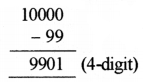
Figure it Out (Page 69)
We shall do some simple estimates. It is a fun exercise, and you may find it amusing to know the various numbers around us. Remember, we are not interested in the exact numbers for the following questions. Share your methods of estimation with the class.
1. Steps you would take to walk:
(a) From the place you are sitting to the classroom door
(b) Across the school ground from start to end
(c) From your classroom door to the school gate
(d) From your school to your home
2. Number of times you blink your eyes or number of breaths you take:
(a) In a minute
(b) In an hour
(c) In a day
3. Name some objects around you that are:
(a) a few thousand in number
(b) more than ten thousand in number
Solution:
Do yourself.
Figure it Out (Page 72)
Question 1.
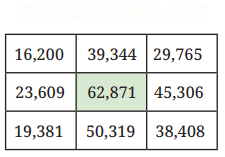
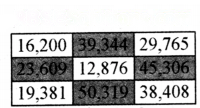
There is only one supercell (number greater than all its neighbours) in this grid. If you exchange two digits of one of the numbers, there will be 4 supercells. Figure out which digits to swap.
Solution:
If we interchange the two digits of the exact middle number 62871 such that it becomes 21876, then 4 super-cells formed here.
Question 2.
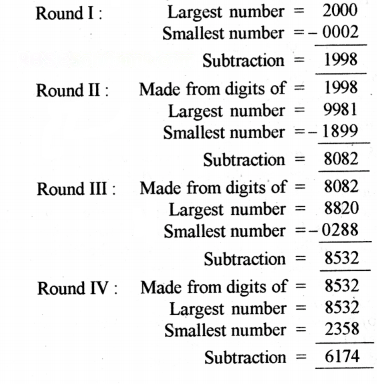
How many rounds does your year of birth take to reach the Kaprekar constant?
Solution:
Let my birth year be 2000.
Which is a Kaprekar constant. Hence, my year of birth i.e. 2000, takes 4 rounds to reach the Kaprekar constant.
Question 3.
We are the group of 5-digit numbers between 35,000 and 75,000 such that all of our digits are odd. Who is the largest number in our group? Who is the smallest number in our group? Who among us is the closest to 50,000?
Solution:
The largest number in a group of 5-digit numbers between 35000 and 75000 whose all digits are odd (When all digits are different)
= 73951
Then, the largest number where digits are repeated = 73999 and the smallest number where digits are not repeated = 35179
Smallest number where digits are repeated = 35111
Close to 50000 (where digits are not repeated) = 49751
Close to 50000 (Where digits are repeated) = 49999
Question 4.
Estimate the number of holidays you get in a year including weekends, festivals and vacation. Then, try to get an exact number and see how close your estimate is.
Solution:
Do yourself.
Question 5.
Estimate the number of liters a mug, a bucket and an overhead tank can hold.
Solution:
Do yourself.
Question 6.
Write one 5-digit number and two 3-digt numbers such that their sum is 18,670.
Solution:
5-digit number = 18000
Two 3-digit numbers = 300 and 370
Sum of these numbers = 18000 + 300 + 370 = 18670
Question 7.
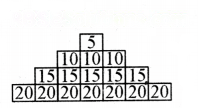
Choose a number between 210 and 390. Create a number pattern similar to those shown in Section 3.9 that will sum up to this number.
Solution:
Sum of digits = 5 × 1 + 10 × 3 + 15 × 5 + 20 × 7
= 5 + 30 + 75 + 140 = 250
The required number between 210 and 390 is 250.
Question 8.
Recall the sequence of Powers of 2 from Chapter 1, Table 1. Why is the Collatz conjecture correct for all the starting numbers in this sequence?
Solution:
The sequence of powers of 2 is 1, 2, 4, 8, 16, 32, 64
We take 64 from these numbers.
Now from Collatz conjecture
(1) Dividing even number 64 by 2 = 32
(2) Dividing even number 32 by 2 = 16
(3) Dividing even number 16 by 2 = 8
(4) Dividing even number 8 by 2 = 4
(5) Dividing even number 4 by 2 = 2
(6) Dividing even number 2 by 2 = 1
Question 9.
Check if the Collatz Conjecture holds for the starting number 100.
Solution:
According to Collatz conjecture, start with any one number, if the number is even then we will halve it and if the number is odd then we will multiply it by three and add one to it and repeat this process until we get one at the end
(1) 100 (even number) so, 100 ÷ 2 = 50
(2) 50 (even number) so, 50 ÷ 2 = 25
(3) 25 (odd number) so, 25 × 3 + 1 = 76
(4) 76 (even number) so, 76 ÷ 2 = 38
(5) 38 (even number) so, 38 ÷ 2 = 19
(6) 19 (odd number) so, 19 × 3 + 1 = 58
(7) 58 (even number) so, 58 ÷ 2 = 29
(8) 29 (odd number) so, 29 × 3 + 1 = 88
(9) 88 (even number) so, 88 ÷ 2 = 44
(10) 44 (even number) so, 44 ÷ 2 = 22
(11) 22 (even number) so, 22 ÷ 2 = 11
(12) 11 (odd number) so, 11 × 3 + 1 = 34
(13) 34 (even number) so, 34 ÷ 2 = 17
(14) 17 (odd number) so, 17 × 3 + 1 = 52
(15) 52 (even number) so, 52 ÷ 2 = 26
(16) 26 (even number) so, 26 ÷ 2 = 13
(17) 13 (odd number) so, 13 × 3 + 1 = 40
(18) 40 (even number) so, 40 ÷ 2 = 20
(19) 20 (even number) so, 20 ÷ 2 = 10
(20) 10 (even number) so, 10 ÷ 2 = 5
(21) 5 (odd number) so, 5 × 3 + 1 = 16
(22) 16 (even number) so, 16 ÷ 2 = 8
(23) 8 (even number) so, 8 ÷ 2 = 4
(24) 4 (even number) so, 4 ÷ 2 = 2
(25) 2 (even number) so, 2 ÷ 2 = 1
Hence, it is clear that Collatz-conjecture holds for the starting number 100.
Question 10.
Starting with 0, players alternate adding numbers between 1 and 3. The first person to reach 22 wins. What is the winning strategy now?
Solution:
Players start from zero. Each player can add any number from 1 to 3 on his turn. The player who reaches 22 first will win.
Target: The game has to be played in such way that you reach 22 first. To do this, you must force your opponent to reach “safe spots’’ (2, 6, 10, 14, 18 and 22). Once you reach these numbers, you can control the game as you like.
Example : Suppose there are two players A and B. Player A starts first.
1. Round I : Player A adds 2 to his first move and moves from 0 to 2. (First safe spot)
2. Round II : Now player B is forced to add any number, suppose he adds 2 and arrives at 4 from 2.
3. Round III : Now player A adds 2 and goes from 4 to 6. (Next safe spot).
4. Round IV : Now player B again adds any number. Suppose he adds 3 and reaches 9 from 6.
5. Round V : Player A. adds 1 and moves from 9 to 10, then next safe spot.
Similarly player A always tries to reach the safe spots and finally reaches 22 first and thus wins the game.
Number Play Class 6 Question Answer
Number Play Class 6 Extra Questions
Multiple Choice Questions—
Question 1.
Which of the following number cell is a supercell?
35 | 70 | 90 | 45 | 60 |
(a) 35
(b) 70
(c) 90
(d) 45
Answer:
(c) 90
Question 2.
Which of the following number cell is a supercell?
521 | 621 | 721 | 821 | 921 | 421 |
(a) 521
(b) 621
(c) 921
(d) 421
Answer:
(c) 921
Question 3.
The correct order of writing the numbers 3240, 8354. 4535 on the number line is—
(a) 3240, 4535, 8354
(b) 8354, 3240, 4535
(c) 4535, 8354, 3240
(d) 3240, 8354, 4535
Answer:
(a) 3240, 4535, 8354
Question 4.
The largest number formed by digits of the number 7349 is—
(a) 7394
(b) 9347
(c) 9437
(d) 9743
Answer:
(d) 9743
Question 5.
How many times does the digit 7 appear while writing all the numbers from 1 to 100?
(a) 10
(b) 15
(c) 20
(d) 25
Answer:
(c) 20
Question 6.
The smallest 5-digit number is—
(a) 10000
(b) 10001
(c) 11000
(d) 10100
Answer:
(a) 10000
Question 7.
The largest four digit number using any one of the digits 5, 9, 2 and 6 twice will be—
(a) 9652
(b) 9562
(c) 9659
(d) 9965
Answer:
(d) 9965
Question 8.
The largest 4-digit number is—
(a) 1000
(b) 9999
(c) 9900
(d) 9000
Answer:
(b) 9999
Question 9.
Kaprekar constant is—
(a) 6174
(b) 6714
(c) 7614
(d) 6417
Answer:
(a) 6174
Question 10.
Which of the following numbers is the correct sum of the digits of the number 186?
(a) 16
(b) 15
(c) 17
(d) 18
Answer:
(b) 15
Fill in the blanks—
1. A cell is a ……………………….. if the number written it is greater than the number written in its adjacent cell.
Answer:
Supercell
2. Numbers that read the same from left to right and right to left are called ……………………. numbers.
Answer:
Palindromic
3. According to Collatz conjecture, every sequence will reach …………………., no matter what whole number we start with.
Answer:
1
4. The digit 7 will appear …………………………. times in the numbers from 1 to 1000.
Answer:
300
5. The smallest four digit number we can make from 3, 9, 0, and 1 is ……………………… .
Answer:
1039
6. The smallest four digit number is ………………………. in which all digits are different.
Answer:
1023
Write True/False for the following statements—
1. The smallest 4-digit even number is 9994. (True/False)
2. The smallest 4-digit even number is 1000. (True/False)
3.
4 | 8 | 6 | 7 | 3 | 9 | 5 |
in this table the cell with number eight is a supercell. (True/False)
4. There are a total of 9 types of 3-digit palindromic numbers that can be formed from numbers 1, 2 and 3. (True/False)
Answer:
1. False
2. True
3. True
4. True
Make the right match—
Question 1.
1. 1 2 3 2 1 | (a) Largest 4-digit number. |
2. 6174 | (b) Palindromic number |
3. 9999 | (c) Smallest 4-digit number |
4. 1000 | (d) Kaprekar number |
(a) Largest 4-digit number.
(b) Palindromic number
(c) Smallest 4-digit number
(d) Kaprekar number
Answer:
1 – (b), 2 – (d), 3 – (a), 4 -(c).
1. 1 2 3 2 1 | (b) Palindromic number |
2. 6174 | (d) Kaprekar number |
3. 9999 | (a) Largest 4-digit number. |
4. 1000 | (c) Smallest 4-digit number |
Very Short Answer Type Questions—
Question 1.
Write the supercell numbers as the following table—
252 | 420 | 355 | 788 | 344 | 677 | 233 |
Solution:
420 and 788
Question 2.
How many two digit numbers are there from 10 to 99?
Solution:
90
Question 3.
How many three digit numbers are there from 100 to 999?
Solution:
900
Question 4.
What is the largest 6-digit number that can be formed from the digits 5, 3, 4, 7, 0, 8 without repeating the digits?
Solution:
875430
Question 5.
How many numbers can be formed from 4-digits in total?
Solution:
9000
Question 6.
Write all the 3-digit palindromic numbers which can be formed by using the digits 1, 2 and 3.
Solution:
111, 121, 131, 212, 222, 232, 313, 323, 333
Question 7.
Explain palindromic time in 12 hour time cycle.
Solution:
01:10, 02:20, 03:30. 04:40, 05:50. 10:01, 11:11, 12:21
Question 8.
Write three examples of palindromic l dates.
Solution:
02/02/2020, 12/02/2021, 22/02/2022
Question 9.
Write the sum of the digits of the numbers 12, 23, 34, 45, 56. Notice some pattern in the result.
Solution:
1 + 2 = 3, 2 + 3 = 5, 3 + 4 = 7, 4 + 5 = 9, 5 + 6 = 11
sequence is 3, 5, 7, 9, 11
Hence, we get odd numbers in ascending order.
Question 10.
Write two digit numbers whose sum is 11.
Solution:
29, 38, 47, 56, 65, 74, 83, 92
Short Answer Type Questions—
Question 1.
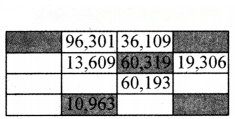
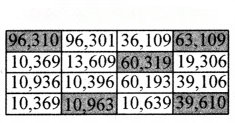
Form a five digit number using the digits 1, 0, 6, 3 and 9 in any order and complete the following table. Only the number in the shaded boxes must be greater than the number in the adjacent boxes.
The largest number in the table is …. The smallest even number in the table is …………………………..
Solution:
The largest number in the table is96310.
The smallest even number in the table is10396.
Question 2.
Starting with a two-digit number, does adding back the number and number obtained by reversing its digits (the inverse) always give a palindrome? Search and find.
Solution:
Not all two-digit numbers become palindromes after flipping and addition.
For example
Example 1 : Number = 12
Reversing the digits = 21
Addition: 12 + 21 = 33
which is a palindrome.
Example 2 : Number = 89
Reversing the digits = 98
Addition = 89 + 98 = 187
187 is not a plaindrome. Again reversing the digit, we get 781. Now addition = 187 + 781 = 968
968 is not a palindrome.
Question 3.
Puzzle :
I am a five-digit palindrome.
I am an odd number.
My tens-digit is 2 times the units digit.
My hundreds digit is twice the tens digit. Who am I?
Solution:
Required number = 1 2 4 2 1
Unit place digit = 1
Tens place digit = 2 = 2 × 1
Hundreds digit = 4 = 2 × 2
Question 4.
Take a number 45, reverse its digits and add the number to the original numbers. Is the result a palindromic number? If not, repeat this process. What is the final palindrome?
Solution:
Number = 45
Reverse Number = 54
Addition = 45 + 54 = 99
Here, we get a palindromic number in the first attempt itself.
Question 5.
First the difference between the number 279 and the number obtained by reversing it.
Solution:
Number = 279
Number obtained by reversing = 972
Difference = 972 – 279 = 693
Long Answer Type Questions—
Question 1.
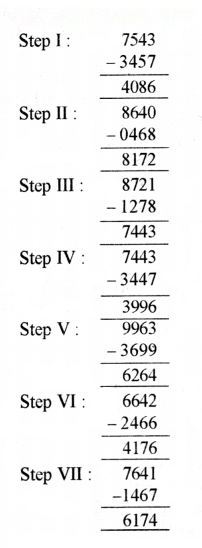
How many steps will it take to send number 5374 to Kaprekar constant?
Solution:
So, it took seven steps to reach the Kaprekar constant 6174 from 5374.
Question 2.
Investigate whether the Collatz conjecture holds if one starts with the number 120.
Solution:
(1) 120 is an even number, so 120 ÷ 2 = 60
(2) 60 is an even number, so 60 ÷ 2 = 30
(3) 30 is an even number, so 30 ÷ 2 = 15
(4) 15 is an odd number, so 15 × 3 + 1 = 46
(5) 46 is an even number, so 46 ÷ 2 = 23
(6) 23 is an odd number, so 23 × 3 + 1 = 70
(7) 70 is an even number, so 70 ÷ 2 = 35
(8) 35 is an odd number, so 35 × 3 + 1 = 106
(9) 106 is an even number, so 106 ÷ 2 = 53
(10) 53 is an odd number, so 53 × 3 + 1 = 160
(11) 160 is an even number, so 160 ÷ 2 = 80
(12) 80 is an even number, so 80 ÷ 2 = 40
(13) 40 is an even number, so 40 ÷ 2 = 20
(14) 20 is an even number, so 20 ÷ 2 = 10
(15) 10 is an even number, so 10 ÷ 2 = 5
(16) 5 is an odd number, so 5 × 3 + 1 = 16
(17) 16 is an even number, so 16 ÷ 2 = 8
(18) 8 is an even number, so 8 ÷ 2 = 4
(19) 4 is an even number, so 4 ÷ 2 = 2
(20) 2 is an even number, so 2 ÷ 2 = 1
Hence, it is clear that Collatz conjecture holds it we start with the number 120.