RBSE Class 6 Science Chapter 5 Question Answer Measurement of Length and Motion
By tackling theseRBSE Class 6 Science Solutionsand RBSE Class 6 Science Chapter 5 Measurement of Length and Motion Question Answer in English Medium, students will build a solid foundation in the topic.
Measurement of Length and Motion Class 6 Questions and Answers
RBSE Class 6 Science Chapter 5 Measurement of Length and Motion Question Answer
Measurement of Length and Motion Class 6 Question Answer – InText
Page 83
Question 1.
Would it be convenient to use the unit metre to measure larger lengths, such as the length of a railway track between two cities, or to measure smaller lengths, such as the thickness of a page of a book?
Answer:
No, it is convenient to use a larger unit kilometre (Km) for measuring large lengths and a smaller unit like centimetre or millimetre for measuring small lengths.
Page 89
Question 2.
What do such kilometre stones indicate?
Answer:
The kilometre stone indicates the distance of that place from a reference point.
RBSE Class 6th Science Chapter 5 Question Answer – Exercise
Let us enhance our learning
Question 1.
Some lengths are given in Column I of Table Some units are given in Column II. Match the lengths with the units suitable for measuring those lengths.
Table
Column-I | Column-II |
Distance between Delhi and Lucknow | Centimetre |
Thickness of a coin | Kilometre |
Length of an eraser | Metre |
Length of school ground | Millimetre |
Answer:
Column-I | Column-II |
Distance between Delhi and Lucknow | Kilometre |
Thickness of a coin | Millimetre |
Length of an eraser | Centimetre |
Length of school ground | Metre |
Question 2.
Read the following statements and mark True (T) or False (F) against each.
(i) The motion of a car moving on a straight road is an example of linear motion.
(ii) Any object which is changing its position with respect to a reference point with time is said to be in motion.
(iii) lkm = 100 cm
Answer:
(i) True
(ii) True
(iii) False
Question 3.
Which of the following is not a standard unit of measuring length?
(i) millimetre (ii) centimetre (iii) kilometre (iv) handspan.
Answer:
(iv) handspan
Question 4.
Search for the different scales or measuring tapes at your home and school. Find out the smallest value that can be measured using each of these scales. Record your observations in a tabular form.
Answer:
Observation Table
Scale | Smallest measurable value |
Geometric scale | 1 millimetre |
Metre scale | 1 centimetre |
Inch tape | 1 inch |
Measuring tape | 1 feet |
Vernier caliper | 0.1 millimetre |
Screw gauge | 0.01 millimetre |
Question 5.
Suppose the distance between your school and home is 1.5 km. Express it in metres.
Answer:
∵ 1 kilometre = 1000 metre
∴ 1.5 km =1.5 × 1000
= 1500 metre
Question 6.
Take a tumbler or a bottle. Measure the length of the curved part of the base of glass or bottle and record it.
Answer:
The length of curved part of the bottom of the glass or bottle can be measured using a flexible measuring tape or thread.
The length of the curved part of the bottom of the glass = 17.2 cm.
Question 7.
Measure the height of your friend and express it in (i) metres (ii) centimetres and (iii) millimetres.
Answer:
Height of friend = 1.25 metre
∵ 1 metre = 100 centimetre
∵ 1.25 m = 1.25 × 100 = 125 cm
∵ 1 metre = 1000 millimetre
∴ 1.25 m = 1.25 × 1000
= 1250 mm
Question 8.
You are given a coin. Estimate how many coins are required to be placed one after the other lengthwise, without leaving any gap between them, to cover the whole length of the chosen side of a notebook.
Verify your estimate by measuring the same side of the notebook and the size of the coin using a 15-cm scale.
Answer:
As per our estimate based on the coin given to us, if we place the coins one after the other without leaving any gaps along the entire edge of one side of the notebook, we will need 9 coins. To verify our guess, we place a scale of 15 cm on the centre of the coin and measure its length. The length is 1.8 cm. Now, using a scale of 15 cm, find the length of the entire edge of one side of the notebook. It turns out to be 18 cm. Well, according to the scale, to cover the entire edge of one side of the notebook without any gaps, we will need 10 coins, which is one more than our guess.
Question 9.
Give two examples each for linear, circular and oscillatory motion.
Answer:
Examples of linear motion—
(i) Fruit falling from a tree
(ii) Students march past in a straight line.
Examples of circular motion—
(i) Rotation of a bicycle wheel
(ii) Merry-go-round
Examples of oscillatory motion—
(i) Motion of a clock’s pendulum
(ii) Motion of a child swinging on a swing
Size | Size Object |
1. mm | (i) Dial of a clock(ii) Thickness of a mobile(iii) Thickness of a glass |
2 cm | (i) Length and breadth of a table(ii) Height of a friend(iii) Thickness of a tree trunk |
3 m | (i) Length and breadth of a house(ii) Height of a tank(iii) Width of a road |
Question 11.
A rollercoaster track is made in the shape shown in Fig. A ball starts from point A and escapes through point F. Identify the types of motion of the ball on the rollercoaster and corresponding portions of the track.
Answer:
1. Linear motion—
(i) From point ‘A’ to point ‘B’
(ii) From point ‘E’ to F’
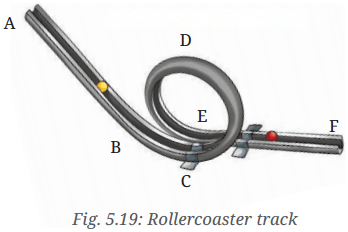
2. Circular motion—
(i) Between the points ‘B’ ‘C’ D’ ‘E’
Question 12.
Tasneem wants to make a metre scale by herself. She considers the following materials for it —plywood, paper, cloth, stretchable rubber and steel. Which of these should she not use and why?
Answer:
Meter scale is used to measure length in a straight line. So Tasneem should not use such material which is flexible and stretchable. So paper, cloth and flexible rubber should not be used to make a meter scale.
Question 13.
Think, design and develop a card game on conversion of units of length to play with your friends.
Answer:
Different cards can be made with different lengths and corresponding units like millimetres, centimetres, kilometres. Each card can have a length in one unit (mm. cm. km) which players can match with its equivalent value in another unit. Like matching a 1 kilometre card with a 1000 metre card.
RBSE Class 6 Science Chapter 5 Important Questions
Multiple Choice Questions
1. The suitable unit for long distance measurement is—
(a) metre
(b) centimetre
(c) kilometre
(d) millimetre
Answer:
(c) kilometre
2. What type of motion does a rolling ball show?
(a) Linear motion
(b) Circular motion
(c) Vertical and linear motion
(d) Linear and circular motion
Answer:
(d) Linear and circular motion
3. Motion along a straight line is called—
(a) Circular motion
(b) Oscillatory motion
(c) Linear motion
(d) All of the above
Answer:
(c) Linear motion
4. Flow many millimetres are there in 1 centimetre?
(a) 10 mm
(b) 100 mm
(c) 1000 mm
(d) 10000 mm
Answer:
(a) 10 mm
5. What was used to measure small lengths in ancient times?
(a) Feet
(b) Hands
(c) Fist
(d) Fingers (cingula)
Answer:
(d) Fingers (cingula)
6. The value of 1 inch is—
(a) 1.54 cm
(b) 2.54 cm
(c) 2.45 cm
(d) 2.46 cm
Answer:
(b) 2.54 cm
7. The symbol of millimetre is—
(a) mM
(b) cm
(c) mm
(d) m
Answer:
(c) mm
8. The motion of the swing is—
(a) Linear motion
(b) Oscillatory motion
(c) Circular motion
(d) Rotational motion
Answer:
(b) Oscillatory motion
9. What is the system of standard units of measurement called?
(a) IS units
(b) ISI units
(c) CM units
(d) SI unit
Answer:
(d) SI unit
10. An example of oscillatory motion is—
(a) Soldiers parade
(b) Rolling of ball
(c) Pendulum
(d) All of the above
Answer:
(c) Pendulum
Fill in the blanks
1. The change in position with respect to time is called …………………….. .
Answer:
motion
2. The motion of the second hand of a clock is an example of …………………….. motion.
Answer:
circular
3. While writing the length, always leave a space between the …………………….. and the …………………….. .
Answer:
number, unit
4. Both circular motion and oscillatory motion are …………………….. in nature.
Answer:
periodic
5. When an object moves to and fro about some fixed position, its motion is called …………………….. motion.
Answer:
oscillatory
6. The …………………….. unit of length is metre.
Answer:
SI
True/False
1. Motion along a straight line is called circular motion. (True/False)
Answer:
False
2. There are 100 millimetres in one centimetre. (True/False)
Answer:
False
3. The symbol for the unit of length metre in m. (True/False)
Answer:
True
4. The length of a curved line can be measured directly using a metre scale. (True/False)
Answer:
False
Match the words given in Column-I with Column-II
Question 1.
Column-I | Column-II |
1. The hands of clock | (a) Linear motion |
2. March past | (b) Circular motion |
3. Swing | (c) Periodic motion |
4. Pendulum | (d) Oscillatory motion |
Answer:
Column-I | Column-II |
1. The hands of clock | (b) Circular motion |
2. March past | (a) Linear motion |
3. Swing | (d) Oscillatory motion |
4. Pendulum | (c) Periodic motion |
Question 2.
Column-I | Column-II |
1. 1500 mm | (a) 2 inch |
2. 50.8 mm | (b) 1.5 m |
3. 1000 mm | (c) 0.002 km |
4. 2000 mm | (d) 1 metre |
Answer:
Column-I | Column-II |
1. 1500 mm | (b) 1.5 m |
2. 50.8 mm | (a) 2 inch |
3. 1000 mm | (d) 1 metre |
4. 2000 mm | (c) 0.002 km |
Very Short Answer Type Questions
Question 1.
What is meant by handspan?
Answer:
The width of the palm of the hand is called handspan.
Question 2.
What type of scale is suitable for measuring the thickness of a tree trunk?
Answer:
Meter scale cannot be used directly for measuring the thickness of a tree trunk. A flexible measuring tape like a tailor’s tape is more suitable for such measurements.
Question 3.
What is the correct way of holding a scale?
Answer:
Meter scale should be kept in contact with the object along its length.
Question 4.
How do visually impaired students measure length?
Answer:
Visually impaired use scales with raised markings that can be felt by touching them.
Question 5.
How many and which are the parts of the result obtained from the measurement of length?
Answer:
The result obtained from the measurement of length has two parts – one part is the number and the other part is the unit of measurement.
Question 6.
How can the length be measured in the case of a curv ed line?
Answer:
In the case of a curved line, the measurement can be done using a flexible measuring tape or thread.
Question 7.
What is meant by ‘reference point’?
Answer:
When distance is stated with respect to a fixed object or point, then this point is called a reference point.
Question 8.
What is called motion’?
Answer:
An object is said to be in motion if its position changes with respect to the reference point with time.
Question 9.
What is ‘linear motion’?
Answer:
When an object moves along a straight line, its motion is called linear motion.
Question 10.
What is ‘circular motion’?
Answer:
When an object moves along a circular path, its motion is called circular motion.
Question 11.
What is ‘periodic motion’?
Answer:
If an object repeats its path after a fixed interval of time, its motion is said to be periodic.
Question 12.
What is measurement?
Answer:
The comparison of an unknown quantity with a known quantity of the same kind is called measurement.
Question 13.
What is meant by unit?
Answer:
The fixed quantities used for measurement are called units.
Question 14.
What is the ‘SI Unit System’?
Answer:
The system of units now used is known as the ‘International System of Units’ or SI units.
Question 15.
What is a ‘Jones Counter?
Answer:
‘Jones Counter’ which is attached to a bicycle wheel and is used for measuring distances.
Short Answer Type Questions
Question 1.
Why was there a need to develop a uniform measurement system?
Answer:
In ancient times, people used handspans and other similar units, such as length of hand, foot, fist or fingers as units of measurement. However this differ from person to person. Thus, there is a need for such a unit for which measurements of the same length made by different people do not differ.
Question 2.
When can an object be called in motion or at rest? Explain.
Answer:
An object is said to be in motion if its position changes with respect to the reference point with time. If an object is not changing its position with respect to the reference point with time, it is said to be at rest.
Question 3.
Both circular motion and oscillatory motion are periodic motion in nature. Explain this statement.
Answer:
If an object repeats its path after a fixed interval of time, its motion is said to be periodic. When an object is in circular motion, it moves along the circular path again and again. An object in oscillatory motion also repeats its motion while moving to and fro. Both circular and oscillatory motion are periodic in nature.
Question 4.
Why are some length measuring instruments made of flexible material?
Answer:
All measurable objects are not in a straight line. For example, if we want to measure the thickness of a tree trunk or the size of our chest or the length of a curv ed line, we cannot directly use the meter scale. Therefore, for this we will need a flexible measuring tape. That is why some length measuring instruments are made of flexible material.
Question 5.
Explain the SI unit of length.
Answer:
The SI unit of length is metre. Its symbol is m. One metre (m) is divided into 100 equal divisions. Each division is called a centimetre (cm). 1 cm length are further divided into 10 equal parts. The length of one of these smaller parts is called a millimetre (mm). For measuring larger lengths, we use a larger unit called a kilometre (km) which is equal to 1000 metres.
1 km = 1000 m, 1 m = 100 cm, 1 cm = 10 mm
Question 6.
What is oscillatory motion? Give some examples.
Answer:
When an object moves to and fro about some fixed position, its motion is called oscillatory motion. The sw aying of the branches of a tree, the motion of a child swinging in a swing, the motion of the strings of a sitar, all are examples of oscillatory motion.
Long Answer Type Questions
Question 1.
Briefly explain the measurement systems of ancient India.
Answer:
India has a rich history of measurement systems dating back to ancient times. Angula (finger width), multiples of angula, dhanusa. and yojana are some of the units mentioned in ancient Indian literature, and used in measuring artefacts, architecture, and town planning. The angula is still used by traditional craftspeople like carpenters and tailors. Several objects with ruled markings which could be scales have been excavated from, sites of the Harappan Civilisation.
Question 2.
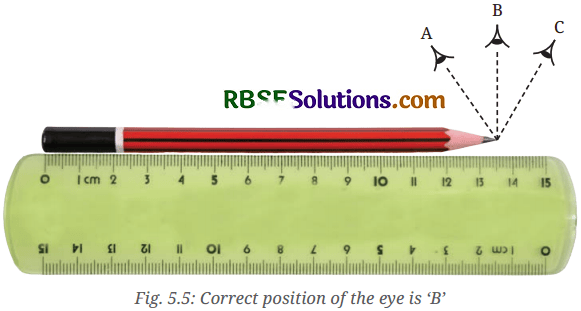
What should be the correct position of the eyes while reading a scale? Explain by drawing a diagram.
Answer:
The correct position of eye while reading a scale can be understood by an example. If we are trying to measure the length of a pencil by aligning it with a scale, the position of your eye should be directly above the tip of the pencil.
Question 3.
If the ends of the scale given to you for measurement are broken due to some reason, can you use it for measurement? Explain by giving an example.
Answer:
If the ends of the scale are broken or the zero marking is not clear, it can still be used for measurement. With such a scale, use any other full mark of the scale, say, 1.0 cm. Then you must subtract the reading of this mark from the reading at the other end. For example, the reading at one end is 1.0 cm and at the other end, it is 8.7 cm. Therefore, the length of the object is 8.7 cm-1.0 cm = 7.7 cm.
Question 4.
How are the symbols of units written? Explain.
Answer:
The results of all measurements will consist of two parts—one part is a number and the other part is the unit of measurement. Units of measurement are represented in the form of symbols. Symbols of units are written in English, which are even same in Hindi. Units of length, such as kilometre, metre, centimetre and millimetre, begin with a lowercase letter, except at the beginning of a sentence. Their symbols km, m, cm and mm are also written in lowercase letters, and are never followed by ‘s’ for the plural. Note that a full stop is not written after the symbol, except at the end of a sentence. While writing the length, always leave a space between the number and the unit.
Question 5.
Can an object be stationary or moving in any situation? Explain by giving an example.
Answer:
To determine whether an object is stationary or dynamic, the reference point is important. For example, suppose we are in a bus in which all the passengers are seated. If we look in the bus again after a minute, then the passengers are still sitting in the bus. That is, the position of the passengers is not changing with time. Therefore, they are definitely still there. However, when we look outside the bus, we find that they are in motion because their position is changing relative to the objects outside. Similarly, an object may be neither stationary nor in motion in one position. In such a case, the reference point becomes important. If we take the bus as the reference point, then the passenger is stationary. However, if we take any object outside the bus as the reference point, then the bus and the passenger are in motion.
Question 6.
What precautions should we take while measuring length?
Answer:
We should take certain precautions while measuring length—
- The measuring scale should be kept in contact with the object along its length.
- The ends of some scales may be broken or the zero point is not clearly visible in them. In such a situation, measurement should not be taken from zero point, rather any other integer should be used.
- The correct position of the eye is also important for taking the measurement. The eye should be exactly in front of the point whose measurement is to be taken.
Essay Type Questions
Question 1.
Explain motion and describe its types.
Answer:
An object is said to be in motion if its position changes with respect to the reference point with time. We can measure this change in position by measuring distance. From this, we can find out at what speed an object is moving. There are many types of motion. Like—
(i) Linear Motion—When an object moves along a straight line, its motion is called linear motion. March past presented by students during parade, fruit falling from a tree, etc. are examples of this type of motion.
(ii) Circular motion—When an object moves along a circular path, its motion is called circular motion. The motion of a merry go round swing is an example of this.
(iii) Oscillatory motion—When an object moves to and fro about some fixed position, its motion is called oscillatory motion. The motion of a child swinging on a swing is an example of this type of motion.
(iv) Periodic motion—If an object repeats its path after a fixed interval of time, its motion is said to be periodic. When an object is in circular motion, it moves along the circular path again and again. An object in oscillatory motion also repeats its motion while moving to and fro. Both circular and oscillatory motion are periodic in nature.
RBSE Class 6 Science Chapter 5 Notes
Class 6 Science Chapter 5 Notes RBSE – Measurement of Length and Motion Class 6 Notes
- People use a scale or measuring tape to measure the length of an object.
- The International System of Units (SI units) has been adopted by countries as standard units of measurement.
- The SI unit of length is metre. Its symbol is m.
- For measuring larger lengths, we use a larger unit called a kilometre (km) which is equal to 1000 metres. And for measuring smaller lengths, we use units such as centimetre or millimetre.
- In the case of a curved line, measurements can be made with the help of a flexible measuring tape or by using a thread.
- When distance is stated with respect to a fixed object or point, then this point is called a reference point
- An object is said to be in motion if its position changes with respect to a reference point with time.
- When an object moves along a straight line, its motion is called linear motion.
- When an object moves along a circular path, its motion is called circular motion.
- When any object moves to and fro about any fixed position, its motion is called oscillatory motion.
- If an object repeats its path after a fixed interval of time, its motion is said to be periodic.