RBSE Class 6 Science Chapter 7 Question Answer Temperature and Its Measurement
By tackling theseRBSE Class 6 Science Solutionsand RBSE Class 6 Science Chapter 7 Temperature and Its Measurement Question Answer in English Medium, students will build a solid foundation in the topic.
Temperature and Its Measurement Class 6 Questions and Answers
RBSE Class 6 Science Chapter 7 Temperature and Its Measurement Question Answer
Temperature and Its Measurement Class 6 Question Answer – InText
Page 123
Question 1.
Can it always be correctly judged, that a person has fever, only by touching the person?
Answer:
No. we cannot always rely upon our sense of touch to decide correctly whether a body is hot or cold.
RBSE Class 6th Science Chapter 7 Question Answer – Exercise
Let us enhance our learning
Question 1.
The normal temperature of a healthy human being is close to
(i) 98.6 °C
(ii) 37.0 °C
(iii) 32.0 °C
(iv) 27.0 °C
Answer:
(ii) 37.0 °C
Question 2.
37 °C is the same temperature as
(i) 97.4 °F
(ii) 97.6 °F
(iii) 98.4 °F
(iv) 98.6 °F
Answer:
(iv) 98.6 °F
Question 3.
Fill in the blanks :
(i) The hotness or coldness of a system is determined by its
(ii) The temperature of ice-cold water cannot be measured by a thermometer.
(iii) The unit of temperature is degree
Answer:
(i) Temperature
(ii) Clinical
(iii) Celsius
Question 4.
The range of a laboratory thermometer is usually
(i) 10 °C to 100 °C
(ii) -10 °C to 110 °C
(iii) 32 °C to 45 °C
(iv) 35 °C to 42 °C
Answer:
(ii) -10 °C to 110 °C
Question 5.
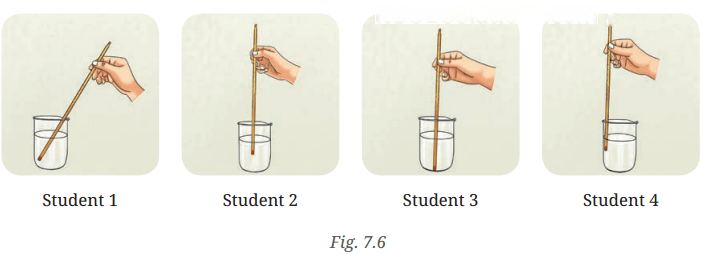
Four students used a laboratory thermometer to measure the temperature of water as shown in Fig.
Who do you think followed the correct way for measuring temperature?
(i) Student 1
(ii) Student 2
(iii) Student 3
(iv) Student 4
Answer:
(ii) Student
Question 6.
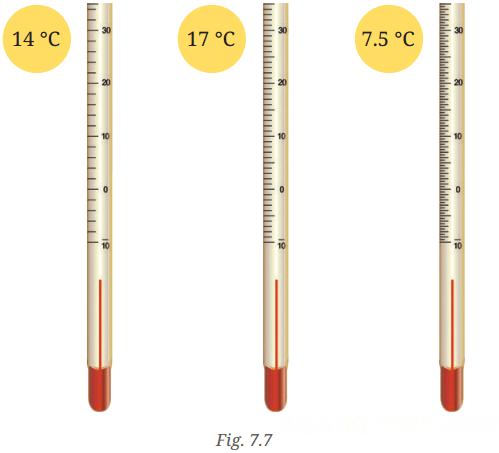
Colour to show the red column on the drawings of thermometers (Fig.) as per the temperatures written below :
Answer:
Question 7.
Observe the part of thermometer shown in Fig. and answer the following questions :
(i) What type of thermometer is it?
(ii) What is the reading of the thermometer?
(iii) What is the smallest value that this thermometer can measure?
Answer:
(i) Laboratory thermometer
(ii) 26 °C (iii) 1 °C

Question 8.
A laboratory thermometer is not used to measure our body temperature. Give a reason.
Answer:
Laboratory thermometer is not used to measure our body temperature because its temperature range is from -10°C to 110°C which is much higher than our body temperature. Due to this, it is not able to measure the body temperature correctly.
Question 9.
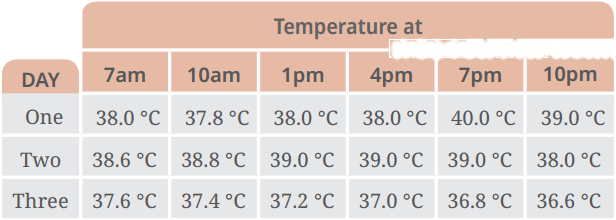
Vaishnavi has not gone to school as she is ill. Her mother has kept a record of her body temperature for three days as shown in Table—
(i) What was Vaishnavi’s highest recorded temperature?
(ii) On which day and at what time was Vaishnavi’s highest temperature recorded?
(iii) On which day did Vaishnavi’s temperature return to normal?
Table : Body temperature record of Vaishnavi Temperature at
Answer:
(i) 40.0 °C (ii) On first day at 7pm (iii) On third day
Question 10.
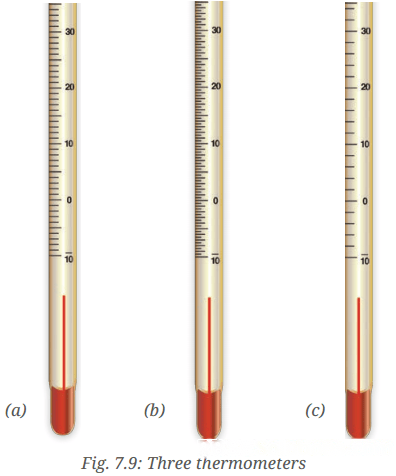
If you have to measure the temperature 22.5 °C, which of the following three thermometers will you use (Fig.)? Explain.
Answer:
If we have to measure a temperature of 22.5°C then the thermometer should be such that its smallest part is capable of measuring 0.5°C temperature, so to measure 22.5°C temperature we will use thermometer (b) because its smallest part is capable of measuring 0.5° temperature.
Question 11.
The temperature shown by the thermometer in Fig. 7.10 is
(i) 28.0 °C
(ii) 27.5 °C
(iii) 26.5 °C
(iv) 25.3 °C
Answer:
(ii) 27.5 °C

Question 12.
A laboratory thermometer has 50 divisions between 0 °C and 100 °C. What does each division of this thermometer measure?
Answer:
The temperature difference between 0°C and 100°C of the laboratory thermometer is 100°C. There are 50 divisions between the two marks. Hence, the value of a smaller division is 100°C/50 = 2°C. This means that the smallest division of this thermometer measures 2°C degrees of temperature.
Question 13.
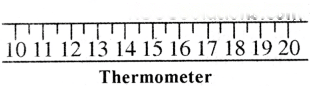
Draw the scale of a thermometer in which the smallest division reads 0.5 °C. You may draw only the portion between 10 °C and 20 °C.
Answer:
Question 14.
Someone tells you that she has a fever of 101 degrees. Does she mean it on the Celsius scale or Fahrenheit scale?
Answer:
If the fever is 101 degrees that it is on the Fahrenheit scale.
RBSE Class 6 Science Chapter 7 Important Questions
Multiple Choice Questions
1. The SI unit of temperature is—
(a) Celsius
(b) Fahrenheit
(c) Kelvin
(d) All of the above
Answer:
(c) Kelvin
2. Which of the following is used in thermometers?
(a) Lead
(b) Mercury
(c) Silver
(d) Copper
Answer:
(b) Mercury
3. The special thermometers used during the Covid-19 pandemic is called—
(a) Doctor’s thermometer
(b) Mercury thermometer
(c) Room thermometer
(d) Infrared thermometer
Answer:
(d) Infrared thermometer
4. The body temperature of a person depends on which factors—
(a) Age
(b) Time of the day
(c) Activity level
(d) All of the above
Answer:
(d) All of the above
5. The human body generally has a temperature range of—
(a) 35°C – 42°C
(b) 32°C – 42°C
(c) 35°C – 45°C
(d) 36°C – 4Q°C
Answer:
(a) 35°C – 42°C
6. The normal temperature of the human body on the Fahrenheit scale is—
(a) 37°F
(b) 98.6°F
(c) 98.4°F
(d) 94.8°C
Answer:
(b) 98.6°F
7. The thennometer that show’ temperature digitally are called—
(a) Laboratory thermometer
(b) Doctor’s thermometer
(c) Digital thermometer
(d) Mercury thermometer
Answer:
(c) Digital thermometer
8. Is not a temperature scale—
(a) Celsius scale
(b) Fahrenheit scale
(c) Richter scale
(d) Kelwin scale
Answer:
(c) Richter scale
9. Generally the minimum temperature that can be measured by a laboratory thermometer is—
(a) 10°C
(b) -10°C
(c) 0°C
(d) 100°C
Answer:
(b) -10°C
10. Who is known as the ‘Weather Women of India”?
(a) Anna Malai
(b) Anna Mani
(c) Sunder Rajan
(d) None of these
Answer:
(b) Anna Mani
Fill in the blanks
1. The …………………….. of a body tells us how hot or cold it is.
Answer:
temperature
2. Temperature in a digital thermometer is determined with the help of …………………….. .
Answer:
heat sensors
3. Normal temperature of a health) human …………………….. is taken to be 37.0°C or 98.6°F.
Answer:
adult
4. Doctors thermometer is used for measursing the …………………….. temperature.
Answer:
human body
5. Mercury is not used in …………………….. thermometer.
Answer:
digital
6. A device that measures temperature is called a …………………….. .
Answer:
thennometer.
True/False
1. We should always rely upon our sense of touch to decide correctly whether a body is hot or cold. (True/False)
Answer:
False
2. For measuring temperature, the clinical thermometers generally use a scale called the Celsius scale. (Tme/False)
Answer:
True
3. The temperature of every person may not be 37.0°C (True/False)
Answer:
True
4. We can use laboratory thermometer to measure the temperature of a human body. (True/False)
Answer:
False
Match the words given in Column-I with Column-II
Question 1.
Column-I | Column-II |
1. Laboratory the mometer | (a) Infrared rays |
2. Doctor’s thermometer | (b) Heat sensors |
3. Digital thermometer | (c) Mercury |
4. Infrared thermometer | (d) Alcohol |
Answer:
Column-I | Column-II |
1. Laboratory the mometer | (d) Alcohol |
2. Doctor’s thermometer | (c) Mercury |
3. Digital thermometer | (b) Heat sensors |
4. Infrared thermometer | (a) Infrared rays |
Question 2.
Column-I | Column-II |
1. -273.15°C | (a) Normal room temperature |
2. 37°C | (b) Fever |
3. 39°C | (c) Minimum (zero) temperature |
4. 25°C | (d) Healthy adult |
Answer:
Column-I | Column-II |
1. -273.15°C | (c) Minimum (zero) temperature |
2. 37°C | (d) Healthy adult |
3. 39°C | (b) Fever |
4. 25°C | (a) Normal room temperature |
Very Short Answer Type Questions
Question 1.
Name the instrument by which temperature can be measured?
Answer:
Thermometer
Question 2.
How many types of thermometers are generally used to measure temperature? Name them.
Answer:
There are two kinds of thermometers— clinical thermometers and laboratory thermometers.
Question 3.
How can we convert the temperature of Celsius scale to Kelvin scale?
Answer:
We can easily convert the temperature from Celsius scale to Kelvin scale by using:
Temperature in Kelvin scale = Temperature in Celsius scale + 273.15
Question 4.
Can a clinical thermometer be used to measure the temperature of boiling water or ice?
Answer:
No, the temperature of boiling water and ice is beyond the measuring range of a clinical thermometer.
Question 5.
How can we measure temperature outside the measuring range of a clinical thermometer?
Answer:
We can measure temperature outside the measuring range of a clinical thermometer using a laboratory thermometer.
Question 6.
Which substance is used for measuring temperature in a laboratory thermometer?
Answer:
The substance commonly used in laboratory thermometers is alcohol (often mixed with red colour for convenience of viewing) or mercury.
Question 7.
Mark the zero value for a normal laboratory thermometer—
(i) What is the minimum temperature it can measure?
(ii) What is the maximum temperature it can measure?
(iii) What is the minimum temperature that can be read by the thermometer?
Answer:
(i) -10 °C
(ii) 110°C
(iii) 1.0 °C
Question 8.
What is called a ‘room thermometer’?
Answer:
The thermometer which tells the approximate value of the temperature of a place is called room thermometer.
Question 9.
Which is the temperature scale commonly used in clinical thermometers? Also tell its unit.
Answer:
The temperature scale commonly used in clinical thermometers is Celsius scale. The unit of temperature on this scale is degree Celsius which is represented by °C.
Question 10.
By whom is the temperature determined in a digital thermometer?
Answer:
In digital thermometer, the temperature is determined by heat sensors.
Question 11.
Tell the temperature range of clinical thermometer on Fahrenheit scale.
Answer:
The temperature range of clinical thermometer is 15 °F to 108 °F.
Question 12.
During the COVID-19 pandemic, some special thermometers were used, which could measure the temperature of a person from a distance. What were those?
Answer:
They are non-contact thermometers, also called infrared thermometers. Such thermometers can measure temperature without touching a person’s body and thus reduce the risk of spreading disease.
Question 13.
On what factors does the body temperature of a person depend?
Answer:
The body temperature of a person depends on many factors, such as age, time of day and activity level.
Question 14.
What is the normal temperature range of the human body?
Answer:
The temperature of the human body normally does not go below 35 °C and above 42°C.
Question 15.
Why do the maximum and minimum air temperatures of a particular place keep changing every day?
Answer:
The weather of a particular place depends on many factors, so the maximum and minimum air temperatures keep changing every day.
Question 16.
What is called ‘absolute zero temperature’?
Answer:
-273.15°C (0 Kelvin) is called absolute zero temperature.
Question 17.
What is the temperature of the Sun’s core?
Answer:
The temperature of the Sun’s core reaches 15 million degrees Celsius.
Question 18.
What is meant by ‘heat’?
Answer:
The reliable measure of the hotness (or coldness) of a body is the temperature of that body.
Question 19.
What does the temperature difference between two bodies tell us?
Answer:
The temperature difference between two bodies tells us how hot one body is compared to the other.
Short Answer Type Questions
Question 1.
Why can’t the temperature of every person be 37°C?
Answer:
The temperature of every person may not be 37.0 °C. What we call nonnal temperature is the average body temperature of a large number of health} people. Aperfectly health}1 person may, therefore, have a normal temperature slightly different from 37.0 °C.
Question 2.
How was fever detected before the invention of thermometer?
Answer:
Fever affects the pulse rate of a person. This was known even in olden days in India. However, apart from fever, some other situations also affect the pulse rate. Hence, pulse rate alone is not a reliable indicator of fever.
Question 3.
What precautions should be taken while using a laboratory thermometer?
Answer:
Precautions should be taken while using a laboratory thermometer—
- It should be used carefully. If it collides with a hard object, it may break.
- It should not be lifted by holding it by the bulb.
Question 4.
What is the importance of ‘air temperature’?
Answer:
Air temperature is an important weather parameter and is monitored at weather stations all over the world. The data gathered on air temperature along with various other parameters are used for making weather forecast.
Question 5.
Who is ‘Anna Mani’? Explain his contribution.
Answer:
Anna Mani (1918-2001) was an Indian scientist, also known as the ‘Weather Woman of India”. She invented and built a large number of weather measurement instruments. This reduced the reliance of India on other nations for such instruments. She also explored the possibilities of using wind and solar energy in India. Her work helped India to become one of the global leaders in renewable energy.
Question 6.
What is the maximum and minimum possible temperature?
Answer:
There is no limit on the highest temperature that can exist. However, as per scientific understanding, there is a limit to the lowest temperature that can be achieved. It is close to -273.15 °C (0 kelvin) and is called absolute zero temperature.
Question 7.
Which is better among mercury thermometer and digital thermometer and why?
Answer:
Mercury thermometers use mercury which is a highly toxic substance and if the thermometer breaks accidentally, it is difficult to dispose of the mercury properly. There is no such risk in a digital thermometer and the numbers on its display are easy to read. Hence, a digital thermometer is better than a mercury thermometer.
Long Answer Type Questions
Question 1.
Which precautions should be taken while using a digital clinical thermometer?
Answer:
The following precautions should be taken while using a digital clinical thermometer—
- To be used after reading the instruction manual of the thermometer.
- Tip of the thermometer to be washed with soap and water before and after use.
- While washing, care to be taken to keep the digital portion such as the display out of w ater.
- Do not hold the thermometer by the tip.
Question 2.
Which are the most commonly used temperature scales and also tell their units?
Answer:
The three most commonly used temperature scales are—
- Celsius scale— The scale commonly used in clinical thermometers for measuring temperature is Celsius scale. The unit of temperature on this scale is degree Celsius, which is represented by °C.
- Fahrenheit Scale— Generally, Fahrenheit scale is used in digital thermometers. The unit of temperature on this scale is degree Fahrenheit and it is represented by °F.
- Kelvin Scale— For scientific work, another scale of temperature is used, which is called Kelvin Scale. The unit of temperature on this scale is Kelvin, which is represented by K. The SI unit of temperature is Kelvin.
Question 3.
How are the units of different scales of temperature written? Explain.
Answer:
- The names of temperature scales— Celsius scale, Fahrenheit scale and Kelvin scale—start with a capital letter.
- For the units for temperature, degree Celsius and degree Fahrenheit, the word degree starts with a lower-case letter while Celsius and Fahrenheit start with a capital letter. The unit kelvin starts with a lower-case letter.
- The symbols of all units (°C, °F, K) are capital letters. Note that degree sign (°) is not written with K. A full stop is not written after the symbol, except at the end of a sentence.
- While writing the temperature, a space is left between the number and the unit. For temperatures more than one degree, use the plural of ‘degree’, that is, ‘degrees’, while writing the full form of the unit.
Question 4.
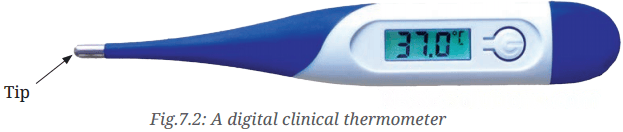
Explain digital clinical thermometer with a diagram?
Answer:
Clinical thermometer is used for measuring our body temperature. Such thermometers show temperatures digitally. These are also known as digital clinical thermometers and run on batteries. These measure temperature when the thermometer is placed in contact with a person’s body.
Question 5.
Explain the structure of laboratory thermometer by drawing a diagram.
Answer:
Laboratory thermometers consists of a long, narrow, uniform glass tube which is sealed. At one end of the tube is a bulb which contains a liquid. Outside the bulb, in the tube, a narrow column of liquid can be seen. There is a Celsius scale marked along the tube. The liquid column rises or falls with change in temperature. The mark of the Celsius scale with which the top level of the liquid column coincides is the temperature reading. The liquid used in the laboratory thermometer is generally alcohol (coloured red to make it easily seen) or mercury.

Question 6.
Explain the method of using digital clinical thermometer.
Answer:
Using digital clinical thennometer. we can measure our body temperature as follows—
- Wash your hands and the tip of the digital thermometer with soap and water.
- Reset the thermometer by pressing the reset button.
- Place the thermometer under the tongue and close your mouth.
- Wait till the thermometer makes a beeping sound or flashes a light.
- Take it out from the mouth and read the temperature on the digital display.
- Clean the tip of the thennometer with soap and water, and dry it.
Question 7.
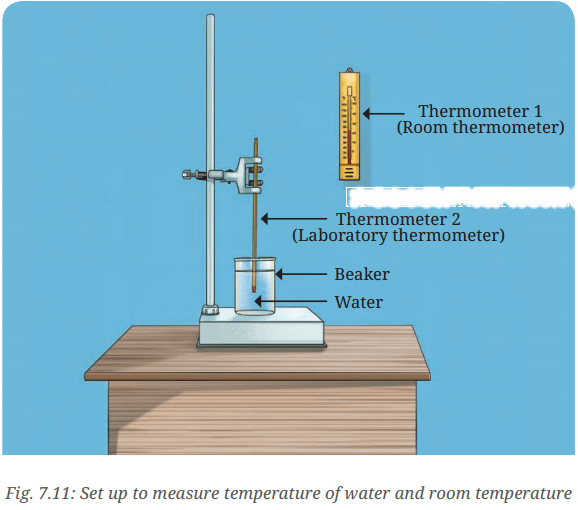
Show the equipment arranged for measuring the room temperature and water by diagram.
Answer:
Question 8.
Compare clinical thermometer and laboratory thermometer?
Answer:
Clinical thermometer and laboratory thermometer have the following similarities.
- Both thermometers are made of a long glass tube with a closed mouth.
- There is a narrow column in the middle of both the thermometers and there is a bulb at one end of the tube which is filled with mercury.
- Celsius scale is marked on both.
There are the following differences between clinical thermometer and laboratory thermometer—
- The temperature measuring range of clinical thermometer is from 35°C to 42°C whereas the temperature range of laboratory thermometer is from-10 °C to 110 °C.
- Clinical thermometer is used to measure body temperature whereas laboratory thermometer is used to measure the temperature of various objects and liquids.
Essay Type Questions
Question 1.
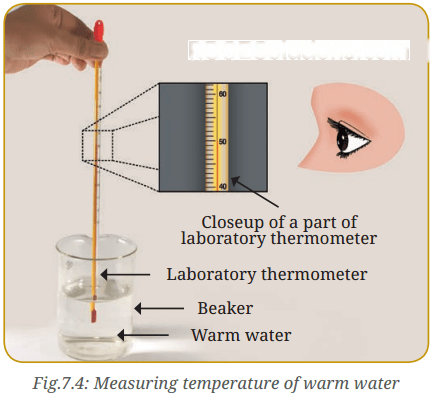
Describe the correct method of measuring temperature with laboratory thermometer with illustration?
Answer:
The following points should be kept in mind measuring temperature with laboratory thermometer—
- When the thermometer is immersed in water, its bulb should not touch the bottom or the sides of the beaker.
- The thermometer should be held vertically. It should not be tilted.
- The temperature must be read while the thennometer is immersed in water.
- While reading the thermometer, the eye should be directly in line with the level of the liquid column to be read.
Question 2.
What are thermometers? Explain the different commonly used thermometers.
Answer:
Thermometer— The device which measures temperature is called thermometer. Many themiometers are used for various purposes, some of the important thermometers are—
(1) Doctor’s thermometer— also known as fever meter. It is a mercury thermometer which is used to measure body temperature.
(2) Digital thermometer— These thermometers show temperature in digital form. These are battery operated. In these, temperature is detennined by heat sensors.
(3) Infrared thermometer— These are also called contactless thermometers. These thermometers can measure the body temperature of a person without touching his body and reduce the risk of infection.
(4) Laboratory thermometer— These are of many types which are used in laboratories to measure the temperature of various objects and substances.
(5) Room thermometers— These themiometers give an approximate idea of the room temperature.
RBSE Class 6 Science Chapter 7 Notes
Class 6 Science Chapter 7 Notes RBSE – Temperature and its Measurement Class 6 Notes
- The temperature of a body tells us how hot or cold it is.
- The instrument which measures temperature is called a thermometer.
- Generally two types of thermometers are used to measure temperature – clinical thermometer and laboratory thermometer.
- A clinical thermometer is used for measuring body temperature.
- Normal temperature of a healthy human adult is taken to be 37.0 °C or 98.6 °F.
- Laboratory thermometers typically have a temperature range from -10 °C to 110 °C.
- The three most-used scales of temperature are: (a) the Celsius scale, (b) the Fahrenheit scale, and (c) the Kelvin scale. The units of temperature in these scales are (a) degree Celsius, denoted by °C, (b) degree Fahrenheit, denoted by °F, and (c) kelvin, denoted by K.
- Room thermometer—These give an approximate idea of the room temperature.
- Air temperature is an important weather parameter and is monitored at weather stations all over the world.