RBSE Class 6 Science Chapter 8 Question Answer A Journe Through States of Water
By tackling theseRBSE Class 6 Science Solutionsand RBSE Class 6 Science Chapter 8 A Journe Through States of Water Question Answer in English Medium, students will build a solid foundation in the topic.
A Journe Through States of Water Class 6 Questions and Answers
RBSE Class 6 Science Chapter 8 A Journe Through States of Water Question Answer
RBSE Class 6th Science Chapter 8 Question Answer – Exercise
Let us enhance our learning
Question 1.
Which of the following best describes condensation?
(i) The conversion of water into its vapour state.
(ii) The process of water changing from a liquid into gaseous state.
(iii) The formation of clouds from tiny water droplets.
(iv) The conversion of water vapour into its liquid state.
Answer:
(iv) The conversion of water vapour into its liquid state.
Question 2.
Identify in which of the given processes, evaporation is very important—
(i) Colouring with
(a) crayons (b) water colours (c) acrylic colours (d) pencil colours
(ii) Writing on paper with
(a) pencil (b) ink pen (c) ball point pen
Answer:
(i) (b), (ii) (b)
Question 3.
We see green coloured plastic grass at many places these days. Space around natural grass feels cooler than space around the plastic grass. Can you find out why?
Answer:
Water from the natural grass keeps evaporating in the form of water vapour, so the area around the natural grass feels cooler than the area around the plastic grass.
Question 4.
Give examples of liquids other than water, which evaporate?
Answer:
Wax, oil, ghee.
Question 5.
Fans move air around, creating a cooling sensation. It might seem strange to use a fan to dry wet clothes since fans usually make things cooler, not warmer. Normally, when water evaporates, it requires heat, not cold air. What do you think about this?
Answer:
The fan increases the speed of the wind, which causes water to evaporate faster because strong winds move water vapour away from the hot spot where the evaporation process is taking place. This reduces the heat of that spot and water starts evaporating faster.
Question 6.
Usually, when sludge is removed from drains, it is left in heaps next to the drain for 3-4 days.
Afterward, it is transported to a garden or a field where it can be used as manure. This approach reduces transportation cost of the sludge and enhances the safety of individuals handling it. Reflect upon it and explain how?
Answer:
The mud is removed from the drains and is left in a heap beside the drain for three to four days so that due to evaporation, the water from the mud evaporates and the garbage shrinks. This reduces the weight and volume of the garbage and also makes its transportation easy. Due to this, the garbage can be easily used as manure. Along with this, due to the sludge being removed, various germs present in it also get destroyed, which increases the safety of the workers working on it.
Question 7.
Observe the activities in your house for a day. Identify the activities that involve evaporation. How does understanding the process of evaporation help us in our daily activities?
Answer:
The activities taking place in the house which involve evaporation are—
- Drying of clothes
- Cooling of water in an earthen pot.
- Drying of mopped floor, drying of water poured in coloured pots etc. Understanding the process of evaporation helps us to slow down or speed up the process of evaporation in our daily activities.
Question 8.
How is water present in the solid state in nature?
Answer:
Water is found in solid state in nature in the form of hail and snow.
Question 9.
Reflect on the statement “Water is our responsibility before it is our right.” Share your thoughts.
Answer:
Water is our responsibility before our right because only a small portion of water available on the Earth is fit for use by plants, animals and humans. Most of the water is in the oceans and it cannot be used directly. We use water for drinking and also for many other activities. The number of people using water is increasing with a rise in population. The increasing demand for water causes its shortage in many parts of the world. Hence, it is very important to use water wisely and avoid wasting it.
Question 10.
The seat of a two-wheeler parked on a sunny day has become very hot. How can you cool it down?
Answer:
You can cool the hot seat of a two-wheeler parked in the sun by sprinkling water on it. Due to this w ater will evaporate and due to the cooling effect the seat will become cold.
RBSE Class 6 Science Chapter 8 Important Questions
Multiple Choice Questions
1. In how many states is water generally found?
(a) 1
(b) 2
(c) 3
(d) 4
Answer:
(c) 3
2. What is the gaseous state of water?
(a) Ice
(b) Water vapour
(c) Hail
(d) Raindrops
Answer:
(b) Water vapour
3. As soon as you mb hand sanitizer on your hand, it disappears. The reason for this is—
(a) Evaporation
(b) Condensation
(c) Freezing
(d) All of the above
Answer:
(a) Evaporation
4. What is the process of transformation of water vapour into liquid state called?
(a) Freezing
(b) Evaporation
(c) Melting
(d) Condensation
Answer:
(d) Condensation
5. Humidity in air is caused by which state of water?
(a) Solid
(b) Liquid
(c) Gas
(d) All of the above
Answer:
(c) Gas
6. Which of the following substances exhibits all three states of matter—
(a) Wax
(b) Oil
(c) Ghee
(d) All of the above
Answer:
(d) All of the above
7. The process of conversion of liquid into solid is called—
(a) Condensation
(b) Freezing
(c) Evaporation
(d) Melting
Answer:
(b) Freezing
8. When water is kept in freezer, it changes into which state—
(a) Solid
(b) Liquid
(c) Gas
(d) Water vapour
Answer:
(a) Solid
9. Which of the following conditions affects the process of evaporation?
(a) Area of contact
(b) Humidity
(c) Wind speed
(d) All of the above
Answer:
(d) All of the above
10. Due to which process dew drops are formed on plants?
(a) Melting
(b) Freezing
(c) Condensation
(d) Evaporation
Answer:
(c) Condensation
Fill in the blanks
1. The amount of water vapour in the air is known as …………………….. .
Answer:
humidity
2. On heating, the ice melts and gets converted into its …………………….. state.
Answer:
liquid
3. The process of conversion of a solid into liquid state is called …………………….. .
Answer:
melting
4. Evaporation imparts …………………….. effect.
Answer:
cooling
5. Water changes its state on …………………….. and …………………….. .
Answer:
heating, cooling
6. The circulation of water between the Earth surface and atmosphere is known as
Answer:
water cycle
True/False
1. The process of conversion of water into vapour state is called condensation. (True/False)
Answer:
False
2. Ice and water are the two forms of a same substance. (True/False)
Answer:
True
3. As the speed of wind increases, water evaporates rapidly. (True/False)
Answer:
True
4. In summers, surahi is used to keep the water cool. (True/False)
Answer:
True
Match the words given in Column-I with Column-II
Question 1.
Column-I | Column-II |
1. Freezing | (a) Conversion of solid into liquid |
2. Evaporation | (b) Conversion of liquid into solid |
3. Melting | (c) Conversion of water vapours into drops. |
4. Condensation | (d) Conversion of water into vapour |
Answer:
Column-I | Column-II |
1. Freezing | (b) Conversion of liquid into solid |
2. Evaporation | (d) Conversion of water into vapour |
3. Melting | (a) Conversion of solid into liquid |
4. Condensation | (c) Conversion of water vapours into drops. |
Question 2.
Column-I | Column-II |
1. Ice | (a) Gas |
2. Oil | (b) Cooling |
3. Water vapour | (c) Liquid |
4. Evaporation | (d) Solid |
Answer:
Column-I | Column-II |
1. Ice | (d) Solid |
2. Oil | (c) Liquid |
3. Water vapour | (a) Gas |
4. Evaporation | (b) Cooling |
Very Short Answer Type Questions
Question 1.
What is water vapour?
Answer:
The gaseous state of water is called water vapour.
Question 2.
When we sprinkle water on a hot pan, why does it disappear?
Answer:
The water that is sprinkled on a hot pan turns into steam. Steam is actually water vapour, some part of which turns into water droplets.
Question 3.
What is the difference between water vapour and steam?
Answer:
Water vapour is invisible but the presence of small droplets in the steam makes it visible.
Question 4.
Why do we see more dew drops plants in the morning?
Answer:
When water vapour present in the air comes in contact with a cold surface, water droplets are formed. It is cold in the morning, that is why more dew drops are seen on plants in the morning.
Question 5.
What is condensation?
Answer:
The process of change of water vapour into its liquid state is called condensation.
Question 6.
What is ‘humidity’?
Answer:
The amount of water vapour in the air is called humidity.
Question 7.
Why do water droplets appear on the outer surface of a glass when cold water is poured in it?
Answer:
Water is present in the air as vapour. When water vapour from the air comes in contact with the cold surface of the glass, it turns into water droplets on the glass due to condensation.
Question 8.
You can feel the smell of cooking food even without entering the kitchen. How does this smell reach us?
Answer:
It is because the aroma of delicious cooking food spreads through the air and reaches our nose even if we are not in the kitchen.
Question 9.
What is ‘melting’?
Answer:
The process of conversion of solid into liquid state is called melting.
Question 10.
What is meant by freezing?
Answer:
The process of conversion of liquid into solid state is called freezing.
Question 11.
Why do clothes dry quickly on a windy day?
Answer:
Clothes dry quickly on a windy day because water evaporates rapidly due to increased wind speed.
Question 12.
Why are there more humidity on rainy days?
Answer:
The amount of water vapour in the air is high on rainy days, so there are more humidity on rainy days.
Question 13.
Why does water remain cool in an earthen pot?
Answer:
Water seeps out from the surface of an earthen pot and evaporates, which has a cooling effect on the water and the water becomes cool.
Question 14.
Why do we feel cool by sitting under a fan in summer?
Answer:
The fan evaporates sweat and helps us feel cool.
Question 15.
Why does air containing water vapour go up in the atmosphere?
Answer:
Water vapour is lighter than air, due to which it rises up.
Question 16.
What is ‘water cycle’?
Answer:
The circulation of water between the earth’s surface and the atmosphere is called water cycle.
Short Answer Type Questions
Question 1.
Are ice and water the same substance? Explain.
Answer:
Yes, ice and water are the two forms of the same substance. These forms are also called states. These different states of water show many differences in their behaviour. Water flows but ice does not. Water splashes but ice does not.
Question 2.
What is evaporation? Give examples.
Answer:
The process of conversion of water into its vapour state is called evaporation. Example— Drying of wet clothes, mopped floor, and sweat on our body are some examples of it.
Question 3.
What are the different states of water?
Answer:
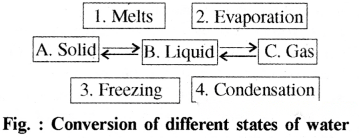
Water is a substance that can be observed in three different states in our daily life. In the solid state, it exists as ice. On heating, the ice melts and gets converted into its liquid state. On further heating, water gets converted into its gaseous state.
Question 4.
How can you change the state of water?
Answer:
If we have to change ice into water, and water into water vapour, we have to supply heat to it. If we have to change water to ice, we can do this by keeping water in a cold environment like a freezer. Water freezes and turns into ice. Ice melts when taken out and turns into water.
Question 5.
What are ‘Atmospheric Water Generator (AWG)’?
Answer:
Atmospheric Water Generator (AWG) machines collect water from humid air to produce drinkable water. This is done through condensation of water vapour by cooling the air. This process is similar to the formation of drops of water outside the glass tumbler filled with ice cold water.
Question 6.
Give any two examples other than water which change from solid to liquid and from liquid to solid?
Answer:
1. Candle— Candle, which is made of wax, is an example of this. When we light a candle, the solid wax turns into liquid state. On cooling the liquid wax, it turns into solid state.
2. Coconut Oil— Coconut oil remains in liquid state in summers but in winters it turns into solid state.
Question 7.
Show the transformation of various states of water with the help of diagram.
Answer:
Long Answer Type Questions
Question 1.
What are the conditions that affect the evaporation of water?
Answer:
The following conditions affect the process of evaporation of water :
1. Area of contact—When water comes in more contact with air, i.e., when the water is spread, its evaporation is faster.
2. Sunlight—Water evaporates faster in sunlight than in a shaded place.
3. Wind speed—Water evaporates faster when the wind speed increases.
4. Humidity—Water evaporates slowly on a rainy day. If the amount of water in the air is already high (more water), than the water evaporates slowly.
Question 2.
How does condensation play an important role in the process of bringing water back to the surface of the earth? Explain.
OR
How do clouds give us rain? Explain.
Answer:
When air moves higher above the Earth’s surface, it becomes cooler and cooler. At certain heights, the air gets so cool that the water vapour in it turns into droplets which are generally formed around dust particles. These small droplets float in the air and form clouds. Many droplets join together to form bigger drops of water. Some drops get so heavy that they start falling. These falling water drops are what we call ram. Under special conditions, it might also fall as hail or snow.
Question 3.
What is cooling effect? Give two examples.
Answer:
When water evaporates from a surface, that surface becomes a- little cooler than the outside environment. This effect is called cooling effect. Cooling effect in daily life car, be understood from the following examples—
(i) Water remains cool in earthen pot because water seeps through the surface of the earthen pot and evaporates, which imparts a cooling effect on the water.
(ii) Sprinkling water on the floor and ceiling to cool them in summer is another example of this.
Essay Type Questions
Question 1.
What are the differences in the properties of water in solid, liquid and gaseous states? Explain.
Answer:
The properties of water in its different states are—
1. Solid State (ice)— Ice or solid state retains its shape irrespective of the container in which it is placed while water takes the shape of the container. Ice does not flow or spread.
2. Liquid State (water)— Water or liquid state flows and changes its shape. Water does not have a fixed shape. It takes up the shape of the container in which it is kept, but the volume of water remains constant.
3. Gaseous State (water vapour)— Water vapour or gaseous state exhibits a property of spreading out in the entire available space. Gases do not possess a fixed shape. Water vapour exists even at room temperature; though it is invisible to us. It is present in the air around us.
Question 2.
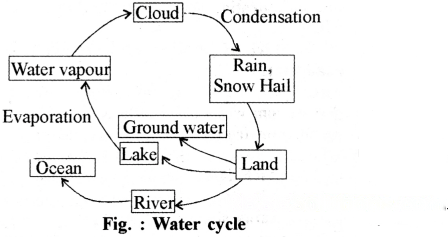
Explain the water cycle with the help of a diagram.
Answer:
The water from the ocean and the Earth’s surface evaporates into the atmosphere as vapour and returns as rain, hail or snow, ultimately flowing back to the oceans. This circulation of water is known as the water cycle.
Question 3.
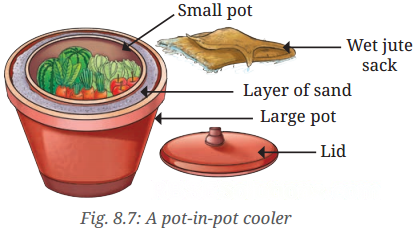
Describe the process of making a ‘pot in pot’ cooler with a diagram.
Answer:
Pot in pot cooler can be made using pots in the following ways :
- Take two earthen pots of different sizes.
- Fill the bottom of the larger pot with a layer of sand.
- Place the smaller pot into the centre of the larger one.
- Fill the gap between the pots with more sand.
- Pour water in the sand area.
- Place a lid or wet jute sack to cover the top of the smaller pot.
- In this way pot in pot cooler is ready.
- Add water regularly to keep the sand moist.
Question 4.
Explain the various processes that take place during the transformation of water into its liquid state.
Answer:
The following processes take place during the transformation of water into its liquid state-
1. Evaporation— The process of conversion of water into its vapour state is called evaporation. The process of evaporation takes place continuously, even at room temperature. The process of evaporation produces a cooling effect.
2. Condensation— When water vapour present in the air comes in contact with a cold surface, water droplets are formed. The process of transformation of water vapour into its liquid state is called condensation. The process of condensation plays an important role in the formation of clouds and rainfall.
3. Melting— The process of conversion of a solid into liquid state is called melting. For example, conversion of ice into water.
4. Freezing— The process of conversion of liquid into solid state is called freezing. For example, conversion of water into ice.
RBSE Class 6 Science Chapter 8 Notes
Class 6 Science Chapter 8 Notes RBSE – A Journey through States of Water Class 6 Notes
- The gaseous state of water is called water vapour.
- The process of conversion of water into its vapour state is called evaporation.
- The process of conversion of water vapour into its liquid state is called condensation.
- Water is found in different states—solid. liquid and gas.
- The amount of water vapour in the air is also called humidity.
- Evaporation causes cooling effect.
- The process of conversion ora solid into liquid state is called melting. The process of conversion of liquid into solid state is called freezing.
- Water changes its state on heating or cooling.
- Conditions which make the evaporation faster or are exposed area, humidity, air movement, etc.
- The water vapour in the air condenses to form tiny droplets of water. which appear as clouds. Many tiny water droplets come together and fall down as rain, hail or snow.
- The circulation of water bemcen the Earth surface and atmosphere is known as the water cycle.