RBSE Class 6 Social Science Chapter 2 Question Answer Oceans and Continents
Start practicing theRBSE Solutions Class 6 Social Scienceand Class 6 SST Chapter 2 Oceans and Continents Question Answer to consolidate your knowledge effectively.
Oceans and Continents Class 6 Questions and Answers
Oceans and Continents Class 6 Question Answer (InText)
Page 27
Question 1.
What are oceans and continents? What are their names and their distribution?
Answer:
Oceans : The largest water bodies on the Earth’s surface is called oceans. There are five major oceans :
(i) The Pacific Ocean (ii) The Atlantic Ocean (iii) The Indian Ocean (iv) The Arctic Ocean (v) The Southern or Antarctica Ocean. These are interconnected.
Continents : A large continuous expanse of land is called continent. They can be counted in several ways but practically there are seven continents. These are as follows : (i) Africa (ii) Antarctica v.ii) Australia (iv) Asia (v) Europe (vi) North America (vii) South America.
Distribution : Oceans and continents are not equally distributed in the Northern and Southern hemisphere. The northern hemisphere has more land than the southern hemisphere, lhe southern hemisphere has more water.
Question 2.
In what ways do oceans and continents impact life on Earth, including human life?
Answer:
Oceans and continents are vital part. of the environment and affect most aspects of our lives. Oceans support all kinds of marine life and play a critical role in the world. We read their impact in human history also.
Page 29
Question 1.
What are the circular lines in each map called? And do you know what the lines radiating out of the two poles are called?
Answer:
The circular lines in every map are called Latitudes. The lines radiating out of the two poles are Longitudes and Latitudes.
Question 2.
Which hemisphere holds more water?
Answer:
The Southern Hemisphere
Question 3.
What do you think could be the approximate proportion of water to land in the Northern Hemisphere? And in the Southern Hemisphere? Discuss in groups.
Answer:
According to us the Northern hemisphere has equal land and water but the Southern hemisphere has more water and it is eleven times as compared to land.
Question 4.
Are all the oceans connected with one another or are there separations between them?
Answer:
All the oceans are interconnected. They are not really separate the lines that divides them on the map are no more than conventions.
Page 31
Question 1.
If there is such abundance of water on the planet, why is there so much talk of ‘water scarcity’ as a ‘water crisis’?
Answer:
Water is available in abundance on the surface of earth but this water is in oceans. Oceans have salty water which is not suitable for consumption of most land animals including humans. On the other hand fresh water make up a very small proportion of the planets water resources. It is found in rivers, glaciers, lakes, in the atmosphere and also underground.
Here, water scarcity means that very little water is available for human consumption.
Question 2.
What ways of saving water are you aware of? Which ones have you seen practiced at home, at your school and in your village, town or city?
Answer:
We are aware with various ways of water conservation such as :
- Water conservation dams and reservoirs etc.
- Water harvesting through Tanka, Khadin and Johad.
- Rooftop rain water harvesting and other water harvesting techniques.At our home and school rooftop rain water harvesting is practised to save water.
Page 32
Question 1.
Locate the five oceans and, in the table below, mark the hemisphere or hemispheres they belong to.
Answer:
NorthernHemisphere | SouthernHemisphere | |
Pacific Ocean | ✓ | ✓ |
Atlantic Ocean | ✓ | ✓ |
Indian Ocean | ✓ | |
Southern Ocean | ✓ | |
Arctic Ocean | ✓ |
Page 36
Question 1.
Counting the numbers of squares, name the largest continent and the smallest (See diagram on Page 36 in the textbook.)
Answer:
In the given figure the number of squares of continents is as follows :
Name of Continents | Number of Squares |
North America | 17 |
South America | 18 |
Europe | 10 |
Asia | 44 |
Africa | 30 |
Australia | 8 |
Antarctica | 13 |
Largest continent is Asia and the smallest is Australia.
Question 2.
Which one is larger : North America or South America? Africa or North America? Antarctica or Australia?
Answer:
- In North America and South America — South America is larger.
- Africa and North America — Africa is larger.
- In Antarctica and Australia — Antarctica is larger.
Question 3.
Re-colour the diagram by having a single colour for Europe and Asia and rename the result as ‘Eurasia’. Compare its size with South America’s.
Answer:
When we compare Eurasia with South America then we find that Eurasia is three times larger than South America.
Question 4.
Write down the list of continents from the smallest to the largest.
Answer:
(1) Australia (2) Europe (3) Antarctica (4) North America (5) South America (6) Africa (7) Asia.
Class 6 SST Oceans and Continents Question Answer (Exercise)
Question 1.
Explain the following terms :
(a) Continent
(b) Ocean
(c) Island
Answer:
(a) Continent : A large continuous expanse of land is called continent. There are seven continents in the world.
(b) Ocean : Oceans are the significant part of hydrosphere. There are five major oceans.
(c) Island : The continents do not include all landmass. Some smaller pieces of land are left out; surrounded by water on all sides, they are called islands. There are lakhs of islands on the planet of very different sizes.
Question 2.
Let us draw—Without looking at the maps in this chapter, draw the continents free hand on a sheet of paper and colour them. Then compare your drawing with the map of oceans and continents in the chapter.
Answer:
Students will do themselves.
Question 3.
Let us do—On the outline map of the world given below, label all the continents and oceans.
Answer:
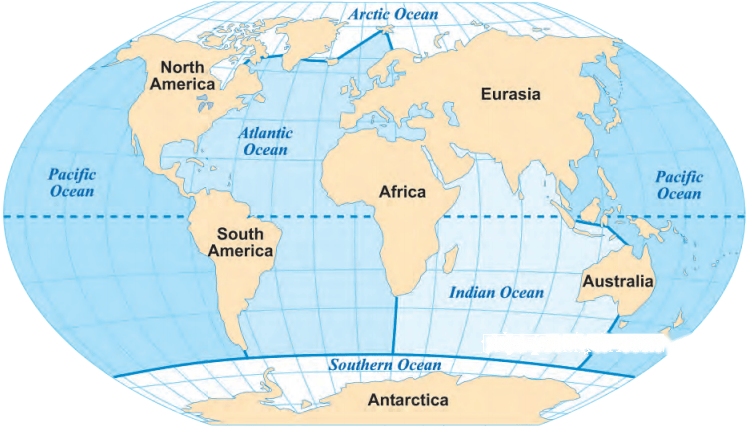
Question 4.
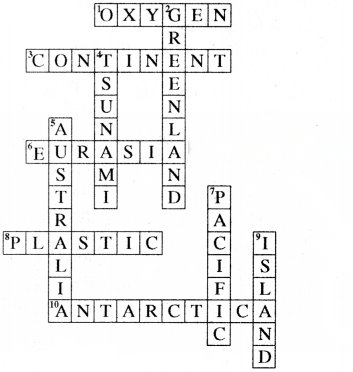
Solve this crossword :
Across :
1. Abundantly produced by the oceans
3. A large expanse of landmass
6. A large continent of which India is a part
8. A major source of pollution of the oceans
10. The coldest continent
Down :
2. Tire largest island on Earth
4. A huge destructive wave from the ocean
5. Ihe smallest continent
7. Ihe largest body of water on the Earth
9. A landmass (but not a continent) surrounded by the sea or ocean
Answer:
Oceans and Continents Class 6 Extra Questions and Answers Social Science Chapter 1
Multiple Choice Questions
1. The large continuous landmass of earth surface is called …………………… .
(a) mountain
(b) island
(c) continent
(d) plains
Answer:
(c) continent
2. Almost …………………… of the Earth surface is covered with water.
(a) one-fourth
(b) half
(c) two-fourths
(d) three-fourths
Answer:
(d) three-fourths
3. The largest water bodies on the Earth surface is called as …………………… .
(a) pond
(b) dam
(c) lake
(d) ocean
Answer:
(d) ocean
4. Which is the smallest continent in the world?
(a) Australia
(b) Asia
(c) Europe
(d) Antarctica
Answer:
(a) Australia
5. Which of the following is the largest ocean in the world?
(a) Atlantic Ocean
(b) Pacific Ocean
(c) Indian Ocean
(d) Southern Ocean
Answer:
(b) Pacific Ocean
6. Which of the following is the smallest ocean in the world?
(a) Pacific Ocean
(b) Indian Ocean
(c) Arctic Ocean
(d) Atlantic Ocean
Answer:
(c) Arctic Ocean
7. The northern extent of the Pacific Ocean is bounded by …………………… .
(a) Asia
(b) Africa
(c) Australia
(d) Antarctic Ocean
Answer:
(a) Asia
8. …………………… are/is the largest island in the world.
(a) The Andaman Islands
(b) The Nicobar Islands
(c) The Lakshadweep Islands
(d) Greenland
Answer:
(d) Greenland
9. Which of the following is the most appropriate option for the lungs of planet?
(a) Ocean’s flora
(b) Land’s flora
(c) Forests
(d) Fields and Plains
Answer:
(a) Ocean’s flora
10. Which continent has very cold and harsh climate?
(a) Asia
(b) Europe
(c) North America
(d) Antarctica
Answer:
(d) Antarctica
Fill in the blanks
1. The …………………… together hold most of the water available on the planet.
Answer:
oceans
2. The marine …………………… includes tiny plants called Algae and all kinds of sea weeds.
Answer:
flora
3. In India the monsoon …………………… originate in the ocean.
Answer:
rains
4. India has its own …………………… Disaster Management Authority to deal with all kinds of disasters.
Answer:
National
5. The United Nations has designated June 8 as world …………………… day.
Answer:
ocean
6. Climate of the …………………… is influenced by oceans and continents.
Answer:
Earth.
State whether True or False
1. All the continents of the world are interconnected.
Answer:
False
2. All the oceans of the world are inter-connected.
Answer:
True
3. The Northern hemisphere has more land than the Southern hemisphere.
Answer:
True
4. The large landmass on the Earth surface is known as island.
Answer:
False
5. The Northern hemisphere has more water than Southern hemisphere.
Answer:
False
6. More than half of the world’s half oxygen is produced by the ocean’s flora.
Answer:
True
Match the following
Question 1.
I | II |
1. The largest water bodies of the Earth | (a) Continent |
2. Aquatic animal | (b) Ocean |
3. Fresh water | (c) Dolphin |
4. Large landmass of the Earth | (d) Dakshin Gangotri |
5. First scientific base station in Antarctica | (e) Rivers |
Answer:
I | II |
1. The largest water bodies of the Earth | (b) Ocean |
2. Aquatic animal | (c) Dolphin |
3. Fresh water | (e) Rivers |
4. Large landmass of the Earth | (a) Continent |
5. First scientific base station in Antarctica | (d) Dakshin Gangotri |
Question 2.
I | II |
1. The largest continent | (a) Greenland |
2. The largest ocean | (b) Eurasia |
3. The smallest continent | (c) Pacific Ocean |
4. The smallest ocean | (d) Australia |
5. The largest island | (e) Arctic Ocean |
Answer:
I | II |
1. The largest continent | (b) Eurasia |
2. The largest ocean | (c) Pacific Ocean |
3. The smallest continent | (d) Australia |
4. The smallest ocean | (e) Arctic Ocean |
5. The largest island | (a) Greenland |
Very Short Answer Type Questions
Question 1.
What is the landmass?
Answer:
A large body of land is called a landmass.
Question 2.
What is the motto on the emblem of the Indian Navy?
Answer:
The motto is Sam noh Varunah.
Question 3.
What colour did early astronauts use to describe Earth?
Answer:
Blue Colour
Question 4.
How much of the Earth is covered with water?
Answer:
Almost three-fourths of the earth’s surface.
Question 5.
Are Oceans and Continents distributed equally between the Northern and Southern hemispheres?
Answer:
No, it is not equally distributed.
Question 6.
What is the nature of Ocean water?
Answer:
The Ocean water is salty in nature.
Question 7.
Where can freshwater suitable for drinking be found on Earth?
Answer:
It is found in glaciers, rivers, lakes in the atmosphere and also underground.
Question 8.
Which ocean is the largest and covers the most surface area of the Earth?
Answer:
The Pacific Ocean
Question 9.
Which continent is largest in terms of area?
Answer:
Asia or Eurasia
Question 10.
Which is the second largest continent in the world?
Answer:
Africa
Question 11.
Which two parts of the Indian Ocean are visible on both sides of India?
Answer:
- The Arabian Sea to the west
- The Bay of Bengal to the east
Question 12.
Where are the Andaman and Nicobar Islands located?
Answer:
In the Bay of Bengal
Question 13.
Which island group is in the Arabian Sea?
Answer:
Lakshadweep islands in the Arabian Sea
Question 14.
Where does the rainfall occurring every summer in India originate from?
Answer:
It originates from the oceans.
Question 15.
Define island.
Answer:
Some smaller pieces of land are left out; surrounded by water on all sides they are called islands.
Question 16.
What is called the lungs of the planet?
Answer:
The Ocean’s flora is called the Planet’s lungs.
Question 17.
Write any one major factor responsible for ocean pollution.
Answer:
Growing human activities are responsible for ocean pollution such as throwing million tonnes of plastic waste into the oceans everywhere.
Short Answer Type Questions
Question 1.
Why is the Earth referred to as the ‘Blue Planet’?
Answer:
Almost three-fourths of the Earth’s surface is covered with water. It appears blue when seen from outer space. That is why, early astronauts lovingly called the Earth the ‘blue planet’.
Question 2.
‘Sam noh Varunah’ where is the given phrase written? Write meaning also.
Answer:
The emblem of the Indian Navy contains the motto ‘Sam noh Varunah’ which means, “Be auspicious to us, O Varuna.”
This is an invocation to Varuna, a Vedic deity associated with the oceans, the sky and water in general.
Question 3.
Where can saltwater and freshwater be found on Earth?
Answer:
Most of the water on the earth is found in the oceans. But this sea water is salty and unfit for consumption by most land animals, including humans.
On the other hand fresh water can be found in glaciers, rivers, lakes in the atmosphere and also underground.
Question 4.
Mention the main species of plants and animals found in the oceans.
Answer:
Many plant and animal species can be found across multiple oceans. The marine flora includes tiny plants called algae and all kinds of sea weeds. The marine fauna consists of thousands of species of colourful fish, dolphin, whales and countless deep sea creatures.
Question 5.
Explain the extent of the Indian Ocean. Which parts of it are visible from both sides of India?
Answer:
The main limits of the Indian Ocean are Asia to the north, Africa to the west and Australia to the east; apart from the Southern Ocean in the south.
On the either side of India, we finds two parts of the Indian Ocean—the Arabian Sea to the west and the Bay of Bengal to the east.
Question 6.
What natural disasters are caused by oceans?
Answer:
The oceans give rise to storms— violent events with extreme rainfall or very strong winds such as cyclones. They can cause widespread damage to coastal regions of the world.
A tsunami is another natural disaster that originates in the ocean.
Question 7.
Why are Europe and Asia considered as two continents while geologists regard them as a single continent called ‘Eurasia’?
Answer:
Europe and Asia form single landmass and it becomes clear in the map. Hence, geologists often regard them as a single continent called ‘Eurasia’. For historical and cultural reasons, Europe’s evolution has been very different from Asia’s, which is why they can be seen as two continents.
Long Answer Type Questions
Question 1.
Highlight major features of the Atlantic Ocean.
Answer:
The major features of the Atlantic Ocean are :
- It is the second largest ocean.
- It is a ‘S’ shaped ocean.
- It is surrounded by North and South America in the west and Europe and Africa in the east.
- It is the busiest ocean from the point of trade and commerce.
- It has a long and indented coastline that provides good sites for sheltered harbour and seaports.
Question 2.
Mention major features of the Indian Ocean.
Answer:
The major features of the Indian Ocean are :
- It is the only ocean in the world named after a country, India.
- It is almost triangular in shape.
- It is the third largest ocean in the world.
- Africa lies in its western side, Australia lies in the eastern side. Its northern limit is Asia and the southern extent is Antarctica.
- On either side of India, we find two parts of the Indian Ocean : the Arabian sea to the west and the Bay of Bengal to the east.
Question 3.
What do you understand by the term tsunami? Explain with an example.
Answer:
A tsunami is a natural disaster that originates in the ocean. It is a huge and powerful wave generally caused by a strong earthquake as a volcanic eruption at the bottom of the ocean. Tsunamis can travel thousands of kilometers and submerged coastal areas, causing widespread damage.
For example : On 26 December 2004, India and another 13 countries around the Indian Ocean were struck by a powerful tsunami caused by an earthquake in Indonesia. More than two lakh people lost their lives.
Question 4.
What is the Indian Antarctic Programme? Explain.
Answer:
Since 1981, the Indian Antarctica Programme has been exploring Antarctica, a continent with a very cold climate and harsh environment. In 1983 India established its first scientific base station there called ‘Dakshin Gangotri’ (two more bases were established later). About 40 teams of Indian scientists have conducted research in this faraway region, especially on the evolution of climate and environment. The settlement where the scientists live has a library and even a post office.
Essay Type Questions
Question 1.
In what ways do oceans affect the environment and human lives?
Answer:
1. Oceans and life : Oceans affect most aspect of our lives. Oceans being rainfall and this is part of the earth’s water cycle. Without oceans there would be no rainfall and the earth would be a desert.
2. More than half of world’s oxygen is produced by the ocean’s ‘flora’ which is why they are called ‘the planet’s lungs’. The ocean therefore play a crucial role in regulating the climate and sustaining life on Earth.
3. Oceans have deeply impacted humanity in many ways. From earlier times people have used oceans and seas to migrate to other regions, to trade in all kinds of goods as a source of foods etc.
4. Oceans have nourished the cultures of coastal people all over the world.
Question 2.
Explain the major threats to the marine environment today. Give some conservation measures also.
Answer:
Oceans are major source of food and medicine. The ocean flora is known as the planet’s lungs. Scientific studies have shown how the oceans are polluted by human activity. We throw several million tonnes of plastic waste into the oceans every year choking marine life. There are several other forms of pollution. As a result, the marine environment is under threat.
Overfishing (excessive fishing) is another cause for the decline of marine life.
It is our collective responsibility to protect oceans for the future of the planet and of humanity.
- We should create awareness for it.
- We should not throw waste in the ocean.
Question 3.
How many continents are there on earth? Give their brief description.
Answer:
There are seven continents :
1. Asia : It is the largest continent and located in the eastern hemisphere. Europe and Asia are a single landmass. Geologists regard them as a single continent Eurasia. Europe’s evolution is different from Asia hence both are considered as two continents.
2. Europe : It is located in the western part of Asia. It is the second smallest continent in the world. Arctic circle passes through it. It is surrounded by water on three sides.
3. Africa : It is the second largest continent in the world. The equator passes through this continent. Its large part is located in Northern hemisphere. It is surrounded by oceans and seas on all sides.
4. North America : It is the third largest continent of the world. It is connected with South America with a narrow stretch of land. It is situated in the northern and western hemisphere. It is surrounded by Pacific Ocean, Atlantic Ocean and Arctic Ocean.
5. South America : The maximum part of this continent is located in Southern hemisphere. It has Atlantic Ocean in the ea|t and Pacific Ocean in the west.
6. Australia : It is the smallest continent in the world and lies in the Southern hemisphere. Australia is surrounded by water on all sides.
7. Antarctica : It lies in the Southern hemisphere. It is covered with thick layer of ice. Dakshin Gangotri; research station of India is located here. It has cold climate.
Question 4.
How many oceans are there on earth? Give their brief description.
Answer:
The largest water bodies we see on the globe are called oceans. There are five major oceans. They are not really separate. They are interconnected. Their brief description is :
1. The Pacific Ocean : It is the largest and deepest ocean in the world. It covers almost one-third of the earth. It is circular in shape. Asia and Australia are situated on its western side while North and South America are lying to the eastern side.
2. The Atlantic Ocean : It is the second largest ocean. It is a ‘S’ shaped ocean. It is surrounded by North and South America in the west and Europe and Africa in the east.
3. The Indian Ocean : It is the only ocean in the world which is named after a country, India. This ocean is triangle in shape. In its western side there is Africa, Australia lies in the eastern side. Its northern limit is Asia.
4. The Southern Ocean : It is the fourth largest ocean. It is situated within the Antarctic circle and surrounds the South Pole.
5. The Arctic Ocean : It is the smallest ocean in the world. The Arctic Ocean lies around the North Pole. It is bounded by Northern coast of North America and Eurasia.
Question 5.
Explain the influence of oceans on human lives.
Answer:
Oceans influence human lives in the following ways :
1. Formation of Clouds and Precipitation : Clouds are formed due to oceans and those clouds bring rain to the continent. Without oceans there would be no rainfall and earth would be a desert.
2. Cyclones : Cyclones and storms are the natural disasters originate in the oceans. Cyclones cause damaged to coastal regions of the world.
3. Tsunami : Tsunami is a natural disaster that originates in the ocean. It is a huge and powerful wave caused by a strong earthquake or a volcanic eruption. It can travel thousands of km and submerged coastal areas causing widespread damage. Many countries collaborate in early morning system. This helps to take measures to protect lives and property.
4. Lungs of the Planet : More than half of the world’s oxygen is produced by the ocean flora. Oceans play a crucial role in regulating the climate and sustaining life on the earth.
5. Role in Trade, Military campaigning and Fishing : From early times people have used oceans and seas to migrate to other region, to trade in all kinds of goods, to conduct military campaign, and as a source of food through fishing.
6. Nourishment of Culture : Oceans have nourished the culture of coastal people all over the world.
Oceans and Continents Class 6 Notes Social Science Chapter 2
- Almost three-fourths of the earth surface is covered with water.
- One-fourth part of the Earth surface is land. A large body of land is called a ‘landrnass’ and a large continuous expanse of land is called a ‘continent’.
- Oceans and continents both play an important role in determining the climate of Earth.
- Oceans and continents are not distributed equally between the Northern and Southern Hemispheres.
- Sea water is salty and unfit for human consumption.
- Five major oceans are : (i) The Pacific Ocean (ii) The Atlantic Ocean (iii) The Indian Ocean (iv) The Arctic Ocean (v) The Southern OceanThese oceans are not separated from each other. The Northern Hemisphere has more landrnass as compared to Southern Hemisphere.
- The monsoon rain comes from oceans. Similarly, natural disasters such as tsunami, strong earthquakes, volcanic eruptions etc. also originate from oceans.
- Large landmasses are called continents. They can be counted in several ways but the seven major continents are : (i) North America (ii) South America (iii) Europe (iv) Asia (v) Africa (vi) Australia (vii) Antarctica
- The continents do not include all landrnass. Some smaller pieces of lands are left out surrounded by water on all sides, they are called islands. The largest island of the world is Greenland.
- Oceans provide life to all kinds of creatures and affect the climate of the world. More than half of the worlds oxygen is produced by oceans flora, they are also known as lungs of planets.
Oceans have deep impacted humanity in many other ways such as to trade in all kinds of goods, to conduct military campaigns, as a source of food through fishing etc. But human activities have adversely affected the oceans. It is our collective responsibility to protect oceans for the future of the planet and of humanity.