RBSE Class 6 Social Science Chapter 9 Question Answer Family and Community
Start practicing theRBSE Solutions Class 6 Social Scienceand Class 6 SST Chapter 9 Family and Community Question Answer to consolidate your knowledge effectively.
Family and Community Class 6 Questions and Answers
Family and Community Class 6 Question Answer (InText)
Page 137
Question 1.
Why is the family unit important?
Answer:
Importance of family :
- All of us live in a family. The family is the fundamental and most ancient unit of any society.
- Relationships among family members are based on love, care, cooperation and interdependence. It means these values are taught to everyone by family only.
- Each member of the family has a role and responsibility towards other members. So, family develops a sense of responsibility among members.
- Through daily practices, children learn to participate in family life. They also learn about traditions, customs, values etc. Hence, family is the carrier of culture.
- The family is also a school where children learn important values such as Ahimsa, Dana, Seva, Tyaga.
- From the above explanation it is clear that family is a fundamental unit of society.
Question 2.
What is a community and what is its role?
Answer:
Community : The group which is formed by the association of members of different families is called a community.
Role of Community :
- Members of a community come together for various reasons like celebrating festivals and organising feasts, weddings and other events. In this way when any member of a community needs help, they come together and help each other without any selfishness.
- For the proper functioning of community, it is necessary that all families and individuals within the community have specific duties to perform. All the members can work for collective interest rather than self-interest.
- Communities are interdependent on each other. For example, Resident Welfare Associations will depend on the trading community for supplies and also on municipal workers to handle waste.
- An individual can be a member of various communities.
Page 138
Question 1.
What types of families do you see in your neighbourhood? List the type with the number of households for each type.
Answer:
We see two types of families in our neighbourhood :
(1) Nuclear family
(2) Joint family
(1) Nuclear family : A nuclear family is limited to a couple and their children and sometimes one parent and children. Some nuclear families have four members including husband-wife and their children.
(2) Joint family : A joint family how several generations living together—grandparents, parents, uncles and aunts, brothers, sisters and cousins. A nuclear family is limited to a couple and their children and sometime one parent and children.
Question 2.
What types are more frequent? Why do you think this is so?
Answer:
Nuclear families are more trequent. We live in Jaipur city. Many people are living here for good job opportunities. These people cannot live with their parents due to non-availability of proper accommodation. Due to lack of income, they are not able to bring other members with them. Hence, they are living in nuclear family.
People of joint families have also disintegrated into nuclear families due to their different professions, different interests and ambitions.
Page 139
Question 1.
Make a list of all the members of your family you can think of, including a few distant relatives. List their terms in your mother tongue or regional language and try to find the equivalent in English.
Answer:
[Do yourself.]
Page 140
Question 1.
Answer these questions and compare your answers with few classmates :
1. Who in your family decides what is to be bought from the market?
Answer:
Mother
2. Who cooks food in your home?
Answer:
Mother
3. Who is the oldest person in your family?
Answer:
Father
4. Who cleans the floor in your home?
Answer:
Maid servant
5. Who washes utensils in your house?
Answer:
Maid servant
6. Who helps you to do your homework?
Answer:
Mother
[Note : Students will compare the answers with their classmates.]
Page 141
Question 1.
Draw a simple tree of Shalini’s family of seven members.
Answer:
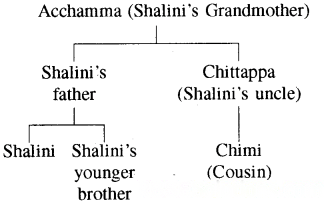
Question 2.
Why do you think Shalini’s parents bought clothes for everyone?
Answer:
Shalini’s uncle has lost his job and having financial difficulties. Shalini’s grandmother told Shalini’s father that his brother cannot buy new clothes for the festival. Hence Shalini’s parents bought new clothes for all the members. In this way they helped each other and shared what they had.
Question 3.
What would you have done if you were in Shalini’s place?
Answer:
If I were at Shalini’s place I would also be happy as everyone could get some new clothes.
Page 142
Question 1.
Why does Tenzing’s father consult his wife for special expenses?
Answer:
Tenzing’s father consults his wife for special expenses so that they can save money for any unexpected needs that may arise in the future.
Question 2.
What do you think about Tenzing’s father’s participation in household chores?
Answer:
Both husband and wife have responsibility to organise household chores. Tenzing’s mother was working in a local handicraft co-operative. She had less time for household chores hence father took the responsibility of that. In my view, Tenzing’s father’s participation in household chores was natural.
Question 3.
What roles do the grandparents fulfill?
Answer:
Tenzing’s grandmother cooks food. She tells interesting stories with humour and wisdom.
Tenzing’s grandfather helps him in his homework and takes him to the school bus stop. He is always actively involved in social work and offering his help to others.
Page 143
Question 1.
In the stories of Shalini and Tenzing, we see examples of joint families. What do you think are the aspects of modern living that make some couple opt for a nuclear family.
Answer:
Due to the rapid process of urbanization in modem life many people from villages and towns comes to city for education, employment etc. Population is also increasing in villages hence pressure on agriculture is also increasing. It has become difficult for all the members of family to depend on it. As a result, they migrate to nearby cities for employment. Many people in villages like carpenter, barber, washerman, potters etc. do not have sufficient work for survival and they are coming to cites for their livelihood. Due to limited living space in cities, people have to adopt nuclear family.
Page 147
Question 1.
Make a list of all people outside your family that are supporting you through their work in one way or another.
Answer:
Students will do themselves.
Page 148
Question 1.
What types of communities are you part of?
Answer:
I am part of various communities such as sports community, drama group, committee of a colony etc.
Question 2.
Is there a club that you are a part of in school? How does it function?
Answer:
Students will do themselves.
Class 6 SST Family and Community Question Answer (Exercise)
Question 1.
What are some of the rules you follow in your family and neighbourhood? Why are they important?
Answer:
Each member of the family has a role and responsibility towards each other. We follow various rules in family such as to live in discipline, to obey our elders, to help our siblings and parents. Family member sacrifice their individual needs to fulfill needs of an entire family. Family members help each other and share what they have.
Families are connected with other families and people around them. They help each other in tough times. People living in family or near us work for collective interest without any profit. In urban areas people form their own rules and regulations. Those could be rules about waste management, cleanliness of common areas, taking care of pets etc.
Question 2.
Do you think some rules are unfair to a few people in the family or community? Why?
Answer:
We feel that some rules are unfair to the blind, disabled, children and disadvantaged people. As these categories need special facilities.
Question 3.
Describe several situations that you have observed where several community support makes a difference. You can draw or write about these.
Answer:
We have seen that community support is beneficial in case of fire, flood and any other disaster. For example, we live in an apartment in a multi storey building. One day around 2 o’clock in the night fire and smoke started to come out from the elevator. We informed about it to our neighbours. Everyone started to climb down the stairs but in one or two houses there were elderly couples. They could not walk quickly without support. In such a situation we helped them. This is a good example of community support.
Family and Community Class 6 Extra Questions and Answers Social Science Chapter 9
Multiple Choice Questions
1. What is the fundamental and the most ancient unit of a society?
(a) Community
(b) Family
(c) Kabila
(d) Village
Answer:
(b) Family
2. On what factors do relationships between family members depend?
(a) Love
(b) Cooperation
(c) Interdependence
(d) All of these
Answer:
(d) All of these
3. How do children learn to cooperate in family?
(a) Through school education
(b) Through moral education
(c) By the instructions of parents
(d) Through daily practice
Answer:
(d) Through daily practice
4. ………………… take care of our basic necessities like food and clothing.
(a) Parents
(b) Children
(c) Neighbours
(d) Teachers
Answer:
(a) Parents
5. On which of the following occassions do members of a community come together?
(a) Celebrating festivals
(b) Organising feasts
(c) At the time of sowing and harvesting
(d) All of the above
Answer:
(d) All of the above
6. Resident welfare association is an example of ………………… .
(a) Tribal communities
(b) Rural communities
(c) Urban communities
(d) Family
Answer:
(c) Urban communities
7. Which among the following can be called community?
(a) A family
(b) A city
(c) A village
(d) A caste
Answer:
(d) A caste
8. An individual can be a part of ………………… communities.
(a) Only one
(b) Two
(c) Three
(d) Several
Answer:
(d) Several
9. Which of the following is a community of people following a particular religion?
(a) Kerala’s scientific community
(b) America’s Indian community
(c) Mumbai’s Parsi community
(d) Village’s farming community
Answer:
(c) Mumbai’s Parsi community
10. What is the community basis of the village’s farming community?
(a) Religion
(b) Specific area
(c) General work
(d) General interest
Answer:
(c) General work
Fill in the blanks
1. Love and dharma are the flower and fruit of ………………… life.
Answer:
family
2. The family is the ………………… and most ………………… unit of any society.
Answer:
fundamental, ancient
3. A ………………… family is limited to a couple and their children.
Answer:
nuclear
4. Relationships among family members are based on love, care, cooperation and ………………… .
Answer:
interdependence
5. The family is also a ………………… where children learn values such as ahimsa, dana, seva and tyaga.
Answer:
school
6. Many families are connected together and it is known as ………………… .
Answer:
Community
State whether True or False
1. The Resident welfare committee is a community.
Answer:
True
2. In complex societies, an individual does not depend on anyone and communities.
Answer:
False
3. An individual may be‘part of many communities.
Answer:
True
4. In nuclear family, many generations live together.
Answer:
False
5. Individual needs are sacrificed by family members for fulfill family needs.
Answer:
True
Match the following
Question 1.
I | II |
1. Foundation of society | (a) Teacher |
2. Shalini’s mother | (b) Employee in handicraft cooperative |
3. Tenzing’s mother | (c) Shalini’s grandmother |
4. Acchamma | (d) A community |
5. Caste | (e) Family |
Answer:
I | II |
1. Foundation of society | (e) Family |
2. Shalini’s mother | (a) Teacher |
3. Tenzing’s mother | (b) Employee in handicraft cooperative |
4. Acchamma | (c) Shalini’s grandmother |
5. Caste | (d) A community |
Question 2.
I | II |
1. A religious community | (a) America’s Indian community |
2. A regional community | (b) Kerela’s scientific community |
3. Community of general interest | (c) Farming Community of Village |
4. Community of specific work | (d) Urban Community |
5. Resident Welfare Association | (e) Chennai’s Sikh Community |
Answer:
I | II |
1. A religious community | (e) Chennai’s Sikh Community |
2. A regional community | (a) America’s Indian community |
3. Community of general interest | (b) Kerela’s scientific community |
4. Community of specific work | (c) Farming Community of Village |
5. Resident Welfare Association | (d) Urban Community |
Very Short Answer Type Questions
Question 1.
What is the fundamental and most ancient unit of any society?
Answer:
The family
Question 2.
Write two major types of families.
Answer:
- Nuclear family
- Joint family
Question 3.
What is joint family?
Answer:
A joint family has several generations living together such as grandparents, parents uncles, aunts, brothers, sisters and cousins.
Question 4.
Define the term nuclear family.
Answer:
A family which has only a couple and their children is knowp as nuclear family.
Question 5.
Which languages have many terms to describe family relationship?
Answer:
Indian languages.
Question 6.
Mention the factors responsible for relationships among family members.
Answer:
Love, care, cooperation and interdependence.
Question 7.
Which festival was Shalini’s family from Kerala preparing for?
Answer:
The festival of Onam.
Question 8.
On what practices did communities agree on overtime?
Answer:
Overtime communities agreed upon some practices on the use of shared natural wealth and resources such as water, grazing lands and forest produce.
Question 9.
Define the term community.
Answer:
Community is a group of connected families and the people around them.
Question 10.
Name any two types of communities.
Answer:
(1) Urban community (2) Rural community.
Question 11.
New types of communities have emerged in the last 30 or 40 years. Give an example of that community.
Answer:
Resident Welfare Associations in many urban areas is an example of these communities.
Question 12.
Why is community a flexible concept?
Answer:
Community is a flexible concept because it has various forms.
Question 13.
Which communities can you join at your school?
Answer:
In our school, we may be part of different communities such as class, the sports community, the National Service Scheme, the National Cadet Corps, a science or drama club etc.
Question 14.
State any two features of a community.
Answer:
(i) It is a group of connected people, (ii) Community is a flexible concept.
Question 15.
Is a jati or a subdivision community?
Answer:
Yes, a jati or a subdivision of it is often a community.
Short Answer Type Questions
Question 1.
Differentiate between nuclear family and joint family.
Answer:
A nuclear family is limited to one couple and their children while a joint family has several generations living together— grandparents, parents, uncles, aunts, brothers, sisters and cousins.
Question 2.
Why do individuals in the family give up their own needs to take care of the family’s needs?
Answer:
All family members help each other. There is no discrimination in fulfilling the needs in the family. In a family, needs of entire family are given priority, then individuals are considered. Hence, individuals in the family give up their own needs.
Question 3.
Why do rural and tribal communities come together?
Answer:
Sometimes members of rural and tribal communities come together to celebrate festivals, organise feasts, weddings, sowing, harvesting etc.
Question 4.
How can rural communities access resources?
Answer:
Communities agreed upon some practices on the use of shared natural wealth, resources such as water, grazing lands and forest produce. This rule is rarely written down but it provides communities secure access to resources.
Question 5.
Write features of Resident Welfare Associations of urban areas.
Answer:
- These associations form their own rules and regulations.
- These rules could be about waste management, cleanliness of common areas, taking care of pets and so on.
- People living in the community participate in making such rules and regulations.
Question 6.
‘Communities are interdependent on each other.’ Explain the statement.
Answer:
Communities are interdependent. Such as Resident Welfare Associations will depend on the trading community for supplies and also on municipal to workers to handle waste.
Long Answer Type Questions
Question 1.
‘Community is a flexible concept.’ Explain.
Answer:
A community cannot be defined in fixed words. It can be defined in several ways. There are many kinds of community such as community of rural area. A group of connected families and people around them form a community. There are some unwritten rules for these connections. In urban areas, people have their own rules and regulations. Some communities are based on birth such as a jati is also a community.
Question 2.
‘Community has various kinds.’ Explain with examples.
Answer:
There are various kinds of the community. Such as :
(1) Rural and Tribal communities : These communities work on rarely written down rules.
(2) Urban Community : Urban communities work on rules and regulations formed by members.
(3) Jati : A jati, or a subdivision of it is also called a community.
(4) Other Communities : A group of people of a particular religion, region, common work especially a smaller group may also be called a community. Such as Mumbai’s Parsi community, Chennai’s Sikh community, Village’s farming community etc.
Question 3.
‘Each member of the family has a rule and responsibility towards other members.’ Explain the statement with example.
Answer:
Each member of the family has a role and responsibility towards other members. Such as parents are responsible for raising their children to become happy individuals and responsible members of the society. As children grow up, they take on more responsibilities in the home to help other family members—whether parents or a sister or a brother etc.
Essay Type Questions
Question 1.
Describe the differences between rural and urban community.
Answer:
Differences between rural and urban community :
- Community life in rural areas is dominated by nature. People depend on each other and come together for various reasons like- celebrating festivals, organising feasts, weddings, sowing, harvesting etc.On the other hand, in urban areas natural environment is dominated by human-made environment. Communities form their own rules and regulations to come together.
- In rural communities, there are rarely written down rules while in urban communities, rules and regulations are formed by members.
- Rural communities often agreed upon some practices on the use of shared natural wealth and resources such as water, grazing land and forest produce? They do not have written rules.On the other hand, urban communities have written rules and regulations for water, electricity, sanitation etc.
- Rural communities are formed at small level while urban communities are formed at large level.
- In the rural community, its members are connected with other on the basis of personal and primary relationships. While in urban communities, members are indirectly connected with each other rather than direct contact.
Family and Community Class 6 Notes Social Science Chapter 9
Family :
- The family is the fundamental and most ancient unit of any society.
- In Indian society there are several types of families. 7lie two major types of families are :(i) Joint family(ii) Nuclear family
- In English there are not many terms to describe family relationship but Indian languages have many terms. For example, in Hindi there is Bua, Tau, Tai, Chacha, Mausi, Nana, Nani and many more. It shows thfe deep bonds among all the family members.
Roles and Responsibilities :
- Relationships among family members are based on love, care, cooperation and interdependence.
- Each member of the family has a role and responsibility towards other members. To follow dharma and duties are the basic principles of Indian culture.
- Through daily practices children learn to participate in the life of the household. They also learn traditions and practices followed by their families for generations.
- The family is also a school where children learn values such as Ahimsa, Dana, Seva and Tyaga.
- Individuals in the family often give up their needs to take care of the family needs.
Community :
- Families are connected not only within themselves but also with our families and the people around them. Such a group of connected people known as Community.
- Members of the community come together for various reasons such as celebrating festivals, weddings, agricultural work etc.
- Overtime communities often agreed upon some practices on the use of shared natural wealth resources such as water, grazing lands. These practices have provided communities a secure access to resources.
- All families and individuals within the community have specific duties to perform so that the community can function well.
- Urban areas also have communities although they worked differently.
- New types of communities have emerged in the last thirty or fourty years. Residents welfare associations in urban areas are example of communities that make their own rules and regulations.
- Communities are interdependent such as resident welfare association will depend on the trading community and also on municipal workers to handle waste.
- Community is a flexible concept.
Other Examples of Communities :
- A Jati or a subdivision of it, also called a community.
- A group of people of a particular religion, region, common work may be called a community. For example, Mumbai’s Parsi community, Kerala’s scientific community.
- A person can be a part of different communities such as a student can be part of sports community, the national cadet corps, a science or drama club.