Travel Question Answer Summary Class 7 English Poorvi Chapter 11
Practicing RBSEClass 7 English Poorvi Solutionsand Class 7 English Chapter 11 Travel Question Answer Summary will help you achieve better results in your studies.
Travel Poem Class 7 Question Answer
Class 7 English Travel Question Answer
Class 7 English Chapter 11 Question Answer
Let us discuss (Pages 159-160)
I. The main ideas of each stanza of the poem are given below. Write the number of the stanza against the matching main idea.
कविता के प्रत्येक पद्यांश (stanza) के मुख्य विचार नीचे दिए गए हैं। मिलते हुए मुख्य विचार के सामने संबंधित पद्यांश की संख्या लिखिए।
1. At night, the speaker imagines the train and hears its engine in the quiet.
2. The speaker feels a strong desire to take any train, no matter where it goes.
3. The speaker hears the train whistle during the day, even though the train is far away.
Answer:
1. Stanza 2
2. Stanza 3
3. Stanza 1
II. Read the poem and underline the rhyming words in each stanza. Write the rhyming words from each stanza. An example has been done for you.
1. Stanza (i) : away-day
2.Stanza (ii) :
3.Stanza (iii) :
Answer:
1. Stanza (i) : away-day; speaking-shrieking
2. Stanza (ii) : by-sky; dreaming-steaming
3. Stanza (iii) : make-take; knowing-going
III. Identify the rhyme scheme of the poem from the options given below.
नीचे दिए गए विकल्पों में से कविता की तुकबंदी योजना (rhyme scheme) पहचानिए।
1. AABB
2. ABCA
3. ABAB
4. ABBC
Answer:
3. ABAB
IV. Identify the word in the poem that personifies the whistle of the train.
कविता में उस शब्द की पहचान कीजिए जो ट्रेन की सीटी का मानवीकरण (personification) करता है।
Answer:
The word that personifies the whistle of the train is “shrieking”.
ट्रेन की सीटी का मानवीकरण करने वाला शब्द ‘shrieking’ है।
V. Tone refers to the attitude the poet has about the poem. Which of these words can be used to describe the poet’s tone in this poem?
‘Tone’ से तात्पर्य कविता के प्रति कवि के दृष्टिकोण/भाव से है। इस कविता में कवि के भाव को व्यक्त करने के लिए निम्न में से कौनसे शब्द उपयुक्त हैं?
Answer:
The words that can be used to describe the poet’s tone in this poem are : Thoughtful, Curious, Enthusiastic, Excited.
कवि के भाव (tone) को व्यक्त करने वाले शब्द हैं : Thoughtful, Curious, Enthusiastic, Excited.

VI. Select the words that tell us what the train symbolises for the poet.
उन शब्दों का चयन करें जो हमें बताते हैं कि कवि के लिए ट्रेन किसका प्रतीक है?
1. education
2. adventure
3. comfort
4. opportunities
Answer:
2. adventure
4. opportunities
VII. Complete the following by choosing the correct option from those given in brackets.
कोष्ठक में दिए गए विकल्पों में से सही विकल्प चुनकर निम्नलिखित को पूरा करें।
The poet repeats the line, ‘…there isn’t a train goes by,’ in all three stanzas to (highlight the speaker’s fascination with the train/suggest that the area has many trains passing through)
Answer:
highlight the speaker’s facination with the train
VIII. The poem contrasts the busy day with the stillness of the night. What is the common factor in these?
कविता में व्यस्त दिन और शांत रात के बीच विरोध दिखाया गया है। इनमें समान तत्त्व(common factor) क्या है?
Answer:
The common factor is the train (or the speaker’s awareness/obsession with the train). Despite the contrast between the busy, noisy day and the quiet, still night, the speaker is constantly aware of the train hearing its whistle during the day and imagining its red cinders and steaming engine at night.
सामान्य कारक (ट्रेन) है या वक्ता की ट्रेन के प्रति (जागरूकता/लगाव)। व्यस्त, शोरगुल भरे दिन और शांत, स्थिर रात के बीच अंतर के बावजूद, वक्ता लगातार ट्रेन के प्रति सजग रहता है-दिन में इसकी सीटी सुनता है और रात में इसके लाल अंगारों और भाप छोड़ते इंजन की कल्पना करता है।
IX. Imagery is a literary device that uses descriptive language to create mental pictures and appeal to the reader’s senses (sight, sound, smell, taste and touch). It makes the descriptions more relatable. Select the phrases from the poem that are examples of imagery. One example is given: day is loud.
Imagery (बिंबात्मकता) एक साहित्यिक उपकरण है, जिसमें वर्णनात्मक भाषा का प्रयोग करके पाठक के मन में चित्र उकेरे जाते हैं और उसकी इंद्रियों (देखना, सुनना, सूँघना, स्वाद और स्पर्श) को आकर्षित किया जाता है। इससे वर्णन अधिक सजीव और प्रभावशाली बनता है। कविता में से वे वाक्याँश चुनिए जो बिंबात्मकता के उदाहरण हैं। एक उदाहरण दिया गया है : day is loud.
Answer:
Examples of Imagery from the poem :
- day is loud (given example) – Sound imagery/ध्वनि बिंब
- voices speaking – Sound imagery/ध्वनि बिंब
- whistle shrieking – Sound imagery/ध्वनि बिंब
- night is still – Sound/Touch imagery/ध्वनि/स्पर्श बिंब
- cinders red on the sky – Visual imagery/दृश्य बिंब
- engine steaming – Visual/Sound imagery/दृश्य/ध्वनि बिंब
- heart is warm – Touch/Emotional imagery/स्पर्श/भावनात्मक बिंब
Travel Poem Questions and Answers Class 7
Let us think and reflect:
I. Read the extract given below and answer the questions that follow.
1. My heart is warm with the friends I make, And better friends I’ll not be knowing…
(i) Choose the suitable option to complete the following. The line ‘My heart is warm’ refers to a heart that is ………….
A. filled with worries
B. full of love
C. feeling upset
D. experiencing anger
Answer:
B. full of love
(ii) What does the speaker say about her current friends?
वक्ता अपने वर्तमान मित्रों के बारे में क्या कहता है?
Answer:
The speaker says that her heart is warm with the friends she makes, and she believes that she will not know better friends than the ones she currently has. This shows she values and cherishes her current friendships deeply.
वक्ता कहता है. कि उसका हृदय अपने मित्रों के साथ गर्मजोशी से भरा है और वह मानता है कि वर्तमान मित्रों से बेहतर मित्र उसे नहीं मिलेंगे। यह दर्शाता है कि वह अपनी वर्तमान मित्रता को गहराई से महत्त्व देता है और संजोता है ।
(iii) What does the line ‘better friends I’ll not be knowing’ suggest about the speaker’s feelings toward their current friends?
पंक्ति ‘better friends I’ll not be knowing’ वक्त की अपने वर्तमान मित्रों के प्रति भावनाओं के बारे में क्या संकेत देती है?
Answer:
This line suggests that the speaker has deep appreciation, loyalty, and contentment with their current friends. The speaker believes that no future friendships could surpass the quality and value of the friendships they currently have, showing complete satisfaction and gratitude.
यह पंक्ति सुझाव देती है कि वक्ता को अपने वर्तमान मित्रों के प्रति गहरी सराहना, वफादारी और संतुष्टि है। वक्ता मानता है कि भविष्य में कोई भी मिश्रता उनकी वर्तमान मित्रता की गुणवत्ता और मूल्य को पार नहीं कर सकती, जो पूर्ण संतुष्टि और कृतझता को दर्शाता है।
(iv) Complete the following suitably.
निम्नलिखित को उपयुक्त रूप से पूरा कीजिए।
The tone of the speaker in these lines is (grateful/content)
Answer:
content.
II. Answer the following questions.
Question 1.
What does the phrase ‘cinders red on the sky’ tell us about the train at night?
वाक्यांश ‘cinders red on the sky’ रात में ट्रेन के बारे में हमें क्या बताता है?
Answer:
The phrase ‘cinders red on the sky’ tells us that the train is passing by at night, throwing red sparks or embers from its engine into the sky, creating a vivid visual image.
वाक्यांश 6 cinders red on the sky’ हमें बताता है कि ट्रेन रात में गुजर रही है, अपने इंजन से आकाश में लाल चिंगारियाँ या अंगारे फेंक रही है, जो एक जीवंत दृश्य चित्र बनाता है।
Question 2.
What is the significance of the repeated references to the train’s whistle?
ट्रेन की सीटी के बार-बार संदर्भों का क्या महत्त्व है?
Answer:
The repeated references to the train’s whistle emphasize the speaker’s constant awareness and obsession with the train. It shows how the sound haunts and fascinates them throughout the day and night.
ट्रेन की सीटी के बार-बार संदर्भ वक्ता की निरंतर जागरूकता और ट्रेन के प्रति जुनून को दर्शाते हैं। यह दिखाता है कि यह ध्वनि दिन और रात उन्हें कैसे प्रभावित करती है और आकर्षित करती है।
Question 3.
What does the line ‘no matter where it’s going’ reveal about the speaker’s attitude towards travel?
पंक्ति ‘no matter where it’s going’ यात्रा के प्रति वक्ता के दृष्टिकोण के बारे में क्या प्रकट करती है?
Answer:
This line reveals that the speaker has a strong desire for adventure and travel. The destination doesn’t matter; what matters is the journey itself and the freedom to explore.
यह पंक्ति प्रकट करती है कि वक्ता को साहसिक यात्रा और घूमने की प्रबल इच्छा है। गंतव्य कोई मायने नहीं रखता; महत्त्वपूर्ण है यात्रा स्वयं और अन्वेषण करने की स्वतंत्रता।
Question 4.
Do you think the poet actually sees and hears the train? Why or why not?
क्या आपको लगता है कि कवि वास्तव में ट्रेन को देखता और सुनता है? क्यों या क्यों नहीं?
Answer:
No, the poet doesn’t actually see and hear the train. The train is miles away, but the poet imagines it so vividly due to their fascination and longing for travel that they can “hear” its whistle and “see” its cinders.
नहीं, कवि वास्तव में ट्रेन को नहीं देखता और सुनता है। ट्रेन मीलों दूर है, लेकिन कवि यात्रा के प्रति अपने आकर्षण और लालसा के कारण इसकी इतनी जीवंत कल्पना करता है कि वे इसकी सीटी – ‘सुन’ सकते हैं और इसके अंगारे देख’ सकते हैं।
Let us Learn:
I. Read the expressions from the poem given in Column 1 and match them with what they indicate in Column 2.
स्तंभ 1 में दी गई कविता की अभिव्यक्तियों को पढ़िए और उन्हें स्तंभ 2 में दिए गए अर्थ/संकेतों से मिलाइए।
Answer:
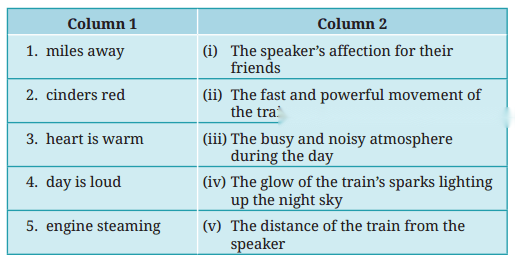
Column 1 | Column 2 |
1. Miles away | (v) The distance of the train from the speaker |
2. Cinders red | (iv) The glow of the train’s sparks lighting up the night sky |
3. Heart is warm | (i) The speaker’s affection for their friends |
4. Day is loud | (iii) The busy and noisy atmosphere during the day |
5. Engine steaming | (ii) The fast and powerful movement of the train |
Now, use the expressions in Column 1 to fill in the following blanks correctly.
अब स्तंभ 1 में दी गई अभिव्यक्तियों का प्रयोग करते हुए नीचे दिए गए रिक्त स्थानों को सही ढंग से भरिए।
1. After meeting her old friend, her …………with the joy of rekindled memories.
2. As I arrived at the railway station I could hear the ………….
3. The marketplace is bustling, and the …………with the chatter of shoppers and vendors.
4. The bonfire glowed brightly, throwing………..into the dark night sky.
5. The sound of a train could still be heard ………..as the evening grew quiet.
Answer:
1. heart is warm
2. engine steaming
3. day is loud
4. cinders red
5. miles away
II. The poet uses the word ‘shrieking’ to tell us about the sound of the train’s whistle. There are other words that tell us about different types of related sounds.
Read the meanings of such words in Column 1 and match them with the words in Column 2. You may use a dictionary. Share your answers with your classmates and the teacher.
स्तंभ 1 में दिए गए ऐसे शब्दों के अर्थ पढ़िए और उन्हें स्तंभ 2 में दिए गए शब्दों से मिलाइए। आप शब्दकोश की सहायता ले सकते हैं। अपने उत्तर अपने सहपाठियों और शिक्षक के साथ साझा कीजिए।
Answer:
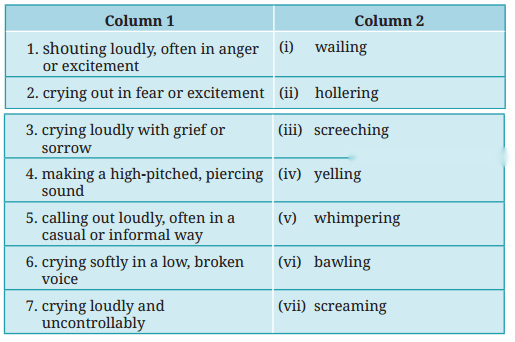
Column 1 | Column 2 |
1. shouting loudly, often in anger or excitement | (iii) screeching |
2. crying out in fear or excitement | (vi) bawling |
3. crying loudly with grief or sorrow | (iv) yelling |
4. making a high-pitched, piercing sound | (i) wailing |
5. calling out loudly, often in a casual or informal way | (vii) screaming |
6. crying softly in a low, broken voice | (ii) hollering |
7. crying loudly and uncontrollably | (v) whimpering |
Now, complete the following paragraph by using suitable words from Column 2.
अब स्तंभ 2 में दिए गए उपयुक्त शब्दों का प्रयोग करते हुए निम्नलिखित अनुच्छेद को पूरा कीजिए।
Answer:
The street was filled with a variety of sounds. A shopkeeper was 1 . yelling to attract customers, while a child nearby was 2 . hollering at his friend to wait for him. From the other side of the road, a toddler was 3. bawling uncontrollably after dropping his ice cream, and his mother tried to calm him as he began 4. whimpering softly. In the background, someone’s loud 5. screeching voice added to the bustling noise of the busy evening.
Seen Extract
Read the following extract carefully and answer the questions that follow :
Extract-1
The railroad track is miles away,
And the day is loud with voices speaking,
Yet there isn’t a train goes by all day
But I hear its whistle shrieking.
Question 1.
How far is the railroad track from the speaker?
(a) A few meters away
(b) Miles away
(c) Very close
(d) Next to the house
Answer:
(b) Miles away
Question 2.
What does the speaker hear even though the train is far away?
Answer:
The speaker hears the train’s whistle shrieking.
Question 3.
How is the day described in the passage?
Answer:
The day is described as loud with voices speaking.
Question 4.
What sound does the train’s whistle make according to the passage?
Answer:
The train’s whistle makes a shrieking sound.
Question 5.
Find from the passage the opposite of ‘night’.
Answer:
day
Question 6.
Find from the passage the word which means ‘a long way off’.
Answer:
miles away
Travel Poem Summary Hindi Translation
The railroad track is miles away ………… I here its whistle shrieking. (Page 58)

कठिन शब्दार्थ:
- Railroad (रेलरोड) = रेलमार्ग।
- track (ट्रैक) = पटरी।
- miles (माइल्ज़) = मील (दूरी की इकाई)।
- voices (वॉइसिज़) = आवाजें।
- speaking (स्पीकिंग) = बोलना।
- goes (गोज़) = जाना।
- shrieking ( श्रीकिंग) = तीखी आवाज़ करना/चीखना।
- loud (लाउड) = ऊँचा/शोरगुल भरा।
हिन्दी अनुवाद:
कवयित्री कहती हैं कि रेल की पटरी यहाँ से मीलों दूर है और दिन भर लोगों की बातचीत का शोर रहता है। फिर भी, दिनभर में ऐसा नहीं होता कि कोई ट्रेन गुज़रे और मुझे उसकी सीटी की तेज़ (चीखती हुई) आवाज़ सुनाई न दें। (अर्थात्, शोर के बावजूद उनका ध्यान ट्रेन की आवाज़ पर ही रहता है।)
All night there isn’t its engine steaming. (Page 58)
कठिन शब्दार्थ:
- night (नाइट) = रात।
- still (स्टिल) = स्थित/शांत।
- sleep (स्लीप) = नींद।
- dreaming (डीमिंग) = स्वप्न देखना।
- cinders (सिन्डर्ज़) = जली हुई राख/अंगारे।
- sky (स्काई) = आकाश।
- engine (इन्जिन) = यंत्र/इंजन।
- steaming (स्टीमिंग) = भाप छोड़ना।
हिन्दी अनुवाद:
रात में जब सब कुछ शांत होता है और यह समय सोने और सपने देखने का होता है, तब भी ऐसा नहीं होता कि कि कोई ट्रेन गुज़रे और मुझे पता न चले। मुझे आकाश में उसके इंजन से निकलती लाल चिंगारियाँ (cinders) दिखाई देती हैं और इंजन के भाप छोड़ने की आवाज़ सुनाई देती हैं।
My heart is warm with ………… No matter where it’s going. (Page 58)
कठिन शब्दार्थ:
- heart (हार्ट) = दिल/हृदय।
- warm (वॉर्म) = स्नेहपूर्ण/गर्म।
- friends (फ्रेन्ड्ज़) = दोस्त/मित्र।
- better (बेटर) = अच्छा/बेहतर।
- knowing (नोइंग) = जानना।
- train (ट्रेन) = रेलगाड़ी।
- wouldn’t (वुडन्ट) = नहीं करूँगा।
- matter (मैटर) = फर्क/महत्त्व।
- going (गोइंग) = जाना।
- take (टेक) = पकड़ना/लेना।
हिन्दी अनुवाद:
मेरा दिल उनदोस्तों के लिए स्नेह से भरा है जो मैंने बनाए हैं और मैं जानती हूँ कि मुझे इनसे बेहतर दोस्त नहीं मिलेंगे। फिर भी, ऐसी कोई ट्रेन नहीं है जिसे मैं पकड़ना न चाहूँ, चाहे वह कहीं भी जा रही हो। (कवयित्री का यात्रा के प्रति प्रेम इतना गहरा है कि वह दोस्तों को छोड़कर भी जाने को तैयार हैं।)