Operations with Integers Class 7 Solutions RBSE Maths Ganita Prakash Part 2 Chapter 2
PracticingGanita Prakash Class 7 Solutionsand RBSE Class 7 Maths Part 2 Chapter 2 Operations with Integers Solutions Question Answer helps develop logical thinking and accuracy.
Ganita Prakash Class 7 Part 2 Chapter 2 Solutions
Class 7 Ganita Prakash Part 2 Chapter 2 Solutions
RBSE Class 7 Maths Ganita Prakash Part 2 Chapter 2 Solutions
In-text Questions
Page 27
Question 1.
From the figures below, what can you conclude about the magnitudes of a and b compared to each other, and what are their directions? Remember to start from 0.
Solution:
(1) In the given figure, movement a is rightwards. So, movement = +a, where a is magnitude and ‘+’ sign indicates rightwards direction. Similarly, movement b is leftwards, then the movement = -b, where b is magnitude and sign indicates leftwards direction. Now, the coin goes from 0 to +a, then comes to -b. i.e., P = +a -b. Also, b > a. Thus, the final movement will be leftwards.
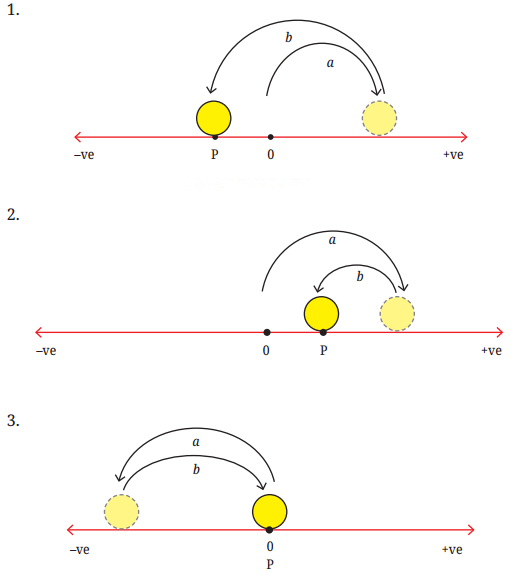
(2) In the given figure, movement a is rightwards. So, movement = +a, where a is magnitude and ‘+’ sign indicates rightwards direction. Similarly, movement b is leftwards, then the movement = -b, where b is magnitude and sign indicates leftwards direction. Now, the coin goes from 0 to +a, then comes to -b i.e., P = +a -b. Also, a > b. Thus, the final movement will be rightwards.
(3) In the given figure, movement a is leftwards. So, movement = -a, where a is magnitude and sign indicates leftwards direction. Similarly, movement b is rightwards, then the movement = +b, where b is magnitude and ‘+’ sign indicates rightwards direction. Now, the coin goes from 0 to +a, then comes back to 0. i.e., P = -a + b. Also, b = a. So, P = -a + a = 0.
Thus, coin comes to the initial position (0).
Page 29
Question 1.
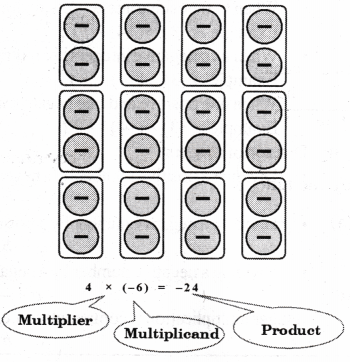
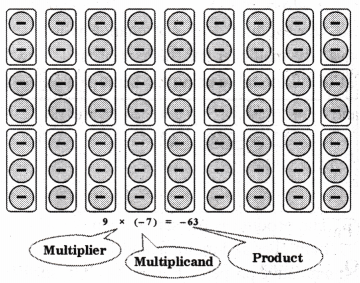
Similarly find the values of 4 × (-6) and 9 × (-7).
Solution:
When the multiplier is positive, we place tokens into the bag. Here,
4 × (-6) can be interpreted as placing 6 negatives into an empty bag 4 times. We use red tokens for negatives, so we place 6 negatives into an empty bag 4 times. There are now 24 red tokens or 24 negatives in the bag, meaning -24.
Thus, 4 × (-6) = (-24).
Similarly, we will find the value of 9 × (-7). When the multiplier is positive, we place tokens into the bag. Here,
9 × (-7) can be interpreted as placing 7 negatives into an empty bag 9 times. We use red tokens for negatives, so we place 7 negatives into an empty bag 4 times. There are now 63 red tokens or 63 negatives in the bag, meaning -63.
Thus, 9 × (-7) = (-63).
Page 31
Question 1.
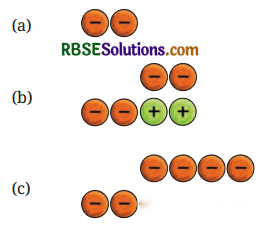
Consider the numbers represented by the following tokens :
We can see that all of them represent the number (-2). Now, take 4 times each of these token sets. That is, place each set into the empty bag 4 times.
What integer do we get as the final answer in each case? Do we get different answers because the sets look different, or the same answer because they all represent -2?
Solution:
Since, each set represents -2, taking it 4 times gives :
4 × (-2) = -8
So, in all three cases, the final answer is -8. No, we get the same answer because even though the arrangement of tokens is different, each group still has the same total value of -2 (because positives and negatives cancel). The value of a token set depends only on the net number of positives and negatives, not on how they are arranged.
Question 2.
Check this for 5 × 4, by taking different token sets corresponding to 4.
Solution:
5 × 4 can be interpreted as placing 4 positives into an empty bag 5 times. We use green tokens for positives, so we place 4 positives into an empty bag 5 times. There are now 20 green tokens or 20 positives in the bag, meaning 20.
Thus, 5 × 4 = 20.
Page 34
Question 1.
Consider the expression 1 × a. We know that the value of this expression is V for all positive integers. Is this true for all negative integers too?
Solution:
The expression 1 × a means we take the number a one time. No matter whether a is positive or negative, taking it once gives the same number.
So
- If a = -3, then 1 × (-3) = -3
- If a = -12, then 1 × (-12) = -12
- If a = -100, then 1 × (-100) = -100
This works because 1 is the multiplicative identity, meaning multiplying any integer by 1 gives the same integer.
Thus
Yes, 1 × a = a holds true for all integers, including negative integers.
Question 2.
(i) In the case of integers, is the product the same when we swap the multiplier and the multiplicand? Try this for some numbers. Observe the following pairs of multiplications (till in the blanks where needed):
3 × -4 = -12 | -4 × 3 = -12 |
-30 × 12 = _____ | 12 × -30 = _____ |
15 × -8 = 120 | -8 × -15 = 120 |
14 × -5 = -70 | -5 × ____ = -70 |
(ii) What do you notice in these pairs of multiplication statements?
(iii) Will this always happen?
Solution:
(i) Yes, the product remains the same when we swap the multiplier and the multiplicand — even for integers, including negative ones.
i.e., a × b = b × a
This property is called the commutative property of multiplication.
Try with some examples :
1. Both positive
4 × 7 = 28
and 7 × 4 = 28
⇒ We get the same result.
2. One positive, one negative
3 × (-5) = -15
(-5) × 3 = -15
⇒ We get the same result.
3. Both negative
(-6) × (-2) = 12
(-2) × (-6) = 12
⇒ We get the same result.
4. Zero with an integer
0 × (-9) = 0 .
(-9) × o = 0
⇒ We get the same result.
Yes, for all integers, whether positive, negative, or zero :
a × b = b × a
So, the product does not change when we swap the multiplier and the multiplicand. Now, let us fill the table using the same analogy—
3 × -4 = -12 | -4 × 3 = -12 |
-30 × 12 =-360 | 12 × -30 =-360 |
15 × -8 = 120 | -8 × -15 = 120 |
14 × -5 = -70 | -5 ×14= -70 |
(ii) The product is the same when we ‘swap’ the multiplier and multiplicand. This is called commulative property. Earlier, we have seen a similar property with addition.
(iii) Yes, this will always happen.
Page 35
Question 1.
Does the sign of the product change if we swap the multiplier and multiplicand?
Solution:
The product does not change when the multiplier and multiplicand are swapped, whatever their signs may be. Thus, multiplication is commutative for integers. In general, for any two integers, a and b, we can say that : a × b = b × a.
Page 38
Question 1.
What is so special about these grids? Is the magic in the numbers or the way they are arranged or both? Can you make more such grids?
8 | -4 | 12 | -6 |
-28 | 14 | -42 | 21 |
12 | -6 | 18 | -9 |
20 | -10 | 30 | -15 |
Solution:
In these grids, we may start with any number, strike out the row and the column containing that number. This process continues until no number is left unstruck and we multiply encircled numbers. These grids are so special because selecting any starting number at the end gives the same product. The magic is in both as the numbers are chosen carefully and they are arranged in such a way that each row is a multiple of the first row and each column is a multiple of the first column. Yes, we can make our own magic grids. Here is a simple method :
- Choose 3-4 numbers for the rows.
- Choose 3-4 numbers for the columns.
- Multiply each row number with each column number and fill the grid.
This will create a new “magic grid” where the same special property holds.
Page 39
Question 1.
Can you summarise the rules for integer division looking at the above pattern?
Solution:
In general, for any two positive integers a and b, where b ≠ 0, we can say that a + – b = -(a ÷ b), -a ÷ b = -(a ÷ b), and -a ÷ -b = a ÷ b.
Question 2.
What is the value of the expression 5 × – 3 × 4? Does it matter whether we multiply 5 × -3 and then multiply the product with 4, or if we multiply -3 × 4 first and then multiply the product with 5?
Solution:
(5 × -3) × 4 = -15 × 4 = -60 and 5 × (-3 × 4) = 5 × -12 = -60.
Since, the product is the same when we ‘group’ the multiplications in these two ways. That is, whether we multiply 5 × -3 and then multiply the product with 4, or if we multiply -3 × 4 first and then multiply the product with 5, we get same product. We may say that- In the expression 5 × – 3 × 4; try to multiply 5 and 4 first and then multiply the product with -3 : (5 × 4) × -3, 5 × 4 = 20, and 20 × -3 = -60.
So, integer multiplication is associative, just like integer addition.
Page 40
Question 1.
Using this understanding of multiplication of many integers, can you give a simple rule to find the sign of the product of many integers?
Solution:
To find the sign of the product, we count how many negative integers are being multiplied.
While multiplying many integers, if the number of negative integers is even, the product is positive.
(Examples : 2 negatives, 4 negatives, 6 negatives. ..)
While multiplying many integers, if the number of negative integers is odd, the product is negative.
(Examples : 1 negative, 3 negatives, 5 negatives. ..)
Hence, the product of many integers is positive if the number of negative integers is even and negative if the number of negative integers is odd.
Question 2.
Now, consider the expression 5 × (4 + (- 2)). As in the case of positive integers, is this expression equal to 5 × 4 + 5 × (-2)?
Solution:
Let us take an expression 5 × (4 + (-2)).
5 × (4 + (-2)) = 5 × (4 – 2) = 5 × 2 = 10
Now, we solve another expression 5 × 4 + 5 × (-2) = 20 + (-10) = 20 – 10 = 10
Both the expressions give same value. Hence, it is clear that
5 × (4 + (-2)) = 5 × (4 + (-2))
i.e., both the expressions are equal.
Page 42
Question 1.
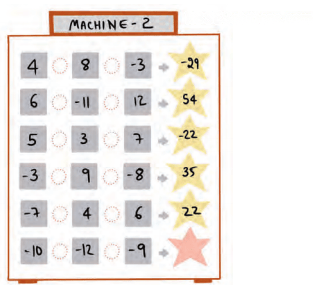
Find the operations being done by Machine 2 and fill in the blank.
Solution:
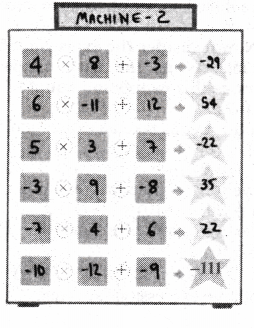
The operation done by Machine 2 = – (first number × second number + third number)
We can write it as an expression, this will be = -(a × b + c)
where a is the first number, b is the second number, and c is the third number.
For example, -[4 × 8 + (-3)] = -[32 – 3] = -29 and -[6 × (-11) + 12] = -[-66 + 12] = 54.
So, the result of the last group will be, -[(-10) × (-12) + (-9)] = -[120 – 9] = -111
Class 7 Maths Operations with Integers Solutions
Figure it Out (Page 25)
Question 1.
Let us try to find a few more pairs of numbers from their sums and differences:
(a) Sum = 27, Difference = 9
(b) Sum = 4, Difference = 12
(c) Sum = 0, Difference =10
(d) Sum = 0, Difference = – 10 .
(e) Sum = – 7, Difference = – 1
(f) Sum = -7, Difference = – 13
Solution:
(a) Sum = 27, Difference = 9
18 and 9 are the numbers whose sum = 18 + 9 = 27 and difference = 18 – 9 = 9
Hence, 18 and 9 are the required numbers.
(b) Sum = 4, Difference = 12
8 and – 4 are the numbers whose sum = 8 + (- 4) = 4 and difference = 8 – (- 4) = 8 + 4 = 12
Hence, 8 and – 4 are the required numbers.
(c) Sum = 0, Difference = 10
5 and – 5 are the numbers whose sum = 5 + (- 5) = 0 and difference = 5 – (- 5)
= 5 + 5 = 10
Hence, 5 and – 5 are the required numbers.
(d) Sum = 0, Difference = – 10
-5 and 5 are the numbers whose sum 5 + (- 5) = 0 and difference = (- 5) – 5 = -5 – 5 = – 10
Hence, – 5 and 5 are the required numbers.
(e) Sum = – 7, Difference = – 1
– 4 and – 3 are the numbers whose sum = (- 4) + (- 3) = -7 and difference = (- 4) – (- 3) = – 4 + 3 = -1
Hence, -4 and -3 are the required numbers.
(f) Sum = – 7, Difference = -13
3 and – 10 are the numbers whose sum = 3 + (- 10) = 3 – 10 = – 7 and difference = (- 10) – 3 = – 10 – 3 = -13
Hence, 3 and – 10 are the required numbers.
Figure it Out (Page 31)
Question 1.
Using the token interpretation, find the values of :
(a) 3 × (-2)
(b) (-5) × (_2)
(c) (-4) × (-1)
(d) (-7) × 3
Solution:
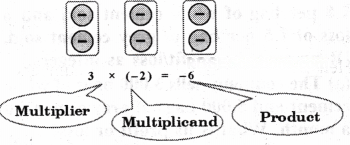
(a) 3 × (-2) can be interpreted as placing 2 negatives into an empty bag 3 times. We use red tokens for negatives, so we place 2 negatives into an empty bag 3 times. There are now 6 red tokens or 6 negatives in the bag, meaning -6. So, 3 × (- 2) = (- 6).
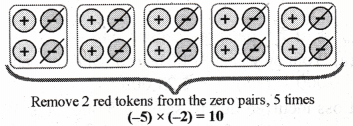
(b) For (-5) × (-2), we need to remove 2 negatives from the bag 5 times. Since, there are no red tokens in the bag, we need to place 2 zero pairs and remove 2 negatives, and we need to do this 5 times.
10 positives are left in the bag. So, -5 × -2 = +10.
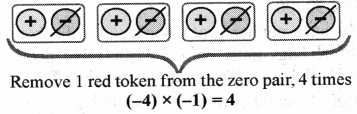
(c) For (-4) × (-1), we need to remove 1 negative from the bag 4 times. Since, there are no red tokens in the bag, we need to place 1 zero pair and remove 1 negative, and we need to do this 4 times.
4 positives are left in the bag. So, -4 × -1 = +4.
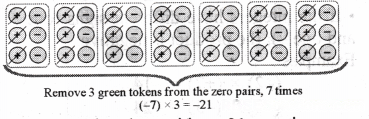
(d) When the multiplier is negative, we remove tokens from the bag. So, for (-7) × 3,we need to remove three positives or three green tokens from the bag 7 times. But there are no tokens in the bag, because we start with an empty bag. Just as in the case of subtraction, to remove 3 positives from an empty bag, we need to first place 3 zero pairs inside and then remove the 3 positives. We need to do this 7 times.
After removing the positives, 21 negatives are left in the bag. This is -21. This shows that (-7) × 3 = -21
Question 2.
If 123 × 456 = 56088, without calculating, find the value of:
(a) (-123) × 456
(b) (-123) × (-456)
(c) (123) × (-456)
Solution:
Here, we have given that
(a) Since, we know that when one of the multiplier or the multiplicand is positive and the other is negative, their product is negative.
∴ (-123) × 456 = -56088
(b) Since, we know that when both the multiplier and the multiplicand are negative, the product is positive.
∴ (-123) × (-456) = 56088
(c) Since, we know that when one of the multiplier or the multiplicand is positive and the other is negative, their product is negative.
∴ (123) × (-456) = -56088
Question 3.
Try to frame a simple rule to multiply two integers.
Solution:
This rule can be understood in 2 steps :
Step 1: Multiply the magnitudes of two integers
Ignore the signs and multiply the numbers as if they were both positive.
Example : For (-2) × 7; calculate 2 × 7 = 14.
Step 2 : Insert the sign of the product by using the following sign rules-
• If both integers have the same sign (both + or both -), the product is positive.
Examples:
(+3) × (+5) = +15
(-4) × (-6) = +24
• If the integers have different signs (one + and one -), the product is negative.
Examples:
(-2) × (+7) = -14
(+8) × (-3) = -24
Figure it Out (Pages 33-34)
Question 1.
Find the following products.
(a) 4 × (-3)
(b) (-6) × (-3)
(c) (-5) × (-1)
(d) (-8) × 4
(e) (-9) × 10
(f) 10 × (-17)
Solution:
Here, we use a very simple rule mentioned in Q. 4 (NCERT Intext Questions Page 32) and calculate these products.
(a) 4 × (-3) = -12
(b) (-6) × (-3) = 18
(c) (-5) × (-1) = 5
(d) (-8) × 4 = -32
(e) (-9) × 10 = -90
(f) 10 × (-17) = -170
Figure it Out (Page 39)
Question 1.
Find the values of :
(a) 14 × (-15)
(b) -16 × (-5)
(c) 36 + (-18)
(d) (-46) + (-23)
Solution:
(a) 14 × (-15) = -210
(b) -16 × (-5) = +80 = 80
(c) 36 + (-18) = -2
(d) (-46) + (-23) = 2
Question 2.
A freezing process requires that the room temperature be lowered from 32°C at the rate of 5°C every hour. What will be the room temperature 10 hours after the process begins?
Solution:
The room starts at 32°C and cools down at 5°C every hour.
In 10 hours, total drop in temperature =10 × 5 = 50°C
Now subtracting this drop from the starting temperature, we get –
32 – 50 = -18°C
Hence, the room temperature after 10 hours will be -18°C.
Question 3.
A cement company earns a profit of ₹ 8 per bag of white cement sold and a loss of ₹ 5 per bag of grey cement sold. [Represent the profit/loss as integers.]
(a) The company sells 3,000 bags of white cement and 5,000 bags of grey cement in a month. What is its profit or loss?
(b) If the number of bags of grey cement sold is 6,400 bags, what is the number of bags of white cement the company must sell to have neither profit nor loss?
Solution:
Profit of ₹ 8 per white cement bag → +8
Loss of ₹ 5 per grey cement bag → -5
(a) Profit by selling 3,000 bags of white cement = 3000 × (+8) = + ₹ 24,000
Loss incurred due to sales of 5,000 bags of grey cement = 5000 × (-5) = – ₹ 25,000 Hence, net loss = 24000 – 25000 = ₹ 1000 [ – sign indicates loss]
Therefore, the company faces a loss of ₹ 1,000.
(b) Grey bags sold = 6,400
Loss from grey bags : 6400 → (-5) = – ?32000
To have neither profit nor loss, profit from white bags must be + ₹ 32,000 and profit earned from selling each white bag is ₹ 8.
Let x = number of white cement bags.
x × 8 = 32000
x = = 4000
Hence, the company must sell 4,000 white cement bags to have neither profit nor loss.
Question 4.
Replace the blank with an integer to make a true statement.
(a) (-3) × ______ = 27
(b) 5 × ________ = (-35)
(c) _______ × (-8) = (-56)
(d) _______ × (-12) = 132
(e) ______ ÷ (-8) = 7
(f) ________ ÷ 5 – 12 = -11
Solution:
(a) (-3) × ______ = 27
27 – (-3) = -9
Thus, (-3) × – 9 = 27
(b) 5 × ______ = -35
-35 ÷ 5 = -7 Thus, 5 × (-7) = -35
(c) _______ × (-8) = -56
-56 ÷ (-8) = 7 Thus, 7 × (-8) = -56
(d) _______ × (-12) = 132
132 ÷ (-12) = -11
Thus, (-11) × (-12) = 132
(e) ______ ÷ (-8) = 7
7 × (-8) = -56
Thus, (-56) ÷ (-8) = 7
(f) _____ ÷ 12 = -11
-11 × 12 = -132
Thus, (-132) ÷ 12 = -11
Figure it Out (Pages 42-44)
Question 1.
Find the values of the following expressions :
(a) (-5) × (18 + (-3))
(b) (-7) × 4 × (-1)
(c) (-2) × (-1) × (-5) × (-3)
Solution:
(a) (-5) × (18 + (-3)) = (-5) × (18 – 3)
= (-5) × 15 = -75
(b) (-7) × 4 × (-1)
= (-7 × 4) × (-1)
= -28 × (-1) = 28
(c) (-2) × (-1) × (-5) × (-3)
= [(-2) × (-1)] × [(-5) × (-3)]
= 2 × 15 = 30
Question 2.
Find the values of the following expressions :
(a) (-27) ÷ 9
(b) 84 ÷ (-4)
(c) (-56) ÷ (-2)
Solution:
(a) (-27) ÷ 9 = -3
(b) 84 ÷ (-4) = -21
(c) (-56) ÷ (-2) = 28
Question 3.
Find the integer whose product with (-1) is :
(a) 27
(b) -31
(c) -1
(d) 1
(e) 0
Solution:
(a) Let the integer be a such that a × (-1) – 27
Dividing by -1 both sides, we have-
a = = -27.
(b) Let the integer be a such that a × (-1) = -31
Dividing by -1 both sides, we have –
a = = 31
(c) Let the integer be a such that a × (-1) = -1
Dividing by -1 both sides, we have-
a = = 1
(d) Let the integer be a such that a × (-1) – 1
Dividing by -1 both sides, we have –
a = = -1
(e) Let the integer be a such that a × (-1) = 0
Dividing by -1 both sides, we have –
a = = 0
Note : We may also multiply by -1 both the sides instead of divide.
Question 4.
If 47 – 56 + 14 – 8 + 2 – 8 + 5 = -4, then find the value of -47 + 56 – 14 + 8 – 2 + 8 – 5 without calculating the full expression.
Solution:
Given that 47 – 56 + 14 – 8 + 2 – 8 + 5 = -4 ……………. (1)
We can write – 47 + 56 – 14 + 8- 2 + 8 – 5 as –
= (-1) × (-1) × [-47 + 56 – 14 + 8- 2 + 8 -5]
{ ∵ (-1) × (-1) = 1, which doesn’t affect the value of the expression}
= (-1) × [47 – 56 + 14 – 8 + 2 – 8 + 5]
= (-1) × (-4) [Using (1)]
= 4
Question 5.
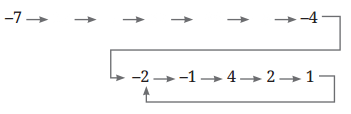
Do you remember the Collatz Conjecture from last year? Try a modified version with integers. The rule is — start with any number; if the number is even, take half of it; if the number is odd, multiply it by -3 and add 1; repeat. An example sequence is shown below.
Try this with different starting numbers : (-21), (-6), and so on. Describe the patterns you observe.
Solution:
According to the rule described in the above question,
Starting with -21 (odd)
-21 → -3 (-21) + 1 = 63 + 1 = 64
+1 = -2
– -1 → -3(-1) + 1 = 4
1 × (-3) + 1 → -2 → -1 → 4 ……
We noticed the following pattern for -21 It falls into a cycle :
4 → 2 → 1 → -2 → -1 → 4 → …
This is a 5-term repeating loop.
Starting with -6 (even)
– → -3
-3 is odd :
⇒ -3 → -3 = (-3) + 1 = 9 + 1 = 10
→ 5
5 × (-3) + 1 → -14
– → -7
-7 × (-3) + 1 → 22
→ 11
11 × (-3) + 1 → -32
After reaching -1 :
-1 → 4 → 2 → 1 → -2 → -1 → 4
We noticed the following pattern for -6 :
It also ends up in the same loop :
4, 2, 1, -2, -1, 4. …..
For both the starting numbers we checked -21 and -6 and for many others, the sequence eventually leads to the same repeating cycle :
4, 2, 1, -2, -1, 4.
Question 6.
In a test, (+4) marks are given for every correct answer and (-2) marks are given for every incorrect answer.
(a) Anita answered all the questions in the test. She scored 40 marks even though 15 of her answers were correct. How many ofher answers were incorrect? How many questions are in the test?
(b) Anil scored (- 10) marks even though he had 5 correct answers. How many of his answers were incorrect? Did he leave any questions unanswered?
Solution:
Given that
Marks awarded for each correct answer = +4 marks
Marks awarded for each incorrect answer = -2 marks
(a) Anita scored 40 marks. She had 15 correct answers.
Marks from correct answers = 15 × (+4) = +60
Let the number of incorrect answers be x. According to the question,
60 + (-2x) = 40
60 – 2x = 40
-2x = -20
x = 10
Hence, total number of questions = Correct + Incorrect = 15 + 10 = 25
Therefore,
Incorrect answers = 10
Total questions = 25
(b) Anil scored -10 marks with 5 correct answers.
Marks from correct answers = 5 × 4 = 20
Let the number of incorrect answers be y.
According to the question,
20 + (-2y) = -10
20 – 2y = -10
-2y = -30
y= 15
So, Anil had 15 incorrect answers.
Unanswered questions = Total number of questions – (Correct Answers + Incorrect answers)
= 25 – (5 + 15) = 25 – 20 = 5 questions
Hence, Anil left 5 unanswered questions.
Question 7.
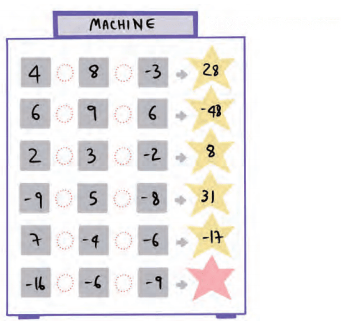
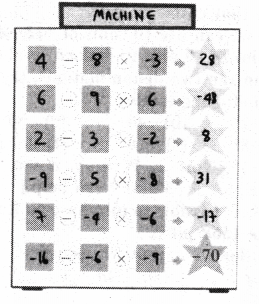
Pick the pattern — find the operations done by the machine shown below.
Solution:
The operation done by the machine = first number – second number x third number We can write it as an expression, this will be = a – b × c
where a is the first number, b is the second number and c is the third number.
For example, 4 – 8 × (-3) = 4 + 24 = 28 and 6 – 9 × 6 = 6 – 54 = -48
So, the result of the last group will be- -16 -(-6) × (-9) = -16 – 54 = -70
Question 8.
Imagine you’re in a place where the temperature drops by 5°C each hour. If the temperature is currently at 8°C, write an expression which denotes the temperature after 4 hours.
Solution:
The temperature drops 5°C every hour. In 4 hours, the total drop will be :
4 × (-5)
Starting temperature = 8°C Expression for temperature after 4 hours is given by-
-8 + 4 × (-5)
This expression represents the new temperature after 4 hours.
Question 9.
Find 3 consecutive numbers with a product of (a) -6, (b) 120.
Solution:
(a) -3, -2, -1 are three consecutive numbers whose product
= (-3) × (-2) × (-1) = -6
-3,-2,-1
(b) 4, 5, 6 are three consecutive numbers whose product = 4 × 5 × 6 = 120
4, 5, 6
Question 10.
An alien society uses a peculiar currency called ‘pibs’ with just two denominations of coins—a +13 pibs coin and a -9 pibs coin. You have several of these coins. Is it possible to purchase an item that costs +85 pibs?
Yes, we can use 10 coins of +13 pibs and 5 coins of -9 pibs to make a total of +85. Using the two denominations, try to get the following totals :
(a) +20
(b) +40
(c) -50
(d) +8
(e) +10
(f) -2
(g) +1 [Hint : Writing down a few multiples of 13 and 9 can help.]
(h) Is it possible to purchase an item that costs 1568 pibs?
Solution:
Let us use the equation 13a – 9b = T
where a = number of+13-pibs coin and b = number of -9-pibs coin (both non-negative integers).
(a) 13 × 5 – 9 × 5 = 65 – 45 = 20.
Hence, we use 5 coins of +13 and 5 coins of -9.
(b) 13 × 10 – 9 × 10 = 130 – 90 = 40.
Hence, we use 10 of +13 and 10 of -9.
(c) 13 × 1 – 9 × 7 = 13 – 63 – -50.
Hence, we use 1 of +13 and 7 of -9.
(d) 13 × 2 – 9 × 2 – 26 – 18 = 8.
Hence, we use 2 of each.
(e) 13 × 7 – 9 × 9 = 91 – 81 = 10.
Hence, we use 7 of +13 and 9 of -9,
(f) 13 × 4 – 9 × 6 = 52 – 54 = -2.
Hence, we use 4 of +13 and 6 of -9.
(g) 13 × 7 – 9 × 10 = 91 – 90 = 1.
Hence, we use 7 of +13 and 10 of -9.
(h) Yes, it is possible to purchase an item that costs 1568 pibs.
13 × 122 – 9 × 2 – 1586 – 18 = 1568
Hence, we use 122 coins of +13 and 2 coins of -9.
Question 11.
Find the values of :
(a) (32 × (-18)) ÷ (-36)
(b) (32 ) + ((-36) × (-18))
(c) (25 × (-12)) ÷ ((45) × (-27))
(d) (280 × (-7)) ÷ ((-8) × (-35))
Solution:
(a) (32 × (-18)) ÷ ((-36))
(b) (32 ) + ((-36) × (-18))
(c) (25 × (-12)) ÷ ((45) × (-27))
(d) (280 × (-7)) ÷ ((-8) × (-35))
Question 12.
Arrange the expressions given below in increasing order.
(a) (-348) + (-1064)
(b) (-348) – (-1064)
(c) 348 – (-1064)
(d) (-348) × (-1064)
(e) 348 × (-1064)
(f) 348 × 964
Solution:
First we evaluate each expression as following:
(a) (-348) + (-1064) = -1412
(b) (-348) – (-1064) = -348 + 1064 = 716
(c) 348 – (-1064) = 348 + 1064 = 1412
(d) (-348) × (-1064) = +370272
(e) 348 × (-1064) = -370272
(f) 348 × 964 = 335472
Arranging in increasing (smallest to largest) order :
(e) < (a) < (b) < (c) < (f) < (d)
Question 13.
Given that (-548) × 972 = -532656, write the values of :
(a) (-547) × 972
(b) (-548) × 971
(c) (-547) × 971
Solution:
We have given that
(-548) × 972 = -532656
(a) (-547) × 972
∵ -547 = – 548 + 1
∴ (-547) × 972
= (-548 + 1) × 972
= (-548 × 972) + (1 × 972)
[Using distributive property of multiplication]
= -532656 + 972 = -531684
(b) (-548) × 971
∵ 971 = 972 – 1
∴ (-548) × 971 = (-548) × (972 – 1)
– (-548 × 972) – (-548 × 1)
[Using distributive property of multiplication]
= -532656 – (-548)
= -532656 + 548 = -532108
(c) (-547) × 971
Using the values from (a) and (b).
(-547) × 971 = (-547) (972 – 1)
= (-547) × 972-547 × (-1)
[Using distributive property of multiplication]
= (-547 × 972) – (-547) We already determined
(-547) × 972 = -531684
So, -531684 -(-547) = -531684 + 547
= -531137
Question 14.
Given that 207 × (-33 + 7) = -5382, write the value of -207 × (33 – 7) = _______.
Solution:
Here, we have given that-
207 × (-33 + 7) = 207 × (-26) = -5382
Now evaluate the required expression :
-207 × (33 – 7) = -207 × 26
But 207 × 26 = 5382
So, -207 × 26 = -5382
Question 15.
Use the numbers 3, -2, 5, -6 exactly once and the operations ‘+’, ‘-‘ and ‘×’ exactly once and brackets as necessary to write an expression such that—
(a) the result is the maximum possible
(b) the result is the minimum possible
Solution:
Here, we can use the numbers 3, -2, 5, -6 exactly once and the operations ‘+’, and ‘×’ exactly once and brackets as necessary to write an expression such that—
(a) the result is the maximum possible = 5 × 3 + (-2) – (-6) = 15 – 2 + 6 = 19
(b) the result is the minimum possible = 5 × (-6) + (-2) – 3 = -30 – 2 – 3 = -35
Question 16.
Fill in the blanks in at least 5 different ways with integers :
(a) ▭ × ▭ × ▭ = -36
(b) (▭ – ▭) × ▭ = 12
(c) (▭ – (▭ – ▭)) = -1
Solution:
(a) -9 + 9 × (-3) = -36
-6 + 10 × (-3) = -36
0 + 12 × (-3) = -36
0 + 36 × (-1) = -36
-4 + 8 × (-4) = -36
(b) (6 – 2) × 3 = 12
(6 – 3) × 4 = 12
(-1 – 2) × (-4) = 12
(-2 – 2) × (-3) = 12
(-4 – 2) × (-2) = 12
(c) (13 – (29 – 15)) = -1
(18 -(37 – 18)) = -1
(20 – (43 – 22)) = -1
(26 – (57 – 30)) = -1
(5 – (13 – 7)) = -1
It’s Puzzle Time
Terhuchu
- Terhuchu is a traditional game played in Assam and Nagaland.
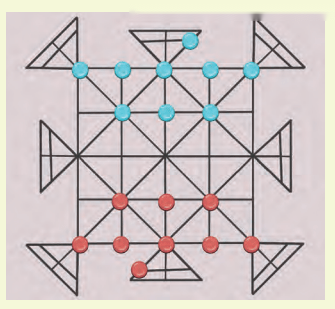
- The game board has 16 squares, with diagonal lines drawn inside them.
- The board is usually scratched on a large stone or drawn on the ground using mud.
- The game is played by two players.
- Each player has 9 coins, which are placed on the board in a fixed pattern.
- The coins of one player look different from the coins of the other player.
Objective:
The aim of the game is to capture all the opponent’s coins. The player who does this wins the game.
A player can also win by blocking the opponent so that they have no legal move left.
If the game cannot be won by either player, then the player with more coins on the board is the winner.
Gameplay:
- The game starts with the coins placed as shown on the board.
- Players play one after the other.
- In one turn, a player can move one coin.
- A coin can move along the lines to a nearby empty point.
- If an opponent’s coin is next to your coin, and the space just after it is empty, you can jump over the opponent’s coin.
- When you jump over an opponent’s coin, that coin is captured and removed from the board.
- You can make more than one capture in a single move.
- After each jump, the coin can change direction.
- In the triangular comers outside the main square, a coin can jump over an empty point and move to the next point directly.