Finding the Unknown Class 7 Solutions RBSE Maths Ganita Prakash Part 2 Chapter 7
PracticingGanita Prakash Class 7 Solutionsand RBSE Class 7 Maths Part 2 Chapter 7 Finding the Unknown Solutions Question Answer helps develop logical thinking and accuracy.
Ganita Prakash Class 7 Part 2 Chapter 7 Solutions
Class 7 Ganita Prakash Part 2 Chapter 7 Solutions
RBSE Class 7 Maths Ganita Prakash Part 2 Chapter 7 Solutions
In-text Questions
Pages 164-166
Question 1.
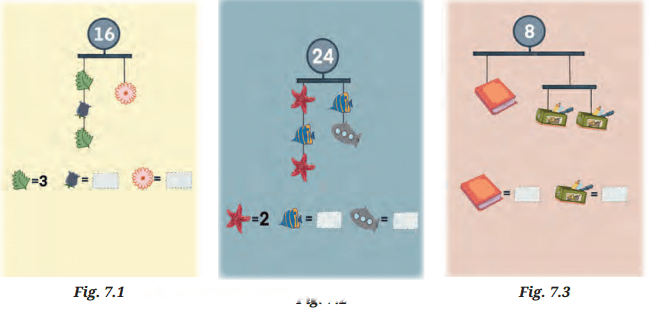
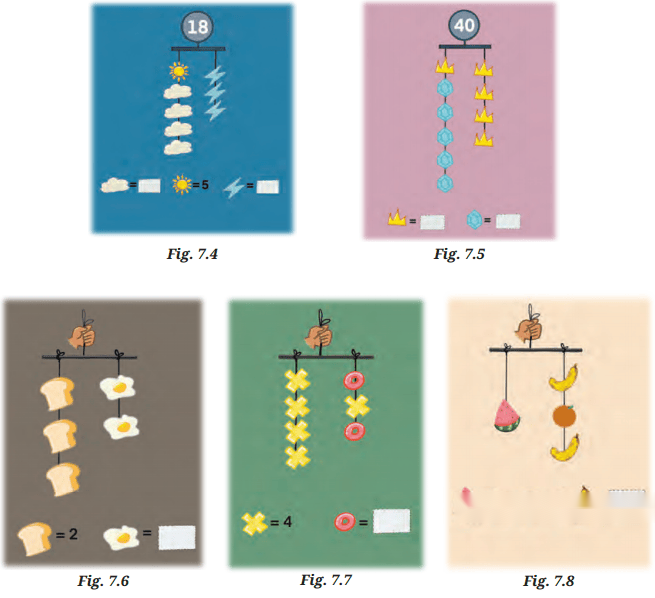
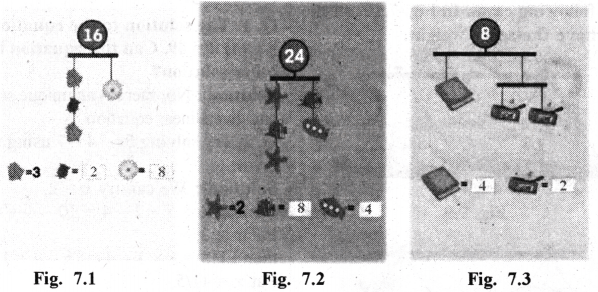
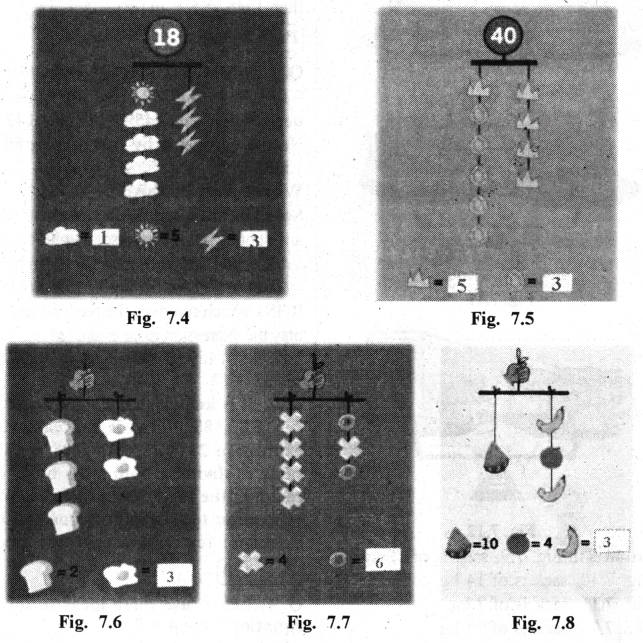
Find the unknown weights in the following cases :
Solution:
Question 2.
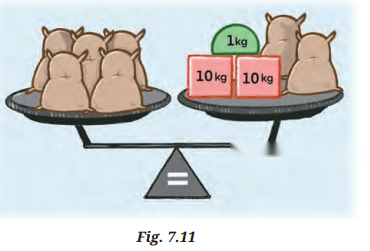
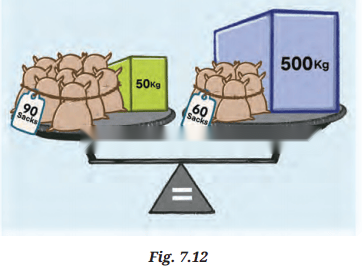
Find the unknown weight of the sack in the following cases. In Fig. 7.10, all the sacks have the same weight.
Solution:
In Fig. 7.9, sack is of 10 kg.
In Fig. 7.10, sack is of 14 kg.
In Fig. 7.11, sack is of 7 kg.
In Fig. 7.12, sack is of 15 kg.
Page 168
Question 1.
The solution to the equation 2n + 1 = 99 is n = 49. Can this equation have any other solution?
Solution:
No, there is an unique solution to any given linear equation.
Question 2.
Try solving 5x – 4 = 7 using trial and error.
Solution:
We can try x = 2,
then LHS = 5 × 2 – 4 = 10-4 = 6 ≠ RHS
Put x = 3,
then LHS = 5 × 3 – 4 = 15-4 = 11 ≠ RHS
Put x = 11/5,
then LHS = 5 × (11/5) – 4 = 11 – 4 = 7
Page 169
Question 1.
It is known that 14593 – 1459 + 145 – 14 + 88 = 13353. To find the value, do we need to evaluate 14593 – 1459 + 145 – 14? No, we can get it by subtracting 88 from 13353.
Why can we do this?
Solution:
We can do this because addition and subtraction are inverse operations. So, the value of the required expression can be found by subtracting 88 from both sides (LHS and RHS), which removes the term 88 and leaves only the expression to be evaluated on the LHS.
14593 – 1459 + 145 – 14 + 88 – 88 = 13353 – 88
Question 2.
It is known that 23 × 41 × 11 × 8 × 7 = 5,80,888. What is the value of the expression 23 × 41 × 11 × 8? Is this the same as dividing both sides by 7, which removes the factor 7 and leaves only the expression to be evaluated on the LHS?
Solution:
Yes, that reasoning is correct.
Page 170
Question 1.
Let us use these ideas to solve the equation 5x – 4 = 7.
Solution:
To retain only 5x on the LHS, we nee’d to remove the term – 4. This can be done by adding 4 to both sides.
Thus, 5x – 4 + 4 = 7 +4.
Hence, 5x = 11.
To retain only the unknown x on the LHS, we need to remove the factor 5. This can be done by dividing both sides by 5.
Thus,
x =
Page 173
Question 1.
What happens in cases like = 6?
Solution:
Multiplying both sides by 15 leaves
u = 6 × 15
u = 90
Page 179
Question 1.
Write equations whose solution is y = 5. Share the equations you made with each other and discuss the methods used.
Solution:
Example 1: y + 3 = 8
Subtract 3 on both sides,
y + 3 – 3 = 8 – 3
y = 5
Example 2: 2y = 10
Divide by 2 on both sides,
2y/2 = 10/2
y = 5
Page 180
Question 1.
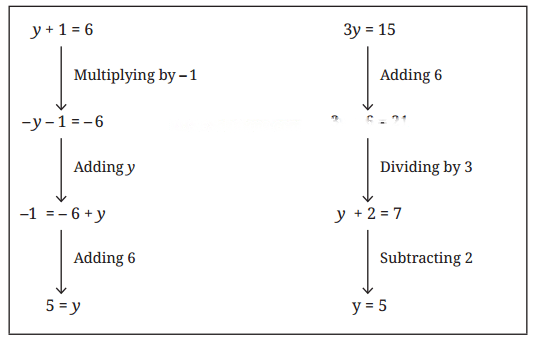
Can you form a chain going from the bottom equation to the top?
Solution:
Yes
Question 2.
Without calculating, can you find the value of the unknown in each equation in the chains above?
Solution:
Yes, we can do so.
Pages 181-182
Question 1.
The following are some equations along with the steps used to solve them to find the value of the letter-number. Go through each solution and decide whether the steps are correct If there is a mistake, describe the mistake, correct it and solve the equation.
1. 4x + 6 = 10
4x = 10 + 6
4x = 16
x = 4
2. 7 – 8z = 5
8z = 7 – 5
8z = 2
z = 4
3. 2v – 4 = 6
v – 4 = 6 – 2
v – 4 = 4
v = 8
4. 5z + 2 = 3z – 4
5z + 3z = – 4 + 2
8z = -2
z = –
5. 15w – 4w = 26
15w = 26 + 4w
15w = 30
w = 2
6. 3 x + 1 = – 12
x + 1 = –
x + 1 = – 4
x = – 5
7. 4(4q + 2) = 50
4(4q) = 50 – 2
16q = 48
q = 3
8. -2 (3 – 4x) = 14
-6v – 8x = 14
– 8x = 14 + 6
-8x = 20
x = –
9. 3(7y + 4) = 9 + 5y
7y + 4 = + 5y
7y + 4 = 3 + 5y
7y – 5y + 4 = 3
2y = 4 – 3
y =
Solution:
1. Second step is incorrect.
Correct solution is :
4x + 6 = 10
4x = 10 – 6
4x = 4
x = 1
2. Third step is incorrect.
7 – 8z = 5
8z = 7 – 5
8z = 2
z = =
3. Second step is incorrect.
2v – 4 = 6
2v = 6 + 4
2v = 10
v = 5
4. Second step is incorrect.
5z + 2 = 3z – 4
5z – 3z = – 4 – 2
2z = – 6
z = = -3
5. Third step is incorrect.
15w – 4w = 26
11w = 26
w =
6. Second step is incorrect.
3x + 1 = – 12
3x = -12 – 1
3x = -13
x =
7. Second step is incorrect.
4 (4q + 2) = 50
16q + 8 = 50
16q = 50 – 8
16q = 42
q = =
8. Second step is incorrect.
– 2(3 – 4x) = 14
-6 + 8x = 14
8x = 14 + 6
8x = 20
x = =
9. Second step is incorrect.
3(7y + 4) = 9 + 5y
21y + 12 = 9 + 5y
21y – 5y = 9 – 12
16y = – 3
y = –
Page 184
Question 1.
Using this formula can you solve this equation 2x + 3 = 4x + 5?
Solution:
x = = -1
Class 7 Maths Finding the Unknown Solutions
Figure it Out (Page 172)
Question 1.
Solve these equations and check the solutions.
(a) 3x – 10 = 35
(b) 5s = 3s
(c) 3u – 7 = 2u + 3
(d) 4(m + 6) – 8 = 2m – 4
(e) = 6
Solution:
(a) 3x – 10 = 35
Adding 10 on both sides, we get
3x – 10 + 10 = 35 + 10
3x = 45
Dividing by 3 on both sides, we get
3x ÷ 3 = 45 ÷ 3
x = 15
Checking : Put x = 15 in LHS, we get
3 × 15 – 10 = 45 – 10 = 35 = RHS
Hence verified.
(b) 5s = 3s
5s – 3s = 0
2s = 0
s = 0
Checking : Put s = 0 in LHS, 5 × 0 = 0
Similarly, put s = 0 in RHS, 3 × 0 = 0
LHS = RHS
Hence verified.
(c) 3u – 7 = 2u + 3
Add 7 on both sides, we get
3u – 7 + 7 = 2u+ 3 + 7
3u = 2u + 10
3u – 2u = 10
u = 10
Checking : LHS : 3 × 10 – 7 = 30 – 7 = 23
RHS : 2 × 10 + 3 = 20 + 3 = 23
Hence verified.
(d) 4 (m + 6) – 8 = 2m – 4
4m + 24 – 8 = 2m – 4
4m + 16 = 2m – 4
Subtracting 16 on both sides, we get
4m + 16 – 16 = 2m – 4 – 16
4m = 2m – 20
4m – 2m = -20
2m = -20
Dividing both sides by 2, we get
m = -10
Checking : Put m = -10 in LHS and RHS,
LHS = 4 (-10 + 6) – 8 = 4 × (-4) – 8 = -16 – 8 = -24
RHS = 2 × (-10) – 4 = -20 – 4 = -24
LHS = RHS
Hence verified.
(e) = 6
Multiply both sides by 15, we get
× 5 = 6 × 15
u = 90
Put u = 90 in LHS,
= 6 = RHS
Hence verified.
Question 2.
Frame an equation that has no solution.
Solution:
An equation has no solution if, after simplifying, it leads to a false statement like 5 = 3
Example : 2x + 3 = 2x + 7
Figure it Out (Page 181)
Question 1.
Write 5 equations whose solution is x = -2.
Solution:
Five equations can be :
(a) x + 2 = 0
(b) 3x + 6 = 0
(c) 2x – 4 = -8
(d) 5x + 10 = 0
(e) -x – 4 = -2
Question 2.
Find the value of each unknown :
(a) 2y = 60
(b) – 8 = 5x – 3
(c) – 53w = -15
(d) 13 – z = 8
(e) k + 8 = 12 – k
(f) 7m = m – 3
(g) 3n = 10 + n
Solution:
(a) 2y = 60
Divide both sides by 2
y = 30
(b) – 8 = 5x – 3
-5x = – 3 + 8
– 5x = 5
x = -1
(c) – 53w = -15
w =
(d) 13 – z = 8
-z = 8 – 13
-z = -5
z = 5
(e) k + 8 = 12 – k
k + k = 12 – 8
2k = 4
k = 2
(f) 7m = m – 3
7m – m = -3
6 m = -3
m = -3/6 = -1/2
(g) 3n = 10 + n
3n – n = 10
2n = 10
n = 10/2 = 5
Question 3.
I am a 3-digit number. My hundred’s digit is 3 less than my ten’s digit. My ten’s digit is 3 less than my unit’s digit. The sum of all the three digits is 15. Who am I?
Solution:
Let unit’s digit = x
Ten’s digit = x – 3
Hundred’s digit = (x – 3) – 3 = x – 6
Sum : x + (x – 3) + (x – 6) = 15
3x – 9 = 15
3x = 24
⇒ x = S
Number : 258 (hundred’s digit = 2, ten’s digit = 5, unit’s digit = 8)
Question 4.
The weight of a brick is 1 kg more than half its weight. What is the weight of the brick?
Solution:
Let weight be w kg.
According to the question,
w = w/2 + 1
2w = w + 2 w = 2 kg
Question 5.
One quarter of a number increased by 9 gives the same number. What is the number?
Solution:
Let number be n.
+ 9 = n
– n = 9
– = -9
n = 12
Question 6.
Given 4k + 1 = 13, find the values of:
(a) 8k+ 2
(b) 4k
(c) k
(d) 4k – 1
(e) – k – 2
Solution:
4k + 1 = 13
4k = 13 – 1
4k = 12
k = 12/4 = 3
(a) 8k + 2
Put k = 3, 8k + 2 = 8 ×, 3 + 2 = 26
(b) 4k
Put k = 3, 4 ×, 3 = 12
(c) k = 3
(d) 4k – 1
Put k = 3
4k – 1 = 4 × 3 – 1 = 12 – 1 = 11
(e) -k – 2
Put k = 3
-k – 2 = -3 – 2 = -5
Figure it Out (Pages 185-189)
Question 1.
Fill in the blanks with integers.
(a) 5 × ___ – 8 = 37
(b) 37 – (33 – ____ ) = 35
(c) – 3 × (-11 + ____ ) = 45
Solution:
(a) Let the number in blank be x
5 × x – 8 = 37
5x – 8 = 37
5x = 37 + 8
5x = 45
x = 9
So, put 9 in the blank.
(b) Let the number in blank be x.
37 – (33 – x) = 35
37 – 33 + x = 35
4 + x = 35
x = 35 – 4 = 31
So, put 31 in the blank.
(c) Let the number in blank be x.
-3 × (-11 + x) = 45
33 – 3x = 45
-3x = 45 – 33
-3x = 12
x = – 4
So, put – 4 in the blank.
Question 2.
Ranju is a daily wage labourer. She earns ₹ 750 a day. Her employer pays her in 50 and 100 rupee notes. If Ranju gets an equal number of 50 and 100 rupee notes, how many notes of each does she have?
Solution:
Let number of ₹ 50 notes = x, number of ₹ 100 notes = x
50x + 100x = 750
150x = 750
x = = 5
∴ She has 5 notes of ₹ 50 and 5 notes of ₹ 100.
Question 3.
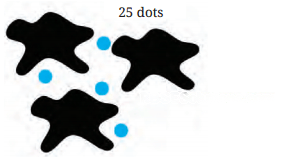
In the given picture, each black blob hides an equal number of blue dots. If there are 25 dots in total, how many dots are covered by one blob? Write an equation to describe this problem.
Solution:
Let each blob cover x dots.
Let’s say there are n blobs and some visible dots v
Required equation : nx + v = 25
Question 4.
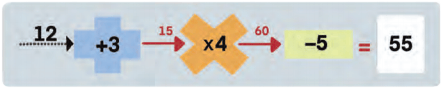
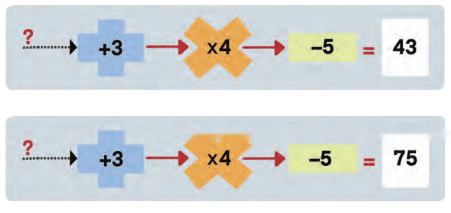
Here are machines that take an input, perform an operation on it and send out the result as an output.
(a)
Find the inputs in the following cases :
(b)
Find the inputs in the following cases :
Solution:
(a) For first image,
Let input be x.
[(x + 3) × 4] – 5 = 43
(x + 3) × 4 = 48
x + 3 = 12
x =9
For second image,
Let input = x
[(x + 3) × 4] – 5 = 75
(x + 3) × 4 = 80
x + 3 = 20
x = 17
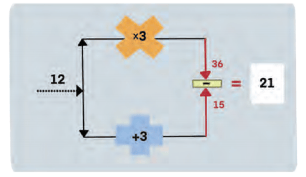
(b) For the first image, let the input number be x.
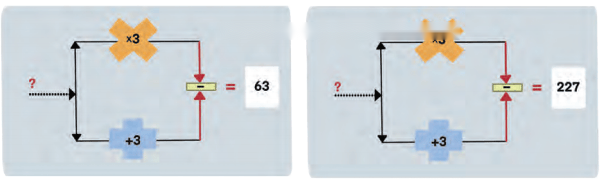
Then, (x × 3) – (x + 3 ) = 63
3x – x – 3 = 63
2x – 3 = 63
2x = 66
x = 33
Thus, input is 33.
For the second image, let the input number be x.
Then, (x × 3) – ( x + 3) = 227
3x – x – 3 = 227
2x – 3 = 227
2x = 230
x = 115
Thus, input is 115.
Question 5.
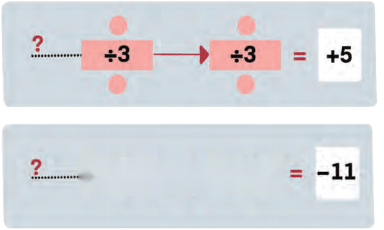
What are the inputs to these machines?
Solution:
The required number is : 5 × 3 = 15
15 × 3 =45
In second figure, -11 + 4 = -7
Then, -7 + 4 = -3.
Question 6.
A taxi driver charges a fixed fee of ₹ 800 per day plus ₹ 20 for each kilometer travelled. If the total cost for a taxi ride is ₹ 2200, determine the number of kilometres travelled.
Solution:
Let distance = d km .
800 + 20d = 2200
20d = 2200 – 800
20 d = 1400
d = 70 km
Question 7.
The sum of two numbers is 76. One number is three times the other number. What are the numbers?
Solution:
Let smaller number = x
Larger number – 3x
x + 3x = 76
4x = 76
x = 19
∴ Numbers are 19 and 57.
Question 8.
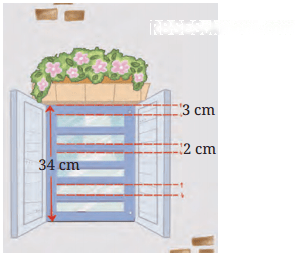
The figure shows the diagram for a window with a grill. What is the gap between two rods in the grill?
Solution:
Total width = 34 cm, Rod width = 2 cm, End margins = 3 cm each.
Let gap be x cm.
Need to count number of rods and gaps from the diagram.
Assuming 5 rods and 4 gaps :
2(3) + 5(2) + 4g = 34
6 + 10 + 4g = 34
4g = 18
g = 4.5 cm
Question 9.
In a restaurant, a fruit juice costs ₹ 15 less than a chocolate milkshake. If 4 fruit juices and 7 chocolate milkshakes cost ₹ 600, find the cost of the fruit juice and milkshake.
Solution:
Let milkshake cost be ₹ m.
Fruit juice cost = ₹(m – 15)
4(m – 15) + 7m = 600
4m – 60 + 7m = 600
11m = 660
m = 60
Milkshake = ₹ 60, Fruit juice = ₹ 45
Question 10.
Given 28p – 36 = 98, find the value of 14p – 19 and 28p – 38.
Solution:
From 28p – 36 = 98 :
28p = 98 + 36 = 134
14p – 19 = – 19
= – 19
= 67 – 19 =48
28p – 38 = 134 – 38 = 96
Question 11.
The steps to solve three equations are shown below. Identify and correct any mistakes.
(a) 6x + 9 = 66
x + 9 = 11
x = 11 – 9
x = 2
Solution:
The first step in this solution is incorrect.
The correct solution is : 6x + 9 = 66
6x = 66 – 9
6x = 57
x =
(b) 14y + 24 = 36
7y + 12 = 18
7y = 6
y =
Solution:
The solution is correct.
(c) 4x – 5 = 9x + 8
4x = 9x + 8 – 5
4x = 9x + 3
4x – 9x = 3
-5x = 3
x =
Solution:
The second step is incorrect, in which when 5 moved to RHS, it does not change its sign.
4x – 5 = 9x + 8
4x = 9x + 8 + 5
4x = 9x + 13
4x – 9x = 13
-5x = 13
x =
Question 12.
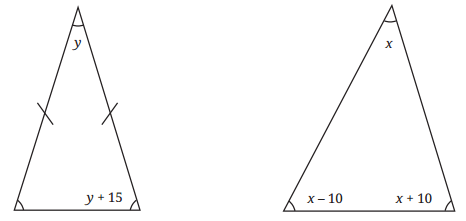
Find the measures of the angles of these triangles.
Solution:
(a) Sum of all angles in a triangle is 180°.
y+y+ 15+_y + 15 = 180° (opposite sides have equal angle opposite to it)
3y + 30°= 180°
3y = 180° – 30°
3y = 150°
y = 50°
Then, angles of the triangle are 50°, 65° and 65°.
(b) Sum of all angles in a triangle is 180°.
x + x – 10° + x + 10° = 180°
3x = 180°
x = 60°
Then, angles of the triangle are 50°, 60° and 70°.
Question 13.
Write 4 equations whose solution is u = 6.
Solution:
u – 2 = 4
2 u = 12
u + 5 = 11
3u – 10 = 8
Question 14.
The Bakhshali Manuscript (300 CE) mentions the following problem. The amount given to the first person is not known. The second person is given twice as much as the first. The third person is given thrice as much as the second; and the fourth person four times as much as the third. The total amount distributed is 132. What is the amount given to the first person?
Solution:
Let first person get be x.
Second person get be 2x.
Third person = 3(2x) = 6x
Fourth person = 4(6x) = 24x
Total : x + 2x + 6x + 24x = 132
33x = 132
x =4
So, the amount given to the first person is 4.
Question 15.
The height of a giraffe is two and a half metres more than half its height. How tall is the giraffe?
Solution:
Let height = h
h = + 2.5
2h = h + 5
h = 5 meters
Question 16.
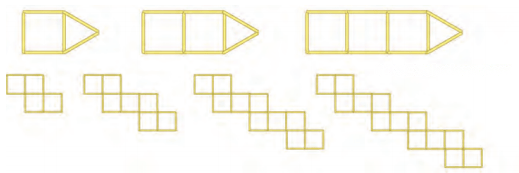
Two separate figures are given below. Each figure shows the first few positions in a sequence of arrangements made with sticks. Identify the pattern and answer the following questions for each figure :
(a) How many squares are in position number 11 of the sequence?’
(b) How many sticks are needed to make the arrangement in position number 11 of the sequence?
(c) Can an arrangement in this sequence be made using exactly 85 sticks? If yes, which position number will it correspond to?
(d) Can an arrangement in this sequence be made using exactly 150 sticks? If yes, which position number will it correspond to?
Solution:
(a) In first pattern, there is 1 square increasing in each step. So, at 11thposition there will be 11 squares.
In second pattern, there are 4 squares in 1stfigure, 7 squares in 2ndfigure, 10 squares in 3rdfigure, 13 squares in 4thfigure. They are increasing by 3.
So, at position there will be 34 squares.
(b) In first pattern, number of sticks used are: 6, 9, 12…
So, number of sticks in 11th position will be 36.
In second pattern, number of sticks used are : 13, 22, 31, 40..
So, number of sticks in 11thposition will be 103.
(c) 85 sticks sequence will not occur in pattern 1.
But it will occur in pattern 2 at 9thterm.
(d) In first pattern, using 150 digits the figure will be 49th.
In second pattern, using 150 digits no figure will be formed.
Question 17.
A number increased by 36 is equal to ten times itself. What is the number?
Solution:
Let number be x.
x + 36 = 10x
36 = 10x – x
36 = 9x
x = 4
Question 18.
Solve these equations :
(a) 5(r + 2) = 10
(b) – 3(u + 2) = 2(u – 1)
(c) 2(7 – 2«) = – 6
(d) 2(x – 4) = – 16
(e) 6(x – 1) = 2(x – 1) – 4
(f) 3 – 7s = 7 – 3s
(g) 2x + 1 = 6 – (2x – 3)
(h) 10 – 5x = 3(x – 4) – 2(x – 7)
Solution:
(a) 5(r + 2) = 10
5r + 10 = 10
5r = 10 – 10
5r = 0
r = 0
(b) -3 = (u + 2) = 2(u – 1)
-3u – 6 = 2u – 2
-3u – 2u = -2 + 6
-5u = 4
u =
(c) 2(7 – 2n) = – 6
14 – 4n = -6
-4n = -6 – 14
-4n = -20
n = 5
(d) 2(x – 4) = – 16
2x – 8= -16
2x= -16 + 8
2x = -8
x = = -4
(e) 6(x – 1) = 2(x – 1) – 4
6x – 6 = 2x – 2 – 4
6x – 2x = -6 + 6
4x = 0
x = 0
(f) 3 – 7s = 7 – 3s
-7s + 3s = 7 – 3
-4s = 4
s = -1
(g) 2x + 1 = 6 – (2x – 3)
2x + 1 = 6 – 2x + 3
2x + 2x = 9 – 1
4x = 8
x = = 2
(h) 10 – 5x = 3(x – 4) – 2(x – 7)
10 – 5x = 3x – 12 – 2x + 14
10 – 5x = x + 2
-5x – x = 2 – 10
-6x = – 8
x =
Question 19.
Solve the equations to find a path from Start to the End. Show your work in the given boxes provided and colour your path as you proceed.
Solution:
Do it yourself
Question 20.
There are some children and donkeys on a beach. Together they have 28 heads and 80 feet. How many donkeys are there? How many children are there?
Solution:
Let children = c, donkeys = d
Equation 1 (heads) : c + d = 28
Equation 2 (feet) : 2c + 4d = 80 (children have 2 feet, donkeys have 4 feet)
From equation 1 : c = 28 – d
Substitute in equation 2 : 2(28 – d) + 4d = 80
56 – 2d + 4d = 80
2d = 24
d = 12
c = 28 – d
c = 28 – 12 = 16
So, there are 12 donkeys and 16 children on the beach.
It’s Puzzle Time
A Magic Trick
Think of any number.
Now multiply it by 2.
Add 10.
Divide by 2.
Now subtract the original number you thought of.
Finally, add 3.
I predict that you now have 8. Am I correct?
Try the trick on your friends and family!
Can you explain why the trick works?
[Hint: Denote the first number thought of by x.]
Can you make your own such tricks?
Solution:
Yes, you are correct! The answer will always be 8, no matter which number is chosen.
Step 1: Translate the steps into algebra
Let’s follow the instructions using the variable x for the original number:
- Think a number : x
- Multiply by 2 : 2x
- Add 10 : 2x + 10
- Divide by 2 : = x + 5
- Subtract the original number : (x + 5) – x = 5
- Add 3 : 5 + 3 = 8
The trick works because the original number x is cancelled out during the subtraction step. By doubling the number and then dividing by two, you return to the original value, but the constant you added (10) also gets halved (to 5). Since you subtract the original x, you are always left with that halved constant. Adding 3 at the end simply moves that predictable result to 8.
Create your own trick : Do it yourself