A Peek Beyond the Point Class 7 Solutions RBSE Maths Ganita Prakash Chapter 3
PracticingGanita Prakash Class 7 Solutionsand RBSE Class 7 Maths Chapter 3 A Peek Beyond the Point Solutions Question Answer helps develop logical thinking and accuracy.
RBSE Class 7 Maths Chapter 3 A Peek Beyond the Point Solutions
Ganita Prakash Class 7 Chapter 3 Solutions
Class 7 Maths Ganita Prakash Part 1 Chapter 3 Solutions
In-text Questions
Pages 46-47
Question 1.
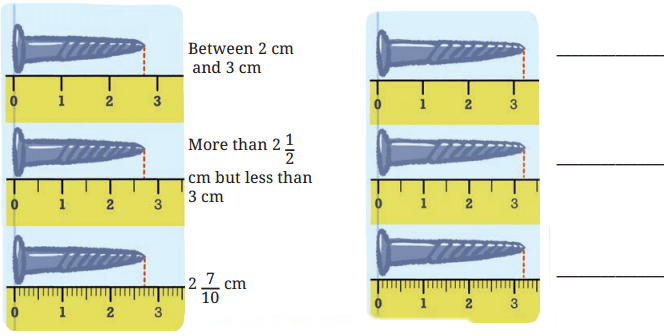
In the following figure, screws are placed above a scale. Measure them and write their length in the space provided.
Solution:
(i) Between 3 cm and 4 cm
(ii) More than 3 cm but less than 3 cm
(iii) 3 cm
Pages 47-48
Question 1.
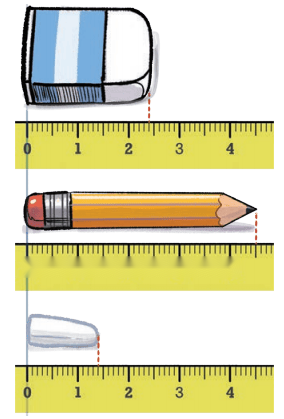
Write the measurements of the. objects shown in the picture:
Solution:
(i) 2 cm
(ii) 4 cm
(iii) 1 cm
Page 49
Question 1.
Arrange these lengths in increasing order:
(a)
(b) 1
(c)
(d) 13
(e) 10
(f) 7
(g) 6
(h)
Solution:
(a) units
(b) 1 units = units
(c) units
(d) 13 units = units
(e) 10 units = units
(f) 7 units = units
(g) 6 units = units
(h)
∵ 4 < 9 < 17 < 67 < 76 < 105 < 130 < 131
∴ < < < < < < <
So the given lengths in increasing order
(h) units
(b) 1 units
(f) 7 units
(c) units
(a) units
(g) 6 units
(e) 10 units
(d) 13 units
Page 50
Question 1.
Arrange the following lengths in increasing order: Class 7
4, , , 41.
Solution:
4 units = units
units
units
41 units = units
∵ 4 < 40, 41 < 411
∴ < = <
So the given lengths in increasing order are units, 4 units, units, 41 units
Page 51
Question 1.
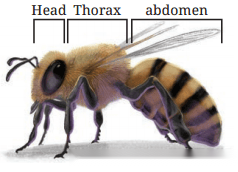
The lengths of the body parts of a honeybee are given. Find its total length.
Head: 2 units
Thorax: 5 units
Abdomen: 7 units
Solution:
The total length of the honeybee
2 + 5 + 7
= 2 + + 5 + + 7 +
= (2 + 5+ 7) + ( + + )
= 14 + = 14 + 1 +
= 15 + = 15 units
Page 52
Question 1.
A Celestial Pearl Danio’s length is 2 cm, and the length of a Philippine Goby is cm. What is the difference in their lengths?
Solution:
Length of a Celestial Pearl Danio = 2 cm
Length of a Philippine Goby = cm
∴ Difference in their lengths
2cm – cm
= cm – cm (∵ 1 unit = 10 one-tenths)
= cm = cm
= cm = ( + )cm
= (1 + )cm = 1cm
Question 2.
Observe the given sequences of numbers. Identify the change after each term and extend the pattern:
(a) 4, 4, 4, ________, ________, ________, ________
(b) 8, 8, 9, ________, ________, ________, ________
(c) 7, 8, ________, ________, ________, ________
(d) 5, 5, ________, ________, ________, ________
(e) 13, 13, 12, ________, ________, ________, ________
(f) 11, 10, 9, ________, ________, ________,
Solution:
(a) 4, 4, 4, 4, 5, 5
(b) 8, 8, 9, 9, 10, 10, 11
(c) 7, 8, 9, 10, 12, 13
(d) 5, 5, 4, 4, 4, 3
(e) 13, 13, 12, 12, 11, 11, 10
(f) 11, 10, 9, 8, 7, 6, 4.
Page 54
Question 1.
Observe the figure below. Notice the markings and the corresponding lengths written in the boxes when measured from 0. Fill the lengths in the empty boxes.
Solution:


Question 2.
For the lengths shown below write the measurements and read out the measures in words.
Solution:
(i) Length shown = 5
= + = + = = 5
= 5 units and 37 one-hunderdths
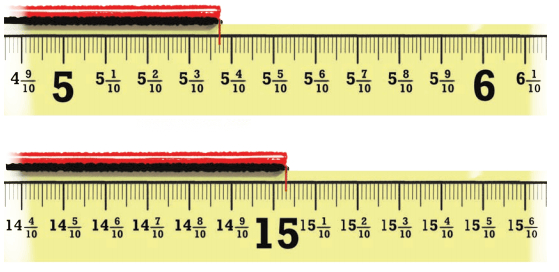
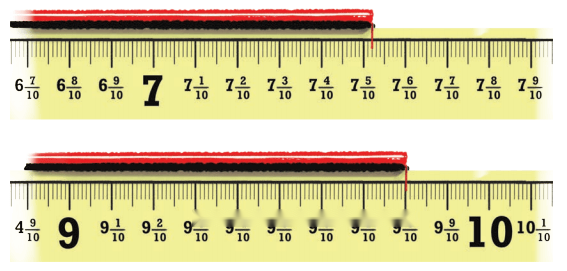
(ii) Length shown = 15 + = 15
= 15 units and 3 one-hunderdths
(iii) Length shown = 7 +
= + = + = = 7
= 7 units and 52 one-hunderdths
(iv) Length shown = 9 = 9
= 9 units and 80 one-hunderdths
Page 55
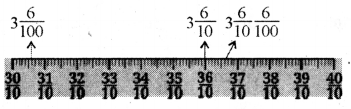
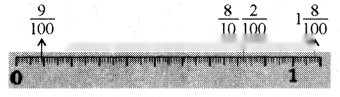
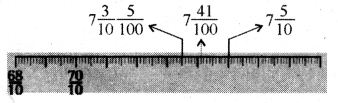
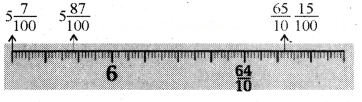
Question 1.
In each group, identify the longest and the shortest lengths. Mark each length on the scale.
(a) , ,
Solution:
Longest:
Shortest:

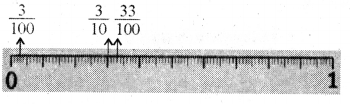
(b) 3, , 1
Solution:
Longest: 3
Shortest: 1

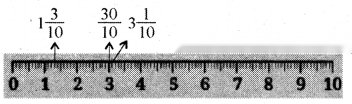
(c) , , ,
Solution:
Longest:
Shortest:

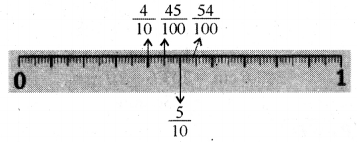
(d) 3 , 3, 3
Solution:
Longest: 3
Shortest: 3

(e) , , 1
Solution:
Longest: 1
Shortest:

(f) 7, 7, 7
Solution:
Longest: 7
Shortest: 7

(g) , 5, 5
Solution:
Longest:
Shortest: 5
Each length has been marked on the scale.

Page 61
Question 1.
We can ask similar questions about fractional parts:
(a) How many thousandths make one unit?
(b) How many thousandths make one tenth?
(c) How many thousandths make one hundredth?
(d) How many tenths make one ten?
(e) How many hundredths make one ten?
Solution:
(a) A thousand thousandths make one unit.
(b) A hundred thousandths make one tenth.
(c) A ten thousandths make one hundredth.
(d) A hundred tenths make one ten.
(e) A thousand hundredths make one ten.
Page 63
Question 1.
Make a place value table similar to the one above (page 62). Write each quantity in decimal form and in terms of place value, and read the number.
(a) 2 ones, 3 tenths and 5 hundredths
(b) 1 ten and 5 tenths
(c) 4 ones and 6 hundredths
(d) 1 hundred, 1 one and 1 hundredth
(e) and
(f)
(g)
(h) 2 4 and 7
Solution:
Decimal Number | Hundreds | Tens | Units | Tenths | Hundredth | Thousandth |
(a) 235 | 2 | 3 | 5 | |||
(b)10.5 | 1 | 5 | ||||
(c) 4.06 | 4 | 6 | ||||
(d) 101.01 | 1 | 1 | 1 | |||
(e) 0.080.9 | 80.9 | |||||
(f) 0.05 | 5 | |||||
(g)0.1 | 1 | |||||
(h) 2.014.17.007 | 247 | 1 | 1 | 7 |
Page 64
Question 1.
Write these quantities in decimal form :
(a) 234 hundredths,
Solution:
234 hundredths = =
= + + = 2 + +
= 2.34
(b) 105 tenths.
Solution:
105 tenths = =
= +
= 10 + = 10.5
Page 65
Question 1.
Fill in the blanks below (g < – > kg):
12 mm = 1.2cm | 56mm = 5.6cm | 70 mm = _____ |
_____ = 0.9cm | 134mm = _____ | _____ = 203.6 cm |
Solution:
70 mm = cm = 7 cm
0.9 cm = 0.9 × 10 mm = 9 mm
134 mm = 130 mm + 4 mm
= cm + cm
= 13 cm + 0.4 cm
= 13.4 cm
203.6 cm = 203.6 × 10 mm
= 2036 mm
Page 66
Fill in the blanks below (cm < – > m):
36 cm = _____ | 50 cm = _____ | _____ = 0.89m |
4 cm = _____ | 325 cm = _____ | _____ = 2.07 m |
Solution:
36cm= m = 0.36 cm
50 cm= m = 0.5 m
0.89 m = 0.89 × 100 cm
= 89 cm
4cm = m = 0.04 m
325 cm = 300 cm + 25 cm
= m + m
= 3 m + 0.25 m
= 3.25 m
2.07 m = 2.07 × 100 cm = 207 cm
Page 67-68
Question 1.
Fill in the blanks below (g < – > kg):
465 g = _____ | 68 g = _____ | 1560 g = _____ |
704 g = _____ | _____ = 0.56 kg | _____ = 2.5 kg |
Solution:
465 gm = = 0.465 kg
68 gm = = 0.068 kg
1560 gm = = 1.56 kg
704 gm = = 0.704 kg
0.56 kg = 0.56 × 1000 = 560 gm
2.5 kg = 2.5 × 1000 = 2500 gm
Page 69
Question 1.
Fill in the blanks below (rupee < – > paise):
10p = _____ | _____ p = ₹ 0.05 | _____ p = ₹ 0.36 |
_____ = ₹ 0.50 | 99 p = _____ | 250 p = _____ |
Solution:
10 p = rupee = rupee = 0.1 rupee
₹ 0.05 = 0.05 × 100 paise = 5 paise
₹ 0.36 =036 × 100 paise = 36paise
₹ 0.50 = 0.50 × 100 paise
= × 100 paise
= 5 × 10 paise
= 50 paise
99 paise = = ₹ 0.99
250 paise = = ₹ 2.50
Page 70
Question 1.
Name all the divisions between 1 and 1.1 on the number line.
Solution:


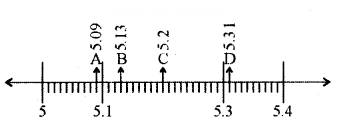
Question 2.
Identify and write the decimal numbers against the letters.
Solution:

Page 71
Question 1.
Which of these are the same : 4.5, 4.05, 0.405, 4.050, 4.50, 4.005, 04.50?
Solution:
4.5, 4.50, 04.50 are the same,
4.05, 4.050 are the same.
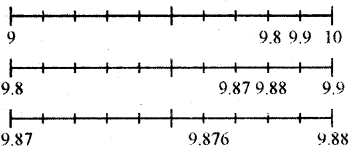
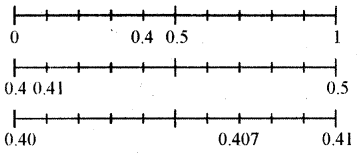
Question 2.
Make such number lines for the decimal numbers:
(a) 9.876
(b) 0.407
Solution:
(a)
(b)
Question 3.
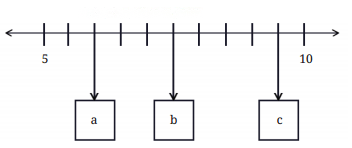
In the number line shown below, what decimal numbers do the boxes labelled ‘a’, ‘b’ and ‘c’ denote? •
Solution:
a = 6
b = 7.5
c = 9.5
Page 73
Question 1.
Which decimal number is greater?
(a) 1.23 or 1.32
(b) 3.81 or 13.800
(c) 1.009 or 1.090
Solution:
(a) 1.32 > 1.23
(b) 13.800 > 3.81
(c) 1.090 > 1.009
Question 2.
Which among these is closest to 4 : 3.56, 3.65, 3.099?
Solution:
Arranging the given numbers in ascending order, we get
3.099 < 3.56 < 3.65.
4 is among from 3.65 and awayfrom3.56. So, 4 is closest to 3.65.
Question 3.
Which among these is closest to 1 : 0.8, 0.69, 1.08?
Solution:
Arranging the given numbers in ascending order, we get
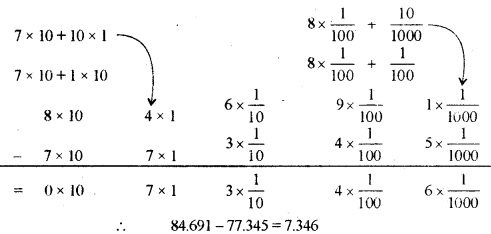
0.69 < 0.8 < 1.08. 1 is away from 0.8 and away from 1.08. So, 1 is closest to 1.08. Page 75 Question 1. Write the detailed place value computation for 84.691 – 77.345, and its compact form. Solution:
Page 76
Question 1.
Similarly, identify the change and write the next 3 terms for each sequence given below. Try to do this computation mentally.
(a) 4.4, 4.45, 4.5,
(b) 25.75, 26.25, 26.75, ….
(c) 10.56, 10.67, 10.78, ….
(d) 13.5, 16, 18.5, …
(e) 8.5, 9.4, 10.3, …
(f) 5, 4.95, 4.90, …
(g) 12.45, 11.95, 11.45, …
(h) 36.5, 33, 29.5, …
Solution:
(a) The next 3 terms are: 4.55, 4.60, 4.65
(b) The next 3 terms are: 27.25, 27.75, 28.25
(c) The next 3 terms are: 10.89, 1100, 11.11
(d) The next 3 terms are: 21.0, 23.5, 26.0
(e) The next 3 terms are: 11.2, 12.1, 13
(f) The next 3 terms are: 4.85, 4.80, 4.75
(g) The next 3 terms are: 10.95, 10.45, 9.95
(h) The next 3 terms are: 26, 22.5, 19
Class 7 Maths Ganita Prakash Chapter 3 Solutions
Figure it Out (Page 58)
Question 1.
(a) + 3
Solution:
Sum = + 3
= + 3 +
= + 3 +
[∵ 1 one-tenth = 10 one-hunderdths]
= 3 + + = 3 + = 3
(b) 9 + 2
Solution:
Sum = 9 + 2
= + = =
=
[∵ 10 one-hunderdths = 1 one-tenth]
= = + = 10 +
= 10 + = 10 + +
= 10 + 1 + [∵ 10 one-tenths = 1 unit]
= 11 + = 11
(c) 15 + 14
Solution:
Sum = 15 + 14
= (15 + + ) + (14 + + )
= (15 + 14) + ( + ) + ( + )
= 29 + +
= 29 + + [∵ 10 one-hunderdths = 1 one-tenth]
= 29 + = 29 +
= 29 + 1 [∵ 10 one-tenths = 1 unit]
= 30
(d) 7 – 4
Solution:
Difference = 7 – 4
= (7 + ) – (4 + )
= (7 – 4) + ( – )
= 3 + = 3
(e) 8 – 5
Solution:
Difference = 8 – 5
= (8 + ) – (5 + )
= (8 – 5) ( – )
= 3 + = 3
(f) 12 –
Solution:
Difference = 12 –
= (12 + + ) – ( + )
= (12 + +) – ( + )
= (12 + ) –
= (11 + 1 + ) –
= (11 + + ) –
= 11 + ( – )
= 11 + = 11
Figure it Out (Page 75)
Question 1.
Find the sums
(a) 5.3 + 2.6
Solution:
(b) 18 + 8.8
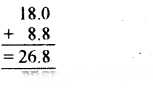
Solution:
(c) 2.15 + 5.26
Solution:
(d) 9.01 + 9.10
Solution:

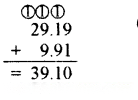
(e) 29.19 + 9.91
Solution:

(f) 0.934 + 0.6
Solution:
(g) 0.75 + 0.03
Solution:

(h) 6.236 + 0.487
Solution:

Question 2.
Find the differences
(a) 5.6 – 2.3
Solution:

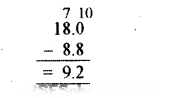
(b) 18 – 8.8
Solution:

(c) 10.4 – 4.5
Solution:
(d) 17 – 16.198
Solution:

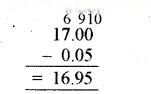
(e) 17 – 0.05
Solution:

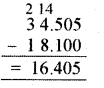
(f) 34.505 – 18.1
Solution:
(g) 9.9 – 9.09
Solution:
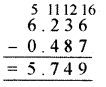
(h) 6.236 – 0.487
Solution:

Figure it Out (Pages 78-80)
Question 1.
Convert the following fractions into decimals:
(a)
Solution:
= 0.05
(b)
Solution:
= 0.016
(c)
Solution:
= = +
= 1 + = 1 + 0.2 = 1.2
(d)
Solution:
= = +
= + = +
= 0.2 + 0.054 = 0.254
Question 2.
Convert the following decimals into a sum of tenths, hundredths and thousandths:
(a) 0.34
(b) 1.02
(c) 0.8
(d) 0.362
Solution:
(a) 0.34 = 0 + +
(b) 1.02 = 1 + +
(c) 0.8 =
(d) 0.362 = + +
Question 3.
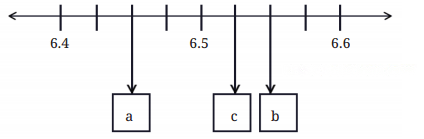
What decimal number does each letter represent in the number line below?
Solution:
Letter a represents
6.4 + = 6.4 +
= 6.4 + = 6.4 + 0.o5 = 6.45
Letter c represents
6.5 + = 6.5 +
= 6.5 + 0.025 = 6.525
Letter b represents
6.5 + ()
= 6.5 +() = 6.5 +
= 6.5 + 0.05 = 6.55
Question 4.
Arrange the following quantities in descending order:
(a) 11.01, 1.011, 1.101, 11.10, 1.01
(b) 2.567, 2.675, 2.768, 2.499, 2.698
(c) 4.678 g, 4.595 g, 4.600 g, 4.656 g, 4.666 g
(d) 33,13 m, 33.31 m, 33.133 m, 33.33 1 m, 33.313m.
Solution:
The given quantities in descending order are as follows:
(a) 11.10 > 11.01 > 1.101 > 1.011 > 1.01
(b) 2.768 > 2.698 > 2.675 > 2.567 > 2.499
(b) 4.678 g > 4.666 g > 4.656 g > 4.600 g > 4.595 g
(c) 33.331 m > 33.313 m > 33.31 m > 33.133 m > 33.13 m.
Question 5.
Using the digits 1,4,0,8 and 6 make :
(a) The decimal number closest to 30.
(b) The smallest possible decimal number between 100 and 1000.
Solution:
(a) 40.168
(b) 104.68
Question 6.
Will a decimal number with more digits be greater than a decimal number with fewer digits?
Solution:
It is not always,
because 0.9 > 0.123456789
Question 7.
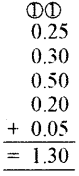
Mahi purchases 0.25 kg of beans, 0.3 kg of carrots, 0.5 kg of potatoes, 0.2 kg of capsicums, and 0.05 kg of ginger. Calculate the total weight of the items she bought.
Solution:
Weight of beans = 0.25 kg
Weight of carrots = 0.3 kg
Weight of potatoes = 0.5 kg
Weight of capsicums = 0.2 kg
Weight of ginger = 0.05 kg
∴ Total weight of the items she bought
= 0.25 kg + 0.3 kg + 0.5 kg + 0.2 kg 0.05 kg
= 1.3 kg
Question 8.
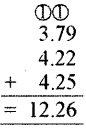
Pinto supplies 3.79 L, 4.22 L, and 4.25 L of milk to a milk dairy in the first three days. In 6 days, he supplies 25 liters of milk. Find the total quantity of milk supplied to the dairy in the last three days.
Solution:
Total quantity of milk supplied to the dairy in the first three days
= 3.79 L +4.22 L +4.25 L 3.79
= 12.26
Total quantity of milk supplied in 6 days = 25 liters
Total quantity of milk supplied to the dairy in the rest three days
= 25 L – 12.26 L
= 12.74 L
Question 9.
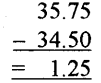
Tinku weighed 35.75 kg in January and 34.50 kg in February. Has he gained or lost weight? How much is the change?
Solution:
Weight of Tinku in January = 35.75 kg.
Weight of Tinku in February = 34.50 kg
∵ 35.75 > 34.50
∴ Tinku has lost weight.
Change = 35.75 kg – 34.50 kg
= 1.25 kg.
Question 10.
Extend the pattern 5.5, 6.4, 6.39, 7.29, 7.28, 8.18, 8.17,….,
Solution:
The extended pattern is as follows:
5.5, 6.4, 6.39, 7.29, 7.28, 8.18, 8.17, 9.07, 9.06
Question 11.
How many millimeters make 1 kilometer?
Solution:
1 kilometer = 1000 meters
= 1000 × 100 centimeters
= 100000 centimeters
= 100000 × 10 millimeters
= 1000000 millimeters
Question 12.
Indian Railways offers optional travel insurance for passengers who book e-tickets. It costs 45 paise per passenger. If 1 lakh people opt for insurance in a day, what is the total insurance fee paid?
Solution:
Total insurance fee paid
= 0.45 × 100000
= × 100000
= 45 × 100000
= ₹ 45000
Question 13.
Which is greater?
(a) or ?
Solution:
or
Clearly is greater
(b) One-hundredth or 90 thousandths?
Solution:
One-hundredth =
90 thousandths = =
Clearly is greater
∴ 90 thousandths is greater
(c) One-thousandth or 90 hundredths?
Solution:
One-thousandth =
90 hundredth = =
Clearly is greater
∴ 90 hundredths is greater
Question 14.
Write the decimal forms of the quantities mentioned (an example is given) :
(a) 87 ones, 5 tenths and 60 hundredths = 88.10
(b) 12 tens and 12 tenths
Solution:
= 12 tens = 12 × 10 = 120
12 tenths = = 1.2
∴ 12 tens and 12 tenths = 120 + 1.2 = 121.2
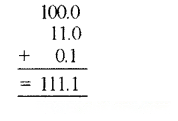
(c) 10 tens, 10 ones, 10 tenths, and 10 hundredths
Solution:
10 tens = 10 × 10 = 100
10 tens = 10
10 tenths = = 1
10 hundredths = = = 0.1
∴ 10 tens, 10 ones, 10 tenths, and 10 hundredths
= 100 + 10 + 1 + 0.1
= 111.1

(d) 25 tens, 25 ones, 25 tenths, and 25 hundredths
Solution:
25 tens = 25 × 10 = 250
25 ones = 25
25 tenths = = 2.5
25 hundredths = = 0.25
∴ 25 tens, 25 ones, 25 tenths, and 25 hundredths
= 250 + 25 + 2.5 + 0.25
= 277.75
Question 15.
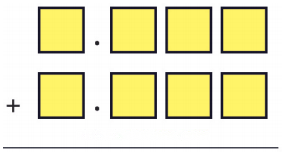
Using each digit 0 – 9 not more than once, fill the boxes below so that the sum is closest to 10.5:
Solution:
Here sum is closet to 10.5
Question 16.
(a)
(b)
(c)
(d)
(e)
(f)
Solution:
(a) = 0.5
(b) = 1.5
(c) = 0.25
(d) = 0.75
(e) = 0.2
(f) = 0.8