Parallel and Intersecting Lines Class 7 Solutions RBSE Maths Ganita Prakash Chapter 5
PracticingGanita Prakash Class 7 Solutionsand RBSE Class 7 Maths Chapter 5 Parallel and Intersecting Lines Solutions Question Answer helps develop logical thinking and accuracy.
RBSE Class 7 Maths Chapter 5 Parallel and Intersecting Lines Solutions
Ganita Prakash Class 7 Chapter 5 Solutions
Class 7 Maths Ganita Prakash Part 1 Chapter 5 Solutions
In-text Questions
Page 106
Question 1.
How many angles do the pair of lines form?
Solution:
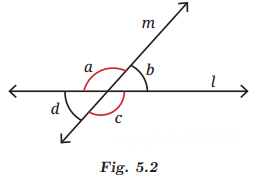
In the following figure, we see that line l intersects line m. We see that four angles are formed.
Page 107
Question 1.
Can two straight lines intersect at more than one point?
Solution:
No, two straight lines cannot intersect at more than one point.
Page 108
Question 1.
Can you draw a pair of intersecting lines such that all four angles are equal? Can you figure out what will be the measure of each angle?
Solution:
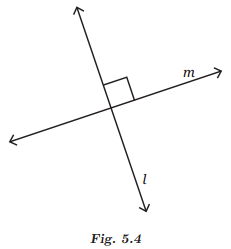
Perpendicular lines are a pair of lines which intersect each other at right angles (90°). Lines l and m are perpendicular to each other.
If two lines intersect and all four angles are equal, then each angle must be a right angle (90°).
Page 110
Question 1.
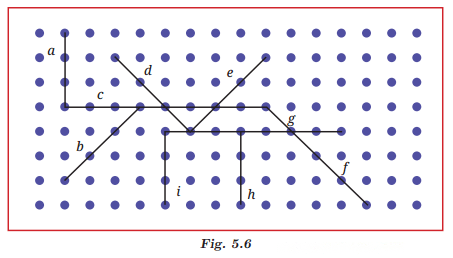
Which pairs of lines appear to be parallel in Fig. below?
Solution:
Line a is parallel to line i and h both,
Line c is parallel to line g,
Line d is parallel to line f
Line b is parallel to line e.
Page 125
Question 1.
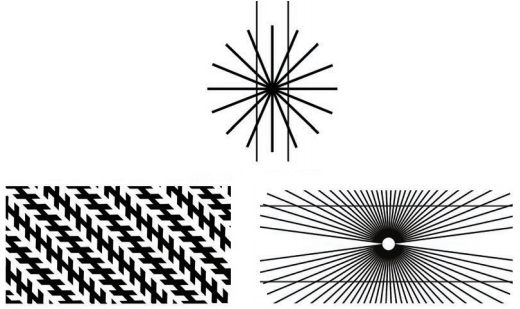
There do not seem to be any parallel lines here, Or, are there?
What causes these illusions?
Solution:
Sun rays seem to be parallel lines due to coming from a very very long distance. Actually, it is not so.
Sunlight causes these illusions.
Class 7 Maths Ganita Prakash Chapter 5 Solutions
Figure it Out (Page 108)
Question 1.
List all the linear pairs and vertically opposite angles you observe in Fig.
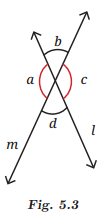
Linear Pairs | ∠a and ∠b, …. |
Pairs of Vertically Opposite Angles | ∠b and ∠d, …. |
Solution:
Linear Pairs | ∠a and ∠b;∠a and ∠d;∠b and ∠c;∠c and ∠d |
Pairs of Vertically Opposite Angles | ∠b and ∠d;∠a and ∠c |
Figure it Out (Pages 113-114)
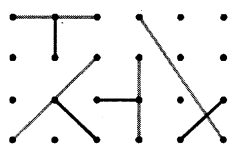
Question 1.
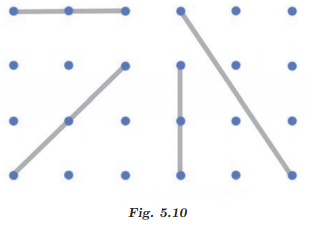
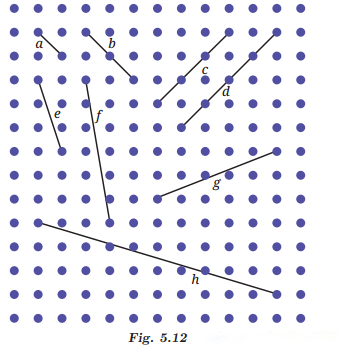
Draw some lines perpendicular to the lines given on the dot paper in Fig. given below.
Solution:
Question 2.
In Fig. 5.11, mark the parallel lines using the notation given above (single arrow, double arrow etc.). Mark the angle between perpendicular lines with a square symbol.
(a) How did you spot the perpendicular lines?
(b) How did you spot the parallel lines?
Solution:
(a) We identified perpendicular lines using the concept that perpendicular lines intersect each other at right angle.
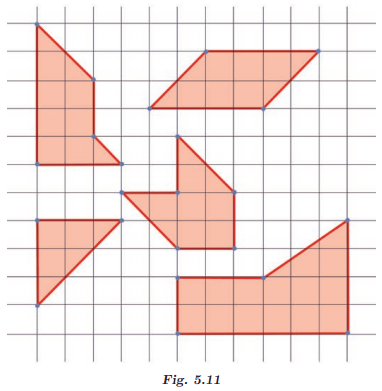
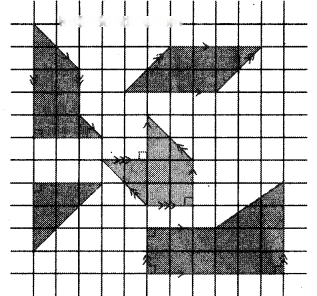
(b) Parallel lines do not meet each other, no matter how far we extend them on both sides.
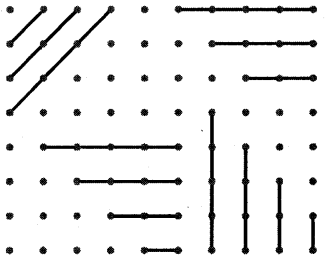
Question 3.
In the dot paper following, draw different sets of parallel lines. The line segments can be of different lengths but should have dots as endpoints.
Solution:
Question 4.
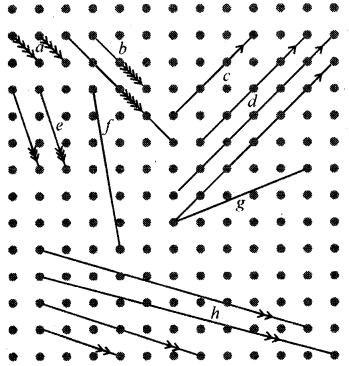
Using your sense of how parallel lines look, try to draw lines parallel to the line segments of this dot paper.
(a) Did you find it challenging to draw some of them?
(b) Which ones?
(c) How did you do it?
Solution:
(a) Yes
(b) a, b and e
(c) By keeping in mind the definition of parallel lines.
Question 5.
In Fig., which line is parallel to line a—line b or line c? How do you decide this?
Solution:
Line a is parallel to line b.
We decided this by keeping in mind the concept of parallel lines.
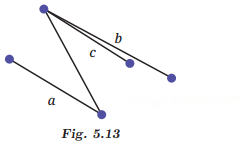
Figure it Out (Page 119)
Question 1.
Can you draw a line parallel to l, that goes through point A? How will you do it with the tools from your geometry box? Describe your method.
Solution:
1. Draw a line m through A intersecting line l making ∠a with l.
2. At A, draw a line n such that it also makes ∠a with m.
Since the two corresponding angles are equal, therefore, line n is parallel to line l and it passes through A
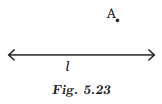
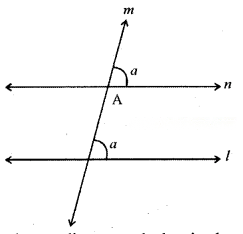
Figure it Out (Pages 123-125)
Question 1.
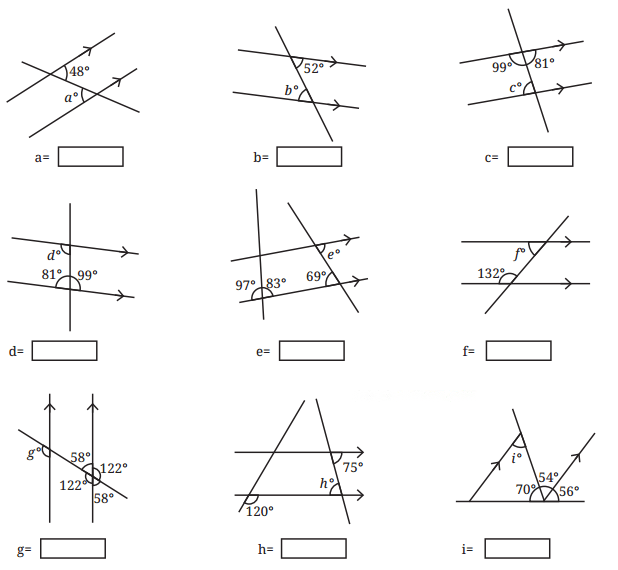
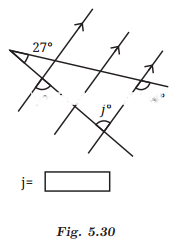
Find the angles marked below.
Solution:
a = 48° (Alternate angles)
b = 52° (Alternate angles)
e = 81° (Alternate angles)
d = 99° (Alternate angles)
e = 69° (Alternate angles)
f + 132° = 180° (Interior angles on the same side of the transversal add upto 1800)
⇒ f = 180° – 132°= 48°
g = 122° (Corresponding angles)
h = 75° (Alternate angles)
i = 54° (Alternate angles)
J = 97° (Alternate angles)
Question 2.
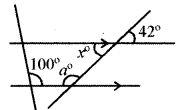
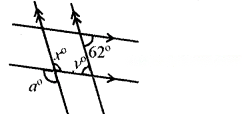
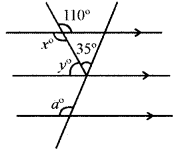
Find the angle represented by a.
Solution:
(i) x° = 42°
Vertically opposite angles are equal
a° + 42° – 180°
Interior angles on the same side formed by a transversal intersecting a pair of parallel lines always add upto 180°
⇒ a° = 180° – 42° = 138°
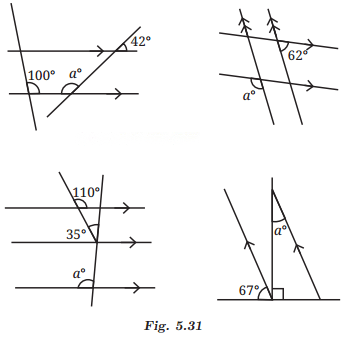
(ii) x° = a°
Vertically opposite angles are equal
y° = 62°
Alternate angles are equal
x° + y° = 180°
Sum of the interior angles on the same side of the transversal always add upto 180°
⇒ a° + 62° = 180°
⇒ a° = 180° – 62° = 118°
(iii) x°= 110°
Vertically opposite angles are equal
x° + y° = 180° (Interior angles on the same side of the transversal add upto 180°)
110° + y° = 180°
y° = 180° – 110° = 70°
a° = y° + 35° (corresponding angles)
a°= 70° + 35° = 105°
(iv) 67° + x° = 90°
A right angle measure 90°
⇒ x° = 90° – 67° = 23°
a° = x°
Alternate angles are equal
⇒ a° = 23°
Question 3.
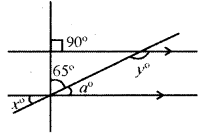
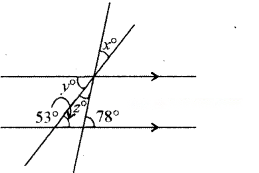
In the figures below, what angles do x and y stand for?
Solution:
(i) 65° + a° = 90°
Corresponding angles are equal
⇒ a° = 25°
x° = a°
Vertically opposite angles are equal
= 25°
⇒ x = 25°
y° + a° = 180°
Sum of the interior angles on the same side of the transversal add upto 180°
⇒ y° + 25°= 180°
⇒ y°= 180° – 25° = 155°
⇒ y= 155°
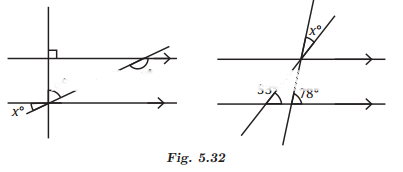
(ii) y°= 53°
Alternate angles are equal
⇒ y = 53
y° + z°= 78°
Alternate angles are equal
⇒ 53° + z° = 78°
⇒ z°= 78 – 53° = 25°
x° = z°
Vertically opposite angles are equal
⇒ x° = 25° ⇒ x = 25
Question 4.
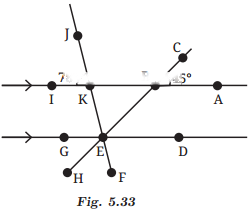
In Fig., ∠ABC = 45° and ∠IKJ = 78°. Find angles ∠GEH, ∠HEF, ∠FED.
Solution:
∠GEK = ∠IKJ
Corresponding angles are equal = 78°
∠GEK = ∠FED = 78°
Vertically opposite angles
∠DEB = ∠ABC = 45°
Corresponding angles are equal
∠HEF = 180° – (78° + 45°)
Linear pair always add upto 180°
∠HEF = 180°- 123° = 57°
∠GEH = 180° – (78° + 57°)
Linear pair always add upto 180°
∠GEH = 45°
Question 5.
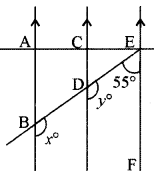
In Fig., AB is parallel to CD and CD is parallel to EF. Also, EA is perpendicular to AB. If ∠BEF = 55°, find the values of x and y.
Solution:
y° + 55° = 180°
Sum of the interior angles on the same side of the transversal add upto 180°
⇒ y° = 180°- 55° = 125°
x° =y°
Corresponding angles are equal
⇒ x° = 125°
Question 6.
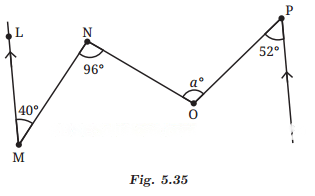
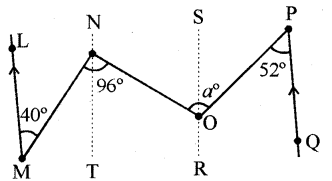
What is the measure of angle ∠NOP in Fig.?
[Hint: Draw lines parallel to LM and PQ through points N and O.]
Solution:
∠LMN = ∠MNT
Alternate angles are equal
⇒ 40° = ∠MNT …….(1)
∴ ∠TNO = ∠MNO – ∠MNT
= 96° – 40° = 56° …….(2)