A Tale of Three Intersecting Lines Class 7 Solutions RBSE Maths Ganita Prakash Chapter 7
PracticingGanita Prakash Class 7 Solutionsand RBSE Class 7 Maths Chapter 7 A Tale of Three Intersecting Lines Solutions Question Answer helps develop logical thinking and accuracy.
RBSE Class 7 Maths Chapter 7 A Tale of Three Intersecting Lines Solutions
Ganita Prakash Class 7 Chapter 7 Solutions
Class 7 Maths Ganita Prakash Part 1 Chapter 7 Solutions
In-text Questions
Page 146
Question 1.
What happens when the three vertices lie on a straight line?
Solution:
When the three vertices lie on a straight line, they do not form a triangle. Actually the vertices are collinear.
Pages 146-147
Question 1.
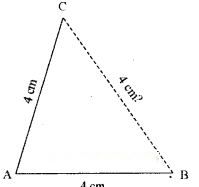
Construct a triangle in which all the three sides are of length 4 cm.
Solution:
Step 1. Draw the base AB of length 4 cm.
Step 2. Mark the third point C using a ruler such that AC = 4 cm.
Step 3. Keep making attempts to mark C till we get BC to be 4 cm long.
Page 150
Question 1.
Construct triangles having the following side lengths (all the units are in cm):
(a) 4, 4, 6
(b) 3, 4, 5
(c) 1, 5, 5
(d) 4, 6, 8
(e) 3.5, 3.5, 3.5
Solution:
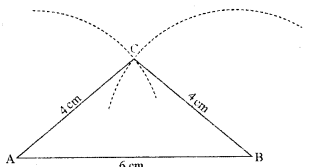
(a) Steps of construction
Step 1. Construct the base AB with one of the side lengths. Let us choose AB = 6 cm.
Step 2. From A, construct a sufficiently long arc of radius 4 cm.
Step 3. From B, construct an arc of radius 4 cm such that it intersects the first arc.
Step 4. The point where both the arcs meet is the required third vertex C.
Join AC and BC to get ∆ABC.
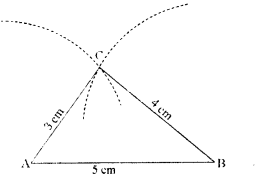
(b) Steps of construction
Step 1. Construct the base AB with one of the
side lengths. Let us choose AB = 5 cm.
Step 2. From A, construct a sufficiently long arc of radius 3 cm.
Step 3. From B, construct an arc of radius 4 cm such that it intersects the first arc.
Step 4. The point where both the arcs meet is the required third vertex C.
Join AC and BC to get ∆ABC.
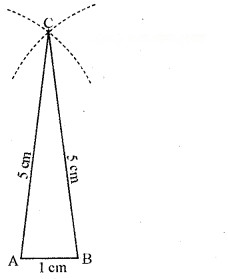
(c) Steps of construction
Step 1. Construct the base AB with one of the
side lengths. Let us choose AB = 1 cm.
Step 2. From A, construct a sufficiently long arc of radius 5 cm.
Step 3. From B, construct an arc of radius 5 cm such that it intersects the first arc.
Step 4. The point where both the arcs meet is the required third vertex C.
Join AC and BC to get ∆ABC
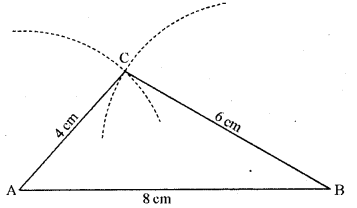
(d) Steps of construction
Step 1. Construct the base AB with one of the
side lengths. Let us choose AB = 8 cm.
Step 2. From A, construct a sufficiently long arc of radius 4 cm.
Step 3. From B, construct an arc of radius 6 cm such that it intersects the first arc.
Step 4. The point where both the arcs meet is the required third vertex C.
Join AC and BC to get ∆ABC.
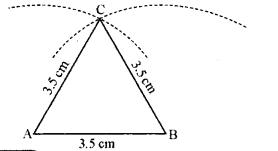
(e) Steps of construction
Step 1. Construct the base AB with one of the side lengths. Let us choose AB = 3.5 cm.
Step 2. From A, construct a sufficiently long arc of radius 3.5 cm.
Step 3. From B, construct an arc of radius 3.5 cm such that it intersects the first arc.
Step 4. The point where both the arcs meet is the required third vertex C.
Join AC and BC to get ∆ABC.
Page 151
Question 1.
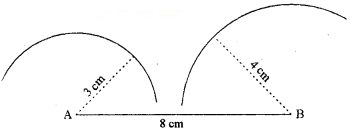
Construct a triangle with side lengths 3 cm, 4 cm, and 8 cm. What is happening? Are you able to construct the triangle?
Solution:
Since the arcs from the points A and B do not meet. So, we are not able to construct the triangle with sidelengths 3 cm, 4 cm and 8 cm.
Question 2.
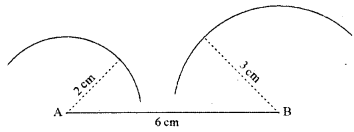
Here is another set of lengths: 2 cm, 3 cm, and 6 cm. Check if a triangle is possible for these sidelengths.
Solution:
The arcs from the points Aand B do not meet. So, a triangle is not possible for sidelengths 2 cm, 3 cm and 6 cm.
Page 153
Question 1.
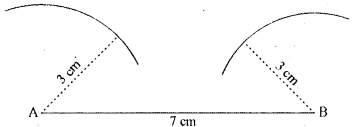
Can we say anything about the existence of a triangle having sidelengths 3 cm, 3 cm and 7 cm? Verify your answer by construction.
Solution:
Sum of the lengths of first two sides
= 3 cm + 3 cm = 6 cm
Length of the third side = 7 cm
Since the sum of the lengths of first two sides is smaller than the length of the third side, therefore, this triangle cannot exist.
Verification of Answer by Construction Steps of construction:
Step 1. Construct the base AB with one of the side lengths. Let us choose AB = 7 cm.
Step 2. From A, construct a sufficiently long arc of radius 3 cm.
Step 3. From B, construct an arc of radius 3 cm since these both the arcs do not meet each other at any point C, therefore we are not able to construct the triangle ABC. So, this triangle cannot exist.
Page 154
Question 1.
Will this always happen? That is, for any set of lengths, will there be at least two comparisons where the direct length is less than the sum of the other two? Explore for different sets of lengths.
Solution:
Yes, this will always happen.
Take two sets of lengths as follows:
(i) 9, 14, 29
(ii) 8, 13, 28
(i) 9 < 14 + 29
14 <9 +29
(ii) 8 < 13 + 28
13 <8 + 28
Page 164
Question 1.
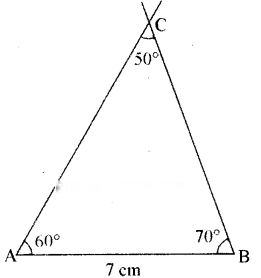
Let us take two angles, say 60° and 70°, whose sum is less than 180°. Let the included side be 5 cm.
What could the measure of the third angle be? Does this measure change if the base length is changed to some other value, say 7 cm? Construct and find out.
Solution:
Given, the measure of two angles is 60° and 70°
So, the measure of third angle = 180°
– 60° – 70° = 50°
No, this measure does not change if the base length is changed to some other value, say 7 cm.
Construction:
Steps of construction
Step 1. Draw the base AB of length 7 cm.
Step 2. Draw ∠A and ∠B of measures 60° and 70° respectively.
Step 3. The point of intersection of the two new line segments is the third vertex C.
By measurement, ∠C = 50°.
Class 7 Maths Ganita Prakash Chapter 7 Solutions
Figure it Out (Page 150-151)
Question 1.
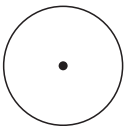
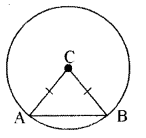
Use the points on the circle and/or the centre to form isosceles triangles.
Solution:
Select any two points on the circle and connect them to the centre of the circle. Also, join these points to each other. This will form an isosceles triangle as the two radii are equal in length.
Question 2.
Use the points on the circles and/or their centres to form isosceles and equilateral triangles. The circles are of the same size.
A and B are the centres of circles of the same size
A, B, and C are the centres of circles of the same size
Solution:
An isosceles triangle can be formed by connecting the intersecting points of two circles and the centres of either circle.
Here, isosceles triangles are AXY and BXY.
An equilateral triangle can be formed by connecting the centers of the 2 equal circles and one of their intersecting points.
Here, triangle AXB or triangle AYB is an equilateral triangle.
An equilateral triangle can be formed by connecting the centres of the 3 equal circles. Here, triangle ABC is an equilateral triangle.
In addition, ∆PAB, ∆QAC and ∆RBC are also equilateral triangles.
Also, the equilateral triangle is a special case of an isosceles triangle.
So, all these equilateral triangles are also isosceles.
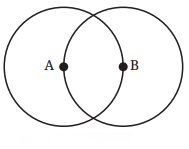
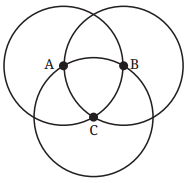
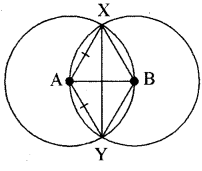
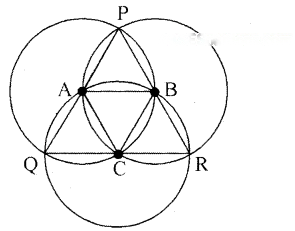
Figure it Out (Page 154)
Question 1.
We checked by construction that there are no triangles having sidelengths 3 cm, 4 cm and 8 cm; and 2 cm, 3 cm and 6 cm. Check if you could have found this without trying to construct the triangle.
Solution:
Yes, we could have found this without trying to construct the triangle.
(1) 3 cm, 4 cm and 8 cm
Sum of the lengths of the first two sides
= 3 cm + 4 cm = 7 cm
Length of the third side = 8 cm
Since the sum of the lengths of the first two sides is less than the length of the third side.
Therefore, it is not possible to construct a triangle with sides 3 cm, 4 cm and 8 cm.
(2) 2 cm, 3 cm and 6 cm
Sum of the lengths of the first two sides
= 2 cm + 3 cm = 5 cm
Length of the third side = 6 cm
Since the sum of the lengths of the first two sides is less than the length of the third side.
Therefore, it is not possible to construct a triangle with sides 2 cm, 3 cm and 6 cm.
Question 2.
Can we say anything about the existence of a triangle for each of the following sets of lengths?
(a) 10 km, 10 km and 25 km
(b) 5 mm, 10 mm and 20 mm
(c) 12 cm, 20 cm and 40 cm
You would have realised that using a rough figure and comparing the direct path lengths with their corresponding roundabout path lengths is the same as comparing each length with the sum of the other two lengths. There are three such comparisons to be made.
Solution:
(a) When we take the direct path = 25 km
Then the roundabout path = 10 km + 10 km = 20 km
Since the direct path is longer than the roundabout path.
So, the existence of a triangle is not possible.
(b) When we take the direct path = 20 mm
Then the roundabout path = 10 mm + 5 mm = 15 mm
Since the direct path is longer than the roundabout path.
So, the existence of a triangle is not possible.
(c) When we take the direct path = 40 cm
Then the roundabout path = 12 cm + 20 cm = .32 cm
Since the direct path is longer than the roundabout path.
So, the existence of a triangle is not possible.
Question 3.
For each set of lengths seen so far, you might have noticed that in at least two of the comparisons, the direct length was less than the sum of the other two (if not, check again!). For example, for the set of lengths 10 cm, 15 cm and 30 cm, there are two comparisons where this happens:
10 < 15 + 30
15 < 10 + 30 But this doesn’t happen for the third length: 30 > 10 + 15.
Solution:
Here, on checking again, we find that
10 < 15 + 30
15 < 10 + 30
but 30 < 10 + 15 is not true. Actually 30 > 10 + 15
Figure it Out (Page 156)
Question 1.
Which of the following lengths can be the sidelengths of a triangle? Explain your answers. Note that for each set, the three lengths have the same unit of measure.
(a) 2, 2, 5
(b) 3, 4, 6
(c) 2, 4, 8
(d) 5, 5, 8
(e) 10, 20, 25
(f) 10, 20, 35
(g) 24, 26, 28
Solution:
(a) 2, 2, 5
We see that 5 > 2 + 2; 2 < 2 + 5
So, the given lengths cannot be the side lengths of a triangle.
(b) 3, 4, 6
We see that 3 < 4 + 6
4 < 6 + 3
6 < 3 + 4
So, the given lengths can be the side lengths of a triangle.
(c) 2, 4, 8
We see that 8 > 2 + 4;
4 < 2 + 8 ;
2 < 4 + 8
So, the given lengths cannot be the side lengths of a triangle.
(d) 5, 5, 8
We see that 5 < 5 + 8
8 < 5 + 5
So, the given lengths can be the side lengths of a triangle.
(e) 10, 20, 25
We see that 10 < 20 + 25
20 < 25 + 10
25 < 10 + 20
So, the given lengths can be the side lengths of a triangle.
(f) 10, 20, 35
We see that 35 > 10 + 20;
10 < 20+ 35;
20 < 10 + 35
So, the given lengths can not be the side lengths of a triangle.
(g) 24, 26, 28
We see that 24 < 26 + 28
26 < 28 + 24
28 < 24 + 26
So, the given lengths can be the side lengths of a triangle.
Figure it Out (Page 159)
Question 1.
Check if a triangle exists for each of the following set of lengths:
(a) 1, 100, 100
(b) 3, 6, 9
(c) 1, 1, 5
(d) 5, 10, 12
Solution:
We know that a triangle exists when each length is shorter than the sum of the other two.
(a) 1, 100, 100
1 < 100 + 100
100 < 1 + 100
So, for sidelengths 1,100,100 a triangle exists.
(b) 3, 6, 9
3 < 6 + 9
6 < 3 + 9
9 = 3 + 6
So, for sidelengths 3, 6, 9 a triangle does not exists.
(c) 1, 1, 5
1 < 1 + 5 5 > 1 + 1
So, for sidelengths 1, 1, 5 a triangle does not exists.
(d) 5, 10, 12
5 < 10 + 12
10 < 5 + 12
12 < 5 + 10
So, for sidelengths 5, 10, 12 a triangle exists.
Question 2.
Does there exist an equilateral triangle with sides 50, 50, 50? In general, does there exist an equilateral triangle of any sidelength? Justify your answer.
Solution:
Yes, an equilateral triangle with sides 50, 50, 50 exists because the sum of two sides is greater than the third side.
In an equilateral triangle, all sides are equal, so this condition is satisfied.
Yes, an equilateral triangle always exists for any position sidelength.
Question 3.
For each of the following, give at least 5 possible values for the third length so there exists a triangle having these as side- lengths (decimal values could also be chosen):
(a) 1, 100
(b) 5, 5
(c) 3, 7
Solution:
(a) 5 possible values for the third length would be 99.5, 99.8, 100, 100.5, 100.9.
100 < 1 + 99.5
100 < 1 + 99.8
100 < 1 + 100
100 < 1 + 100.5
100 < 1 + 100.9
(b) 5 possible values for the third length would be 1, 3.5, 5, 7.5, 8.9.
5 < 1 + 5
5 < 3.5 + 5
5 < 5 + 5
5 < 7.5 + 5
5 < 8.9 + 5
(c) 5 possible values for the third length would be 4.5, 5, 6.9, 8, 9.5.
7 > 3 + 4.5
7 > 3 + 5
7 > 3 + 6.9
7 > 3 + 8
7 > 3 + 9.8
Figure it Out (Page 161)
Question 1.
Construct triangles for the following measurements where the angle is included between the sides:
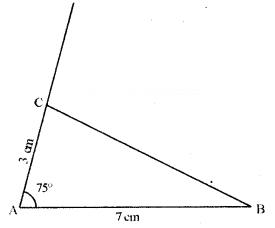
(a) 3 cm, 75°, 7 cm
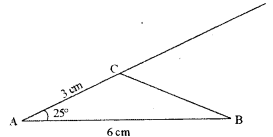
(b) 6 cm, 25°, 3 cm
(c) 3 cm, 120°, 8 cm
Solution:
(a) 3 cm, 75°, 7 cm Steps of construction
Step 1. Construct a side AB of length 7 cm.
Step 2. Construct ∠A = 75° by drawing the other arm of the angle.
Step 3. Name the point C or the other arm such that AC = 3 cm.
Step 4. Join BC to get the required triangle.
(b) 6 cm, 25°, 3 cm
Steps of construction
Step 1. Construct a side AB of length 6 cm. Step 2.
Construct ∠A = 25° by drawing the other arm of the angle.
Step 3. Mark the point C on the other arm such that AC = 3 cm.
Step 4. Join BC to get the required triangle.
(c) 3 cm, 120°, 8 cm
Steps of construction
Step 1. Construct a side AB of length 8 cm.
Step 2. Construct ∠A= 120° by drawing the other arm of the angle.
Step 3. Mark the point C on the other arm such that AC = 3 cm.
Step 4. Join BC to get the required triangle.
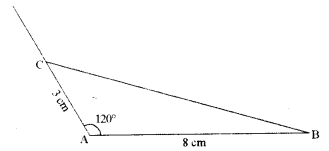
Figure it Out (Page 162)
Question 1.
Construct triangles for the following measurements:
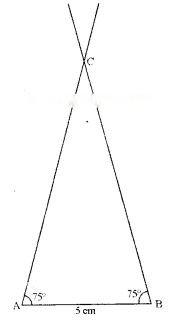
(a) 75°, 5 cm, 75°
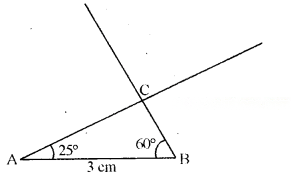
(b) 25°, 3 cm, 60°
(c) 120°, 6 cm, 30°
Do triangles always exist?
Solution:
(a) 75°, 5 cm, 75°
Steps of construction
Step 1. Draw the base AB of length 5 cm.
Step 2. Draw ∠A and ∠B of measures 75° and 75° respectively.
Step 3. The point of intersection of the two new line segments is the third vertex C.
(b) 25°, 3 cm, 60°
Steps of construction
Step 1. Draw the base AB of length 3 cm.
Step 2. Draw ∠A and ∠B of measures 25° and 60° respectively.
Step 3. The point of intersection of the two new line segments is the third vertex C.
(c) 120°, 6 cm, 30°
Steps of construction
Step 1. Draw the base AB of length 3 cm.
Step 2. Draw ∠A and ∠B of measures 120° and 30° respectively.
Step 3. The point of intersection of the two new line segments is the third vertex C.
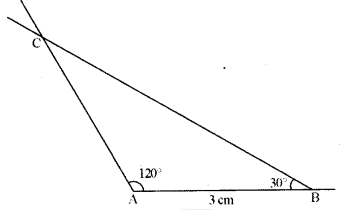
Figure it Out (Page 163)
Question 1.
For each of the following angles, find another angle for which a triangle is (a) possible, (b) not possible. Find at least two different angles for each category :
(a) 30°
(b)70°
(c) 54°
(d) 144°
Solution:
(a) 30°
Another angle for which a triangle is possible will be any less than 150°.
Two different angles are 60° and 90°.
Another angle for which a triangle is not possible will be any angle greater than or equal to 150°. Two different angles are 160° and 170°.
(b) 70°
Another angle for which a triangle is possible will be any less than 110°.
Two different angles are 80° and 30°.
Another angle for which a triangle is not possible will be any angle greater than or equal to 110°. Two different angles are 110° and 150°.
(c) 54°
Another angle for which a triangle is possible will be any less than 126°.
Two different angles are 78° and 80°.
Another angle for which a triangle is not possible will be any angle greater than or equal to 126°. Two different angles are 13 5° and 160°.
(d) 144°
Another angle for which a triangle is possible will be any less than 36°.
Two different angles are 10° and 26°.
Another angle for which a triangle is not possible will be any angle greater than or equal to 36°. Two different angles are 46° and 70°.
Question 2.
Determine which of the following pairs can be the angles of a triangle and which cannot:
(a) 35°, 150°
(b) 70°, 30°
(c) 90°, 85°
(d) 50°, 150°
Solution:
(a) 35°, 150°
The sum of the given angles = 35° + 150° = 185°
This is not possible because the total exceeds 180°
(b) 70°, 30°
The sum of the given angles = 70° + 30° = 100° Possible third angle = 180° -100° = 80°
The pair can be the angles of a triangle.
(c) 90°, 85°
The sum of the given angles = 90° + 85°= 175° Possible third angle = 180° – 175° = 5°
The pair can be the angles of a triangle.
(d) 50°, 150°
The sum of the given angles = 50° + 150° = 200°
This is not possible because the total exceeds 180°
Figure it Out (Page 165)
Question 1.
Find the third angle of a triangle (using a parallel line) when two of the angles are:
(a) 36°, 72°
(b) 150°, 15°
(c) 90°, 30°
(d) 75°, 45°
Solution:
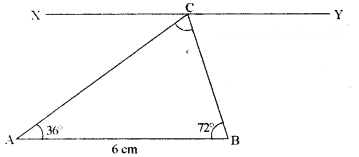
(a) 36°, 72°
Construction: Construct a line XY parallel to AB through the vertex C.
Determination : ∵ Line XY is parallel to AB.
∴ ∠XCA = ∠A = 36°
and ∠YCB = ∠B = 72°
∵ They are alternate angles of the transversals C A and CB.
∵ ∠XCA, ∠YCB and ∠ACB together form 180°
So, ∠XCA + ∠YCB + ∠ACB = 180°
⇒ 36° + 72° + ∠ACB =180°
⇒ 108° + ∠ACB = 180°
⇒ ∠ACB = 180° – 108°
= 72°
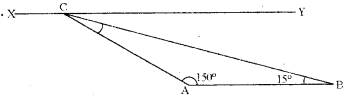
(b) 150°, 15°
Construction: Construct a line XY parallel to AB through C.
Determination : ∵ Line XY is parallel to AB
∴ ∠XCA = ∠A = 150°
and ∵ ∠YCB = ∠B = 15°
∵ They are alternate angles of the transversals CA and CB.
∵ ∠XCA, ∠YCB and ∠ACB together form 180°.
So, ∠XCA + ∠YCB + ∠ACB = 180°
⇒ 150°+15° + ∠ACB = 180°
⇒ 165° + ∠ACB = 180°
⇒ ∠ACB = 180°-165°
= 15°
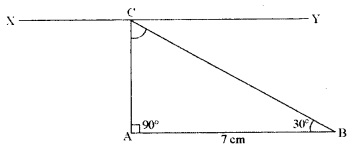
(c) 90°, 30°
Construction: Construct a line XY parallel to AB through C.
Determination:
∵ Line XY is parallel to AB.
∴ ∠XCA = ∠A = 90°
and ∠YCB = ∠B = 30°
∵ They are alternate angles of the transversals CA and CB.
∵ ∠XCA, ∠YCB and ∠ACB together form 180°.
So, ∠XCA + ∠YCB + ∠ACB = 180°
⇒ 90° + 30° + ∠ACB = 180°
⇒ ∠ACB = 180°-120°
= 60°
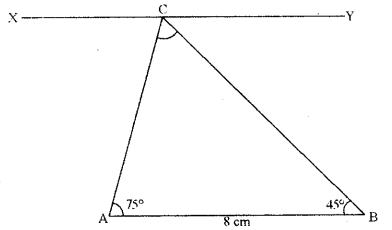
(d) 75°, 45°
Construction: Construct a line XY parallel to AB through C.
Determination : ∵ Line XY is parallel to AB.
∴ ∠XCA = ∠A = 75°
and ∠YCB = ∠B = 45°
∵ They are alternate angles of the transversals CA and CB.
∵ ∠XCA, ∠ ∠YCB and ∠ACB together form 180°
So, ∠XCA + ∠YCB + ∠ACB = 180°
⇒ 75° +45° + ∠ACB = 180°
⇒ 120° + ∠ACB = 180°
⇒ ∠ACB = 180° – 120° = 60°
Question 2.
Can you construct a triangle all of whose angles are equal to 70°? If two of the angles are 70° what would the third angle be? If all the angles in a triangle have to be equal, then what must its measure be? Explore and find out
Solution:
No, it is not possible to construct a triangle with all angles equal to 70°.
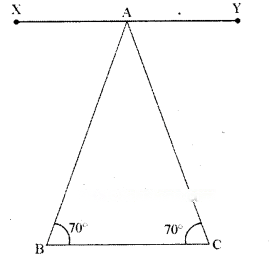
If we take two base angles as 70° that is, ∠B and ∠C = 70°, then we have to find ∠BAC.
Since XY is parallel to BC.
So, ∠XAB = ∠B = 70° 1 (i)
∠YAC = ZC = 70° 1
∵ They are alternate angles of the transversals AB and AC.
∠XAB + ∠BAC + ∠YAC = 180°
70° + ∠BAC + 70° = 180° [From eq. (i)]
∠BAC = 180° – 70° – 70°
∠BAC = 40°
So, the third angle would be 40°.
If all the angles in a triangle have to be equal, then each angle must measure 60°.
Question 3.
Here is a triangle in which we know ∠B = ∠C and ∠A = 50°. Can you find ∠B and ∠C?
Solution:
Given ∠A = 50° and ∠B = ∠C
Draw a line XY that is parallel to BC.
∠XAB = ∠B and ∠YAC = ∠C
(Alternate angles )……. (i)
∠XAB + ∠BAC + ∠YAC = 180°
∠B + 50° + ∠C = 180° [From eq. (i)]
∠B + ∠C = 180° – 50°
∠B + ∠B =130° (Given)
2∠B = 130°
∠B = 65°
∠B = ∠C = 65°
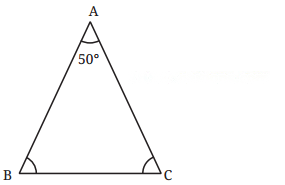
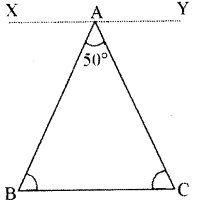
Figure it Out (Page 170-171)
Question 1.
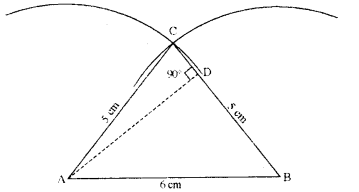
Construct a triangle ABC with BC = 5 cm, AB = 6 cm, CA = 5 cm. Construct an altitude from A to BC.
Solution:
Steps of construction
Step 1. Construct the base AB with one of the side lengths. Let us choose AB = 6 cm.
Step 2. From A, construct a sufficiently long arc of radius 5 cm.
Step 3. From B, construct an arc of radius 5 cm such that it intersects the first arc.
Step 4. The point where both the arcs meet is the required third vertex C. Join AC and BC to get ∆ABC.
Step 5. From A draw perpendicular AD to BC. Then AD is the altitude from A to BC.
Question 2.
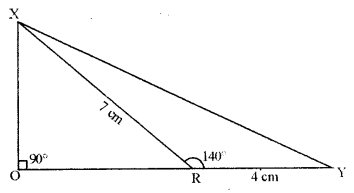
Construct a triangle TRY with RY = 4 cm, TR = 7 cm, ∠R = 140°. Construct an altitude from T to RY.
Solution:
Steps of construction
Step 1. Construct a side RY of length 4 cm.
Step 2. Construct ∠R = 140° by drawing the other arm of the angle.
Step 3. Mark the point T on the other arm such that RT = 7 cm.
Step 4. Join TY to get the required triangle TRY.
Step 5. From T draw perpendicular TD to extended RY.
Then TD is the altitude from T to RY.
Question 3.
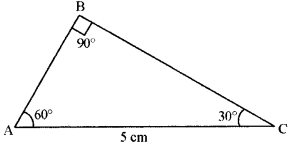
Construct a right-angled triangle ∆ABC with ∠B = 90°, AC = 5 cm. How many different triangles exist with these measurements?
[Hint : Note that the other measurements can take any values. Take AC as the base What values can ∠A and ∠C take so that the other angle is 90°?]
Solution:
Any number of different triangles exist with these measurement. As an example, take ∠A = 60° and ∠C = 30°.
Steps of construction
Step 1. Draw the base AC of length 5 cm.
Step 2. Draw ∠A and ∠C of measures 60° and 30° respectively.
Step 3. The point of intersection of the two new line segments is the third vertex B:
Then ∆ABC is the required triangle.
Note : Since ∠B = 90°, therefore if we take ∠A = 60° then ∠C will have to be 30° due to angle sum property of triangle
Question 4.
Through construction, explore if it is possible to construct an equilateral triangle that is (i) right-angled (ii) obtuse-angled. Also construct an isosceles triangle that is (i) right-angled (ii) obtuse-angled.
Solution:
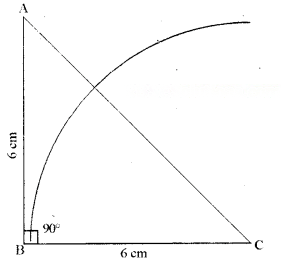
(a).Equilateral triangle
(i) Right-angled
Steps of construction
Step 1. Draw the base BC of length 6 cm.
Step 2. Construct ∠B = 90° by drawning the other arm of the angle.
Step 3. Make the point A on the other arm such that BA = 6 cm.
Step 4. From C, construct a sufficiently long arc of radius 6 cm.
We see that this arc does not intersect BA.
So, it is impossible to construct an equilateral triangle that is right-angled.
(ii) obtuse-angled.
Steps of construction
Step 1. Draw the base BC of length 6 cm.
Step 2. Construct ∠B = 120° (an obtuse angle) by drawing the other arm of the angle.
Step 3. Mark the point A on the other arm such that BA = 6cm.
Step 4. From C, construct a sufficiently long arc of radius 6 cm. We see that this arc does not intersect BA.
So, it is impossible to construct an equilateral triangle that is obtuse-angled.
(b) Isosceles triangle
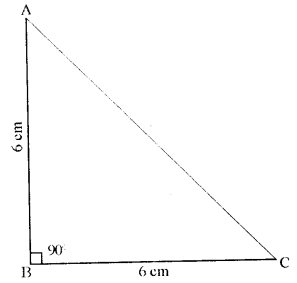
(i) Right-angled
Steps of construction
Step 1. Construct a side BC of length 6 cm.
Step 2. Construct ∠B = 90° by drawing the other arm of the angle.
Step 3. Mark the point A on the other arm such that AB = 6 cm.
Step 4. Join AC to get the required isosceles triangle ABC which is right-angled.
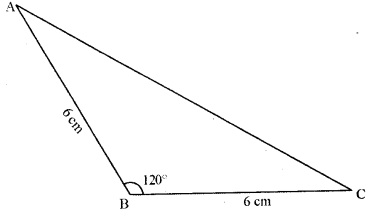
(ii) Obtuse-angled
Step 1. Construct a side BC of length 6 cm.
Step 2. Construct ∠B = 120° (an obtuse angle) by drawing the other arm of the angle.
Step 3. Mark the point A on the other arm such that AB = 6cm.
Step 4. Join AC to get the required isosceles triangle ABC which is obtuse-angled.
It’s Puzzle Time
Shortest Path in a Box!
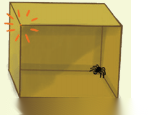
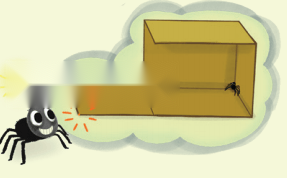
There is a spider in a comer of a box. It wants to reach the farthest opposite corner (marked in the figure). Since it cannot fly, it can reach the opposite point only by walking on the surfaces of the box. What is the shortest path it can take?
Take a cardboard box and mark the path that you think is the shortest from one comer to its opposite comer. Compare the length of this path with that of the paths made by your friends.
Hint:
Solution:
The shortest path it can take is to wa k first along its length, then along its breadth and finally along its height.