Geometric Twins Class 7 Solutions RBSE Maths Ganita Prakash Part 2 Chapter 1
PracticingGanita Prakash Class 7 Solutionsand RBSE Class 7 Maths Part 2 Chapter 1 Geometric Twins Solutions Question Answer helps develop logical thinking and accuracy.
Ganita Prakash Class 7 Part 2 Chapter 1 Solutions
Class 7 Ganita Prakash Part 2 Chapter 1 Solutions
RBSE Class 7 Maths Ganita Prakash Part 2 Chapter 1 Solutions
In-text Questions
Page 1
Question 1.
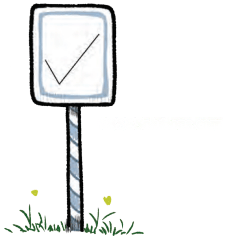
The symbol on this signboard needs to be recreated on another board. How do we do it? One way is to trace the outline of this symbol on tracing paper to reconstruct the figure. But this is difficult for big symbols. What else can we do?
Solution:
Instead of tracing the symbol which becomes difficult for large figures, we can recreate it by measuring the lengths of the arms and the angle between them, then we can accurately redraw the same shape on another board. These measurements allow us to construct an exact copy without tracing it.
Page 2
Question 1.
(i) Suppose these lengths are AB = 4 cm, BC = 8 cm. We observe that several such symbols can be constructed with the same lengths.
To get the exact replica, would it help to take any other measurement?
(ii) Can you draw the symbol if it is known that AB = 4 cm, BC = 8 cm, and ∠ABC = 80°?
Solution:
(i) Yes, the measure of ∠ABC, along with the two arm lengths AB and BC, would help to get the exact replica.
(ii) Yes, we can draw the symbol using these measurements because they give us two sides and the included angle (SAS), which is enough to fix the exact shape.
Steps of constructing the symbol :
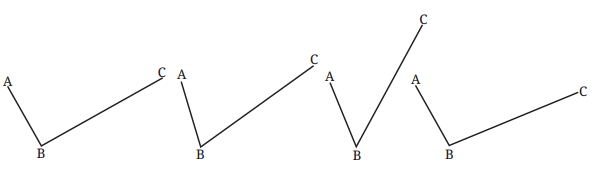
- Draw AB = 4 cm.
- Construct ∠ABC = 80°. Place the protractor at point B and draw a ray making an 80° angle with BA.
- Mark BC = 8 cm. On the ray forming the 80° angle, measure 8 cm from B and mark that point as C.
- Join the endpoints if needed to complete the shape exactly as shown in the original symbol.
Page 3
Question 1.
If it is known that both symbols have the same arm lengths, can it be concluded that the two symbols are congruent?
Solution:
We have seen that there can exist several such non-congruent figures with different angles between the given arm lengths. Thus, if both symbols have the same arm lengths, we cannot be sure that the figures are congruent. As two arm lengths are not enough, because the angle between them can vary.
Page 4
Question 1.
Meera and Rabia have been asked to make a cardboard cutout identical to a triangular frame they have in school. They see that the frame is too big to be traced on a paper and replicated.
What do you think they can do?
Solution:
Since, the frame is too large to trace, Meera and Rabia can measure the lengths of its three sides using a measuring tape. With these side lengths, they can construct another triangle that has exactly the same dimensions.
This will give them a congruent triangle, which will be an exact copy of the original frame.

Page 6
Question 1.
(i) The two triangles given below are congruent. How can these two triangles be superimposed? Which vertices of ∆XYZ and ∆ABC should we overlap? This has to be done so that the equal sides overlap. Figure out how.
(ii) Are there other ways of overlapping the vertices so that the triangles fit exactly over each other?
Solution:
(i) To superimpose the two congruent triangles so that equal sides overlap, match corresponding vertices in the same order. In this case, place A on X, B on Y or C on Z. This makes the corresponding sides lie on top of each other :
AB on XY, BC on YZ, AC on XZ.
Hence, the triangles coincide exactly and we write ∆ABC ≅ ∆XYZ.
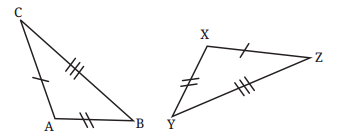
(ii) No, there are no other different ways of overlapping the vertices so that the triangles fit exactly over each other.
For two triangles to coincide perfectly, each side must overlap with its corresponding equal side and each angle with its corresponding equal angle. This requirement fixes the correspondence between vertices uniquely. Although a triangle can be rotated or flipped before placing it over the other, the order of corresponding vertices remains the same. Any other pairing of vertices would cause unequal sides or angles to overlap, and the triangles would not fit exactly.
Page 7
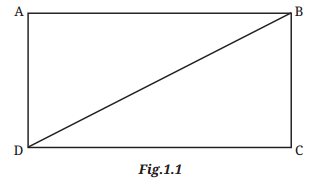
Question 1. Can you identify a pair of congruent triangles below? Why are they congruent?
Solution:
Here, we have given a rectangle ABCD.
Consider ∆ABD and ∆CDB. Since ABCD is a rectangle and its opposite sides are equal, so we have
AB = CD
AD = CB
BD = BD [Common side length]
∆ABD ≅ ∆CDB [SSS congruence rule]
∵ SSS condition holds. Hence, the triangles are congruent.
Page 9
Question 1.
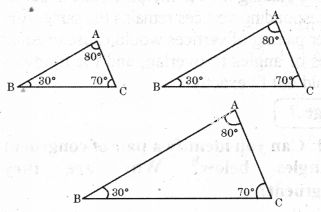
Suppose the angles are 30°, 70° and 80°. Can we create an exact copy of the frame with this?
Solution:
No, we cannot create an exact copy of the frame using only the angles 30°, 70°, and 80°. Since, these three angles tell us only the shape of the triangle, not its size. The triangles that have three equal angles are called similar triangles; they have the same shape but can be of many different sizes.
So, using only the angles 30°, 70°, and 80°, we can draw infinitely many triangles that look alike but are not congruent.
Page 10
Question 1.
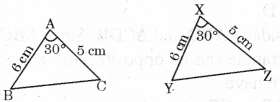
∆ABC and ∆XYZ are two triangles such that AB = XY = 6 cm, AC = XZ = 5 cm, and ∠A = ∠X = 30° Are they congruent?
Solution:
In ∆ABC and ∆XYZ, we have
AB = XY = 6 cm
AC = XZ = 5cm
∠A = ∠X = 30°
Therefore, using SAS (Side-Angle-Side) condition for congruence.
Congruence rule, we have
∆ABC ≅ ∆XYZ
Yes, ∆ABC and ∆XYZ are congruent.
Question 2.
∆ABC and ∆XYZ are two triangles such that AB = XY = 6cm, AC = XZ = 4 cm, and ∠B = ∠Y = 30°. Are they congruent?
Solution:
No, the two triangles are not necessarily congruent. As we have given ∆ABC and ∆XYZ such that
AB = XY = 6 cm, AC = XZ =4 cm, and ∠B = ∠Y = 30°
But the given ∠B is not the angle between the given sides AB and AC. So, the information corresponds to the SSA (Side-Side-Angle) case — a side, another side and a non-included angle.
With SSA, more than one triangle can be drawn using the same measurements. As different triangles may satisfy : the same two sides,
the same angle at one end of one of those sides, but still have different shapes.
This happens because the third side is not fixed, and the triangle can open in more than one possible way.
Since, the given measurements come under the SSA condition, which does not guarantee a unique triangle.
Hence, ∆ABC and ∆XYZ cannot be concluded to be congruent.
Page 12
Question 1.
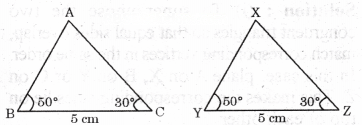
∆ABC and ∆XYZ are two triangles with, BC = YZ = 5 cm, ∠B = ∠Y = 50° and ∠C = ∠Z = 30°. Are they congruent?
Solution:
In ∆ABC and ∆XYZ,
BC = YZ = 5 cm
∠B = ∠Y = 50°
∠C = ∠Z = 30°
⇒ ∆ABC = ∆XYZ (ASA congruence rule)
Yes, ∆ABC and ∆XYZ are congruent.
Page 14
Question 1.
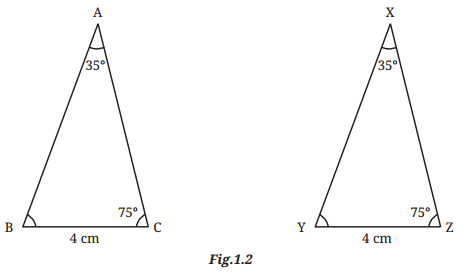
The following triangles ∆ABC and ∆XYZ are such that ∠A = ∠X = 35°, ∠C = ∠Z = 75°, and BC = YZ = 4 cm. Are the triangles congruent? Give a reason.
Solution:
Since, we know that the sum of the angles of a triangle is 180°.
So, ∠B + 35° + 75° =180°
or ∠B + 110° = 180°
Thus, ∠B = 70°
Similarly, using angle sum property of triangle ∠XYZ, ∠Y is also 70°. Thus, we have ∠B = ∠Y. Let us check congruence.
In ∆ABC and ∆XYZ,
∠C = ∠Z = 75° (Given)
BC = YZ = 4 cm
∠B = ∠Y (We proved above)
⇒ ∆ABC ≅ ∆XYZ (ASA congruence rule)
Hence, ∆ABC and ∆XYZ are congruent.
Page 16
Question 1.
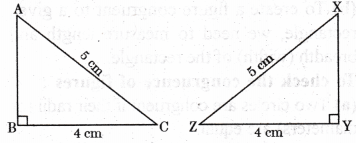
∆ABC and ∆XYZ are right-angled triangles such that BC = YZ = 4 cm, ∠B = ∠Y = 90° and AC = XZ = 5 cm. Are they congruent?
Solution:
Here, in ∆ABC and ∆XYZ,
∠B = ∠Y = 90°
AC = XZ = 5 cm (Hypotenuse)
BC = YZ = 4 cm
⇒ ∆ABC ≅ ∆XYZ (RHS condition)
Hence, ∆ABC and ∆XYZ are congruent.
Page 17
Question 1.
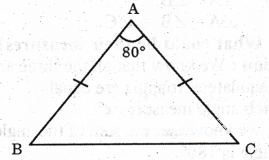
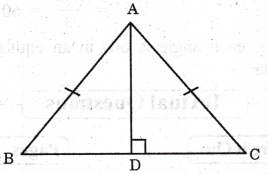
∆ABC is isosceles with AB = AC, and ∠A = 80°. What can we say about ∠B and ∠C?
Solution:
Given that ∆ABC is isosceles with AB = AC, and ∠A = 80°.
First, we construct the altitude from A to BC.
Now in ∆ADB and ∆ADC,
AB = AC (Given hypotenuses)
∠ADB = ∠ADC = 90° (from construction)
AD = AD (Common side of the two triangles ∆ADB and ∆ADC)
⇒ ∆ADB ≅ ∆ADC (RHS condition)
Hence, ∆ADB ≅ ∆ADC.
This shows that ∠B = ∠C, as they are corresponding parts of congruent triangles.
Thus, the angles opposite to equal sides are equal.
Pages 18-19
Question 1.
Equilateral triangles are those in which all the sides have equal lengths. What can we say about their angles?
Solution:
We know that equilateral triangles are those in which all the sides have equal lengths. In equilateral triangle ABC :
Since AB = BC, (We know that the angles opposite sides are equal.)
⇒ ∠C = ∠A.
Also, BC= CA,
⇒ ∠A =∠B.
Thus, ∠A = ∠B = ∠C
Question 2.
What could be their measures?
Solution:
We know that all the three angles of an equilateral triangle are equal.
Let each angle measures x°.
Since, we know that the sum of the angles of a triangle is 180°.
So, x° + x° + x° = 180°
3x° = 180°
x° = = 60°
Hence, each angle is 60° in an equilateral triangle.
Class 7 Maths Geometric Twins Solutions
Figure it Out (Pages 3-4)
Question 1.
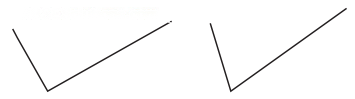
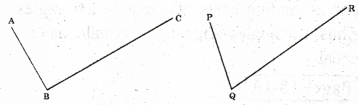
Check if the two figures are congruent
Solution:
For the sake of our convenience, we give name to these figures.
Here, AB and PQ are QR are equal. Also, BC and QR are equal. But the angle between their arms that is ∠ABC and or ∠ABC > ∠PQR.
So, the given two figures are not congruent.
Question 2.
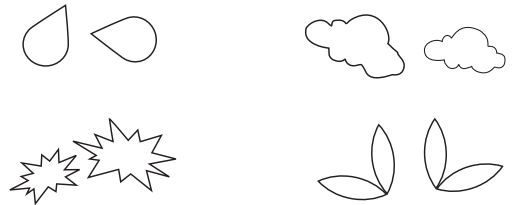
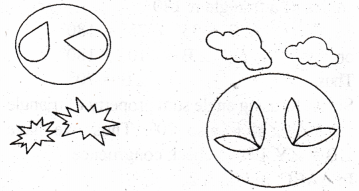
Circle the pairs that appear congruent
Solution:
The encircled figures have the same shape and size. Hence, they are congruent.
Question 3.
What measurements would you take to create a figure congruent to a given :
(a) Circle
(b) Rectangle
Using this, state how would you check if two—
(a) Circles are congruent?
(b) Rectangles are congruent?
Solution:
(a) To create a figure congruent to a given circle, we need to measure the radius of the circle (or equivalently, the diameter),
(b) To create a figure congruent to a given rectangle, we need to measure length and breadth (width) of the rectangle.
To check the congruence of figures :
(a) Two circles are congruent if their radii (or diameters) are equal.
(b) Two rectangles are congruent if their lengths and breadths are equal.
Question 4.
How would we check if two figures like the one below are congruent?
Use this to identify whether each of the following pairs are congruent.
Solution:
To check if two figures like the one given first are congruent, we could use a tracing paper to trace the first figure and superimpose it on the second one. If they fit exactly, one over the other, figures are said to be congruent. Now using this we can conclude that pair A and B are congruent. As when we superimpose pair A on pair B, they fit exactly, one over the other.
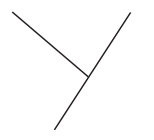
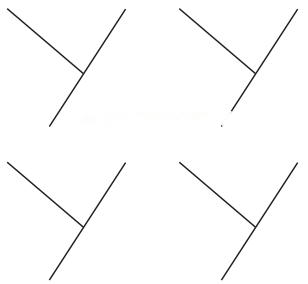
Figure it Out (Pages 8-9)
Question 1.
Suppose ∆HEN is congruent to ∆BIG List all the other correct ways of expressing this congruence.
Solution:
If ∆HEN = ∆BIG then the corresponding vertices are :
- H ↔ B
- E ↔ I
- N ↔ G
Any correct congruence statement must keep this correspondence and the same order of vertices in both triangles.
Below are other correct ways of expressing the congruence:
- ∆HNE ≅ ∆BGI
- ∆EHN ≅ ∆IBG
- ∆ENH ≅ ∆IGB
- ∆NHE ≅ ∆GBI
- ∆NEH ≅ ∆GIB
Question 2.
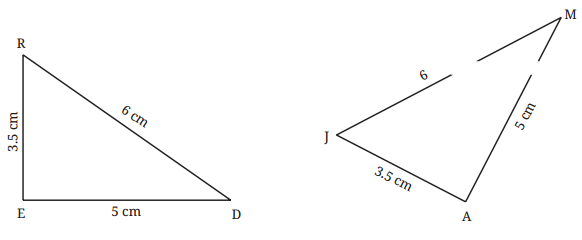
Determine whether the triangles are congruent. If yes, express the congruence.
Solution:
In ∆RED and ∆JAM,
RE = JA = 3.5 cm (Given)
RD = JM = 6 cm (Given)
ED = AM = 5 cm (Given)
⇒ ∆RED ≅ ∆JAM (SSS rule)
Hence, ∆RED and ∆JAM are congruent.
Question 3.
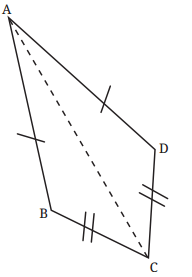
In the figure below, AB = AD, CB = CD. Can you identify any pair of congruent triangles? If yes, explain why they are congruent. Does AC divide ∠BAD and ∠BCD into two equal parts? Give reasons.
Solution:
Here, we have AB = AD (Given)
CB = CD (Given)
AC = AC (Common)
⇒ ∆ABC ≅ ∆ADC (SSS rule)
Also, we know that (∠BAC, ∠DAC) and (∠BCA, ∠DCA) are corresponding parts of
congruent triangles ∆ABC and ∆ADC Hence, by c.p.c.t. –
∠BAC = ∠DAC and ∠BCA = ∠DCA i.e., AC divide ∠BAD and ∠BCD into two equal parts.
Question 4.
In the figure below, are ∆DFE and ∆GED congruent to each other? It is given that DF = DG and FE = GE.
Solution:
Consider ∆DFE and ∆DGE,
FE = GE (Given)
DE = DE (Common)
DF = DG (Given)
⇒ ∆DFE ≅ ∆DGE (SSS rule)
Hence, ∆DFE and ∆DGE are congruent to each other.
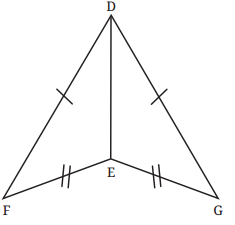
Figure it Out (Pages 13-14)
Question 1.
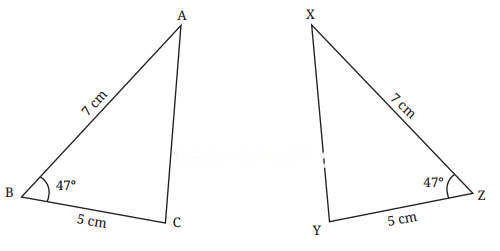
Identify whether the triangles below are congruent. What conditions did you use to establish their congruence? Express the congruence.
Solution:
Yes, the two triangles are congruent. Given information from the figure
For ∆ABC :
AB = 7 cm, BC = 5 cm and ∠B = 47°
For ∆XYZ :
XZ = 7 cm, ZY = 5 cm and ∠Z = 47°
The triangles satisfy the SAS (Side-Angle-Side) condition because :
AB = XZ = 7 cm
BC = ZY – 5 cm
∠B = ZZ = 47°
Hence, by the SAS congruence condition, the triangles are congruent.
∆ABC ≅ ∆XYZ
Question 2.
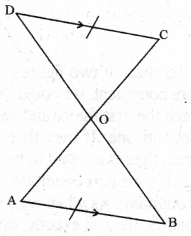
Given that CD and AB are parallel, and AB = CD, what are the other equal parts in this figure? (Hint: When the lines are parallel, the alternate angles are equal. Are the two resulting triangles congruent? If so, express the congruence.)
Solution:
We know that when the lines are parallel, the alternate angles are equal. Here, CD and AB are parallel. So-
∠OAB = ∠OCD (Alternate angles)
∠OBA = ∠ODC (Alternate angles)
AB = CD (Given)
⇒ ∆OAB ≅ ∆OCD (ASA rule)
Yes, the two resulting triangles ∆OAB and ∆OCD are congruent.
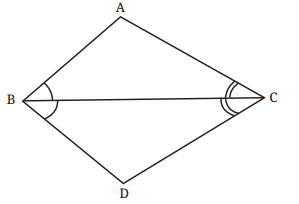
Question 3.
Given that ∠ABC = ∠DBC and ∠ACB = ∠DCB, show that ∠BAC = ∠BDC. Are the two triangles congruent?
Solution:
∠ABC = ∠DBC (Given)
∠ACB = ∠DCB (Given)
BC = BC (Common)
⇒ ∆ABC ≅ ∆DBC (ASA rule)
Now, since ∠BAC and ∠BDC are the corresponding parts of congruent triangles ∆ABC and ∆DBC.
Hence, by c.p.c.t. –
∠BAC = ∠BDC.
Question 4.
Identify the equal parts in the following figure, given that ∠ABD = ∠DCA and ∠ACB = ∠DBC.
Solution:
To identify the equal parts in the following figure, we need to check the congruence between ∆ABC and ∆DCB.
We have given that ∠ACB = ∠DBC and ∠ABD = ∠DCA
Adding ∠ACB both sides in the above equation,
∠ABD + ∠ACB = ∠DCA + ∠ACB ∠ABD + ∠DBC = ∠DCA + ∠ACB
(Since, ∠ACB = ∠DBC) ∠ABC= ∠DCB
In ∆ABC and ∆DCB,
∠ABC = ∠DCB (Proved above)
BC = BC (Common)
∠ACB = ∠DBC (Given)
⇒ ∆ABC ≅ ∆DCB (ASA rule)
Then we know that all the corresponding parts (sides and angles) of congruent triangles ∆ABC and ∆DCB are equal.
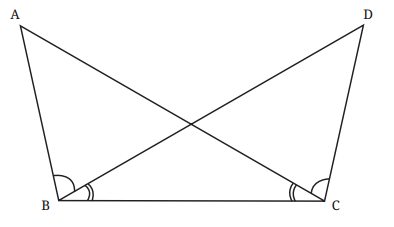
Figure it Out (Pages 20-21)
Question 1.
∆AIR ≅ ∆FLY. Identify the corresponding vertices, sides and angles.
Solution:
Corresponding Vertices : A ↔ F, I ↔ L, R ↔ Y
Corresponding Sides : AI ↔ FL, IR ↔ LY, AR ↔ FY
Corresponding Angles : ∠A ↔ ∠F, ∠I ↔ ∠L, ∠R ↔ ∠Y
Question 2.
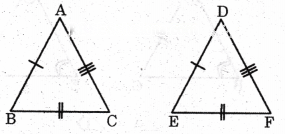
Each of the following cases contains certain measurements taken from two triangles. Identify the pairs in which the triangles are congruent to each other, with reason. Express the congruence whenever they are congruent.
(a) AB = DE
BC = EF
CA = DF
Solution:
(a) Here, we have given that AB = DE
BC = EF
CA= DF
⇒ A ↔ D, B ↔ E, C ↔ F.
Hence, AABC = ADEF (SSS congruence rule)
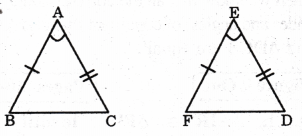
(b) AB = EF
∠A = ∠E
AC = ED
Solution:
Here, we have given that AB = EF
∠A = ∠E
AC = ED
⇒ A ↔ E, C ↔ D
Hence, ∆ABC ≅ ∆EFD (S AS congruence rule)
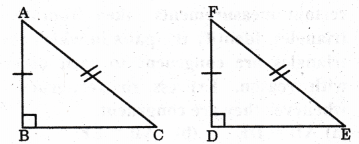
(c) AB = DF
∠B = ∠D = 90°
AC = FE
Solution:
Here, we have given that AB = DF
∠B = ∠D = 90°
AC = FE
⇒ A ↔ F, B ↔ D, C ↔ E (by figure)
Hence, ∆ABC ≅ ∆FDE (RHS congruence rule)
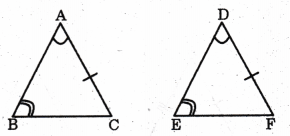
(d) ∠A = ∠D
∠B = ∠E
AC = DF
Solution:
Here, we have given that
∠A = ∠D
∠B = ∠E
AC = DF
The given side AC is not the included side between ∠A and ∠B.
Hence, the condition is AAS (Angle-Angle- Side).
Since, AAS guarantees congruence, the triangles are congruent.
⇒ ∆ABC ≅ ∆DEF (AAS congruence rule)
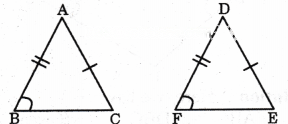
(e) AB = DF
∠B = ∠F
AC = DE
Solution:
Here, we have given that AB = DF
∠B = ∠F
AC = DE
The given angle (∠B) is not the angle included between the two given sides.
This is the SSA (Side-Side-Angle) case and SSA does not guarantee congruence.
Hence, the given triangles are not congruent.
Question 3.
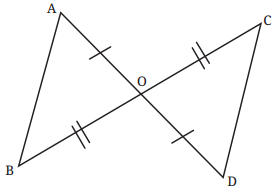
It is given that OB = OC, and OA = OD. Show that AB is parallel to CD. [Hint : AD is a transversal for these two lines. Are there any equal alternate angles?]
Solution:
In ∆AOB and ∆DOC,
OB = OC (Given)
OA = OD (Given)
∠AOB = ∠DOC (Vertically opposite angles)
⇒ ∆AOB ≅ ∆DOC (SAS congruence rule)
Since, corresponding parts of congruent triangles are equal. So,
∠BAO = ∠CDO
⇒ AD is a transversal for these two lines,
i. e., Alternate angles are equal. Hence, AB || CD.
Question 4.
ABCD is a square. Show that ∆ABC ≅ ∆ADC. Is ∆ABC also congruent to ∆CDA?
Give more examples of two triangles where one triangle is congruent to the other in two different ways, as in the case above. Can you give an example of two triangles where one is congruent to the other in six different ways?
Solution:
Given : ABCD is a square.
So, AB = BC = CD = DA
∠ABC = ∠ADC = 90°
AC is a common diagonal.
Now, we have to show that ∆ABC ≅ ∆ADC
Consider triangles ∆ABC and ∆ADC,
AB = AD (sides of a square)
BC = DC (sides of a square)
∠ABC = ∠ADC = 90°
Thus, the two triangles have two corresponding sides equal and the included angle equal.
Hence, ∆ABC ≅ ∆ADC (by SAS condition) Is ∆ABC also congruent to ∆CDA?
Yes. Rewriting the order of vertices we get:
A ↔ C
B ↔ D
C ↔ A
All corresponding sides and angles still match.
Hence, ∆ABC ≅ ∆CDA
There are few examples where two triangles
are congruent in two different ways as—
Example 1 : Rectangle
In a rectangle, each diagonal divides the rectangle into two congruent triangles. Each triangle can be matched with the other in two different vertex orders.
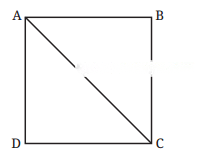
Example 2 : Isosceles Triangle In an isosceles triangle, the two smaller triangles formed by the altitude from the vertex are congruent and can be matched in more than one way due to symmetry.
Example where two triangles are congruent in six different ways : Equilateral Triangle
Consider two equilateral triangles of the same size.
- All sides are equal
- All angles are equal
- Any vertex of one triangle can correspond to any vertex of the other
There are 6 possible ways to match the vertices. Hence, two equilateral triangles are congruent to each other in six different ways.
Question 5.
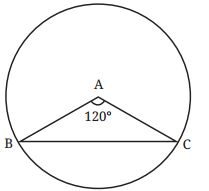
Find ∠B and ∠C, if A is the centre of the circle.
Solution:
Here, A is the centre of the circle,
∵ AB = AC (Radii of the circle)
⇒ ∠B = ∠C (Angles opposite to
equal sides are equal in a triangle)
Let ∠B = ∠C = x°
Since, we know that the sum of the angles of a triangle is 180°.
So, ∠A + ∠B + ∠C = 180°
120° + x° + x° = 180°
2x° = 180° – 120°
x° = = 30°
Hence, ∠B = ∠C = 30°
Question 6.
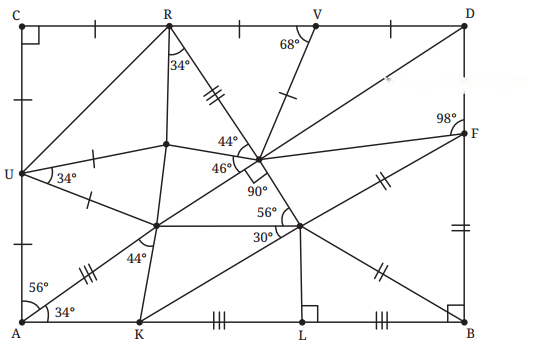
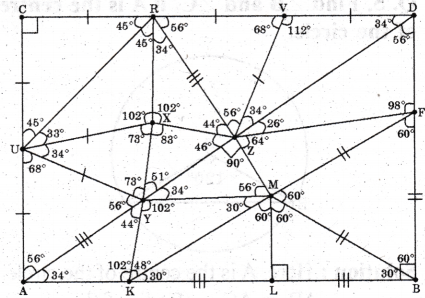
Find the missing angles. As per the convention that we have been following, all line segments marked with a single ‘|’ are equal to each other and those marked with a double ‘|’ are equal to each other, etc.
Solution:
For our convenience, we named the unknown points using letters.
∵ ∆MFB is an equilateral triangle. Hence, ∠MFB = ∠MBF = ∠FMB – 60°.
Since, sum of three angles of a triangle is 180°. So-
In ∆MZY, •
∠ZYM + 90° + 56° = 180°
∠ZYM = 180° – 146°
∠ZYM = 34°
In ∆ZMF,
∠ZMF = 180° – (56° + 30°) = 180° – 86° (Since, KF is a straight line.)
∠ZMF = 94°
and ∠ZFM = 180° – (98° + 60°)
= 180° – 158° (Since, BD is a straight line.)
∠ZFM = 22°
Also, sum of three angles of a triangle is 180°. So-
∠MZF = 180° – (94° + 22°) = 180° – 116° ∠MZF = 64°
Now, in ∆ZVD, .
∠ZVD = 180° – 68° = 112° (Since, CD is a straight line.)
Also, ∠VZD = ∠VDZ
Sum of three angles of a triangle is 180°. So-
∠VZD + ∠VDZ + ∠ZVD = 180°
∠VZD + ∠VZD +112° =180°
2∠VZD = 180° – 112°
∠VZD = = 34°
⇒ ∠VDZ = 34°
In ∆RVZ,
∠VRZ = ∠VZR
68° + ∠VRZ + ∠VZR = 180°
2∠VRZ – 180° – 68°
2∠VRZ = 112°
∠VRZ = = 56°
⇒ ∠V∠R = 56°
Since, RM is a straight line. Then- ∠DZF = 180° – (56° + 34° + 64°) = 26°
In ∆RXZ,
∠RXZ + 34° + 44° = 180°
∠RXZ = 180° – 78° = 102°
In ∆UXY,
34° + ∠UYX + ∠UXY = 180°
∠UXY + ∠UXY = 180° – 34°
(Since, UX = UY ⇒ ∠UXY – ∠UYX)
2 ∠UXY = 146°
∠UXY = — = 73°
⇒ ∠UYX = 73°
∵ ∆RCU is a right-angled triangle where ∠C = 90° and CR = CU.
⇒ ∠CRU = ∠CUR = 45°
Similarly, we can find out the remaining angles and write in the figure.
It’s Puzzle Time!
Expression Engineer!
Draw lines and split the region consisting of white squares into 6 smaller congruent regions.
Solution:
Divide the 24 white squares into 6 congruent L-shaped regions, each consisting of 4 squares.