RBSE Class 7 Science Chapter 10 Question Answer Life Processes in Plants
By tackling theseRBSE Solutions Class 7 Scienceand RBSE Class 7 Science Chapter 10 Life Processes in Plants Question Answer, students will build a solid foundation in the topic.
Life Processes in Plants Class 7 Question Answer
RBSE Class 7 Science Chapter 10 Life Processes in Plants Question Answer
Class 7 Science Curiosity Chapter 10 Question Answer (Exercise)
(Let Us Enhance Our Learning)
Question 1.
Complete the following table.
Answer:
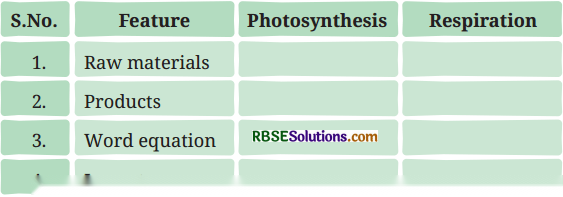
Feature | Photosynthesis | Respiration |
Raw materials | CO2, water, sunlight, chlorophyll | Glucose, oxygen |
Products | Glucose, oxygen | CO2, water, energy |
Word equation | CO2+ Water → Glucose + O2 | Glucose + O2→ CO2+ Water + Energy |
Importance | Produce food and O2 | Produce energy |
Question 2.
Imagine a situation where all the organisms that carry out photosynthesis on the earth have disappeared. What would be the impact of this on living organisms?
Answer:
If all the organisms carry out photosynthesis on the earth have disappeared (like—fungi, algae) then production of oxygen will be stopped and there will be lack of oxygen in atmosphere.
The food chain will be broken, because plants are primary producers. Animals will die due to deficiency of food. Amount of carbon dioxide in atmosphere will be increased and result will be the increased global warming.
Question 3.
A potato slice shows the presence of starch with iodine solution. Where does the starch in potatoes come from? Where is the food synthesized in the plant, and how does it reach the potato?
Answer:
Starch in potato formed due to photosynthesis in leaves. Food is synthesized in leaves and transported to roots (potato) through phloem tissue where it is stored.
Question 4.
Does the broad and flat structure of leaves make plants more efficient for photosynthesis? Justify your answer.
Answer:
Yes, the broad and flat structure of leaves makes plants more efficient for photosynthesis because more surface area can get direct sunlight, chloroplast are present in more amount and having more stomata to come in contact with air, which are helpful in exchange of gases.
Question 5.
X is broken down using Y to release carbon dioxide, Z and energy.
X + Y → Carbon dioxide + Z + Energy
X, Y and Z are three different components of the process. What do X, Y and Z stand for?
Answer:
X is glucose. Y is oxygen and Z is water.
Question 6.
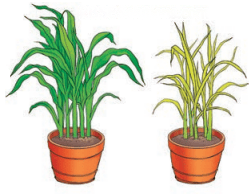
Krishna step-up an experiment with two potted plants of same size and placed one of them in sunlight and the other in a dark room, as shown in Fig. 10.10.
Answer the following questions:
(i) What idea might she be testing through this experiment?
(ii) What are the visible differences in plants in both the conditions?
(iii) According to you, leaves of which plants confirm the iodine test for the presence of starch?
Answer:
(i) She is testing for need of sunlight for photosynthesis.
(ii) The plants kept in sunlight will grow well, leaves will be greener and the leaves of plant kept in dark may have yellow leaves and less growth.
(iii) The leaves of plant kept in sunlight will confirm the iodine test for presence of starch.
Question 7.
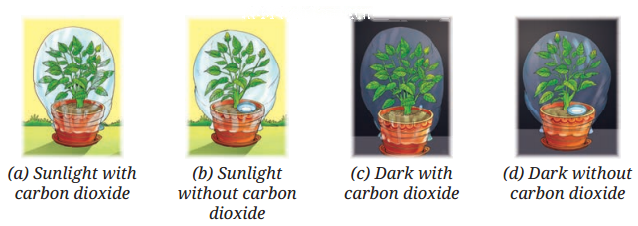
Vani believes that ‘Carbon dioxide is essential for photosynthesis’. She puts an experimental set-up, as shown in Fig. 10.11, to collect evidence to support or reject idea.
Answer the following questions:
(i) In which plant(s) in the above set-up(s) will starch be formed?
(ii) In which plant(s) in the above set-up(s) will starch not be formed?
(iii) In which plant(s) in the above set-up(s) will oxygen be generated?
(iv) In which plant(s) in the above set-up(s) will oxygen not be generated?
Answer:
(i) Starch will be formed in (a). Because sunlight and carbon dioxide are present.
(ii) Starch will not be formed in (b), (c) and (d)
(iii) Oxygen will be generated in (a)
(iv) Oxvgen will not be generated in (b), (c) and (d)
Question 8.
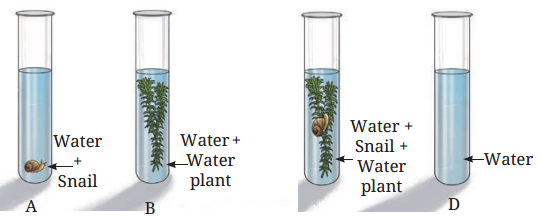
Ananya took four test tubes and filled three-fourth of each test tube with water. She labelled them A, B, C and D (Fig. 10.12). In test tube A, she kept a snail; in test tube B, she kept a water plant; in test tube C, she kept both a snail and a plant. In test tube D, she kept only water. Ananya added a carbon dioxide indicator to all the test tubes. She recorded the initial colour of water and observed if there are any colour changes in the test tubes after 2-3 hours. What do you think she wants to find out? How will she know if she is correct?
Answer:
She wants to find out that carbon dioxide is emitted during respiration. If colour in test tube changes (like violet to yellow) that means CO2is present. In test tube ‘A’ (snail) and C (snail and plant) colour will be changed because respiration is taking place in both.
Question 9.
Design an experiment to observe if water transportation in plants is quicker in warm or cold conditions?
Answer:
Water transportation in plants is quicker in warm conditions because the rate of evaporation is increased.
Experiment: Place two plants in coloured water. Keep one in a hot place and another in cold place. Check after some time that in which plant the coloured water rises up quicker.
Question 10.
Photosynthesis and respiration are essential to maintain balance in nature. Discuss.
Answer:
During photosynthesis CO2is absorbed and O2is released whereas in respiration O2is absorbed and CO2is released. These both processes maintains balance of gases in atmosphere. This balance is essential to maintain because it help to continuity of cycle of O2and CO2.
Life Processes in Plants Class 7 Questions and Answers (Intext)
(Page No. – 141)
Question 1.
How does sunlight contribute in the production of starch in plants?
Answer:
Starch production is an outcome of photosynthesis and in process of photosy nthesis water, sunlight carbon dioxide and chlorophyll makes food in the form of glucose, which is later stored as starch.
(Page No. 143)
Question 2.
Which gas from the air is essential in the process of food preparation in plants?
Answer:
Carbon dioxide gas from the air is essential m the process of food preparation in plants.