RBSE Class 7 Science Chapter 11 Question Answer Light Shadows and Reflections
By tackling theseRBSE Solutions Class 7 Scienceand RBSE Class 7 Science Chapter 11 Light Shadows and Reflections Question Answer, students will build a solid foundation in the topic.
Light Shadows and Reflections Class 7 Question Answer
RBSE Class 7 Science Chapter 11 Light Shadows and Reflections Question Answer
Class 7 Science Curiosity Chapter 11 Question Answer (Exercise)
(Let Us Enhance Our Learning)
Question 1.
Which of the following are luminous objects? Mars, Moon, Pole Star, Sun, Venus, Mirror.
Answer:
Sun is a luminous object because it emit its own light. Pole star is also a luminous object because it also emits its own light. Others shine due to light of sun.
Question 2.
Match the items in column A with those in column B.
Column A | Column B |
Pinhole camera | Blocks light completely |
Opaque object | The dark. region formed behind the object |
Transparent object | Forms an inverted image |
Shadow | Light passes almost completely through it |
Answer:
Column A | Column B |
Pinhole camera | Forms an inverted image |
Opaque object | Blocks light completely |
Transparent object | Light passes almost completely through it |
Shadow | The dark. region formed behind the object |
Question 3.
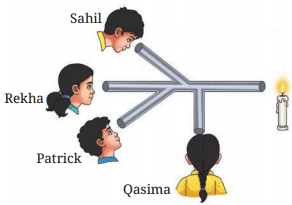
Sahil, Rekha, Patrick and Qasima are trying to observe the candle flame through the pipe as shown in Fig. 11.16. Who can see the flame?
Answer:
Only Rekha can see candle flame through are seeing are blocked due to bends, so they can’t pipe because only Rekha’s line of sight reaching see candle flame. Only Rekha can see. directly at candle flame. Pipes through which
Question 4.
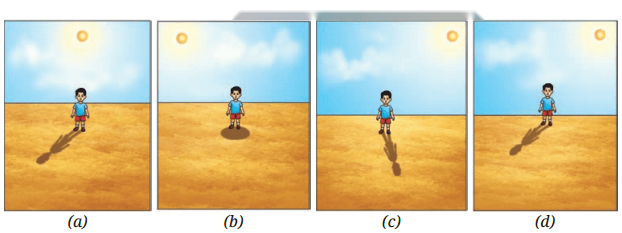
Look at the images shown in Fig. 11.17 and select the correct image showing the shadow formation of the boy.
Answer:
Shadow is smallest when sun is overhead. When sun is right or left to an object the shadow will be formed in opposite side. So, image (D) is correct only.
Question 5.
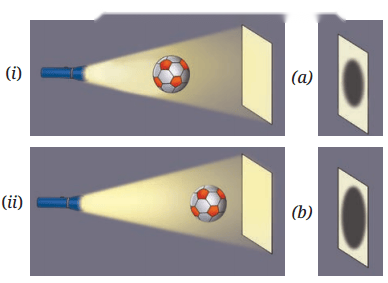
The shadow of a ball formed on a wall by placing the ball in front of a fixed torch as shown in Fig. 11.18. In scenario (i) the ball is closer to the torch, while in scenario (ii) the ball is closer to the wall. Choose the most accurate representation of the shadows formed in both scenaries from the
Answer:
If ball is closer to torch then shadow formed on wall will be large and blurred, (ii) Represents it. If ball is closer to wall then shadow formed on wall will be small and sharp. Its represented by (i).
Question 6.
Based on Fig. 11.18, match the position of the torch in column A with the characteristics of the ball’s shadow in column B.
Column A | Column B |
If the torch is close to the ball If the torch is farawayIf the ball is removed from the set-up If two torches are present in the set-up on the left side of the ball | The shadow would be smallerThe shadow would be largerTwo shadows would appear on the screen A bright spot would appear on the screen |
Answer:
Column A | Column B |
If the torch is close to the ball If the torch is farawayIf the ball is removed from the set-upIf two torches are present in the set-up on the left side of the ball | The shadow would be largerThe shadow would be smallerA bright spot would appear on the screenTwo shadows would appear on the screen |
This match shows travel of light in a linear path and effect of distance on shadow. According to Fig., when ball is closer to torch shadow formed will be larger and if ball is closer to wall the shadow will be small.
Question 7.
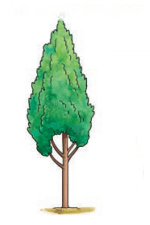
Suppose you view the tree shown in fig. 11.19 through a pinhole camera. Sketch the outline of the image of the tree formed in the pinhole camera.
Answer:
A straight standing tree is shown in Fig. if we see it through pinhole camera then the upside down image will be seen on screen means apex of tree will be seen in down side and lower parts like stem, and root will be seen in upper side. Size of image will be smaller.
Question 8.
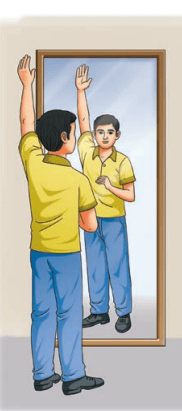
Write your name on a piece of paper and hold it in front of a plane mirror such that the paper is parallel to the mirror. Sketch the image. What difference do you notice? Explain the reason for the difference.
Answer:
The names seen in mirror will be laterally inverted.
Ex.:
Letters of name are seen inverted (laterally inverted), the part is in left side, visible in right side and letters which are in right side are visible in left side, there is no change in size and height. This event take place because of reflection of light. Ray of light comes back on the same angle after hitting mirror, which changes the direction in left-right.
Question 9.
Measure the length of your shadow at 9 AM, 12 PM and 4 PM with the help of your friend. Write down your observations:
(i) At which of the given times is your shadow the shortest?
(ii) Why do you think this happen?
Answer:
It is found in observation that on the same place length of shadow was measured in morning 9 O’clock, 12 at noon and after 4 PM, the length will changed with time.
(i) Shadow is shortest at 12 PM in noon.
(ii) This happens because during noon at 12 PM the sun is overhead and rays of the sun are vertical on the object resulting shadow will be formed in lower direction with shorter length. In morning and evening the sun will be horizontal, so rays fall obliquely and the shadow will be seen longer.
Question 10.
On the basis of following statements, choose the correct option.
Statement A : Image formed by a plane mirror is laterally inverted.
Statement B : Images of alphabets T and O appear identical to themselves in a plane mirror.
(i) Both statements are true
(ii) Both statements are false
(iii) Statement A is true, but statement B is false
(iv) Statement A is false, but statement B is true
Answer:
(ii) Both statements are true
Question 11.
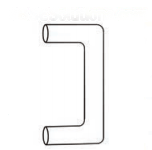
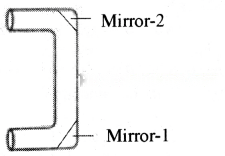
Suppose you are given a tube of the shape shown in the figure 11.20 and two plane mirrors smaller than the diameter of the tube. Can this tube be used to make a periscope? If yes, mark where you will fix the plane mirrors.
Answer:
Yes, this pipe can be used to make a periscope. Both plane mirrors will be placed under the open end. Each mirror should be inclined on 45° angle so it bents towards reflected surface and both mirrors pass the reflected light to each other. Like this the rays coming from mirror will travel in pipe after getting reflected from first mirror and reach to the sight of another mirror.
Question 12.
We do not see the shadow on the ground of a bird flying high in the sky. However the shadow is seen on the ground when the bird swoops near the ground. Think and explain why it is so.
Answer:
Due to long distance between the bird flying high in the sky and its shadow the light scattered and shadow disappeared, and seen when the bird swoops near the ground.
Life Processes in Plants Class 7 Questions and Answers (Intext)
(Page NO. 156)
Question 1.
What happens when an object conies in the path of light?
Answer:
It depends on whether the object is transparent, translucent or opaque. If the object is transparent, light will travel through it completely. If translucent, light travel partially and if opaque then light will not travel through it.
(Page No. 157)
Question 2.
What happens when an opaque object blocks the path of light?
Answer:
When an opaque object blocks the path of light there a black spot formed and is called a shadow.
(Page No. 159)
Question 3.
When the opaque object was a shiny object like a polished steel plate, I got a shadow on the screen, but I also saw that there was a bright spot of light on the wall on the opposite side. Why was it so?
Answer:
A shiny surface or mirror changes the direction of light that falls upon it. This change in direction of light by a mirror is called reflection of light.
(Page No. – 160)
Question 4.
In a mirror, I can also see my face. Is that also due to the reflection of light?
Answer:
Yes, it is also possible due to reflection of light.
(Page No. 162)
Question 5.
Can we see an image of an object only in a mirror or are there some other ways as well?
Answer:
Along with mirror we can see image in still water, any polished stone or metal piece. Ex. : In Kerala, ‘Aranamula Konnadi