RBSE Class 7 Science Chapter 12 Question Answer Earth Moon and the Sun
By tackling theseRBSE Solutions Class 7 Scienceand RBSE Class 7 Science Chapter 12 Earth Moon and the Sun Question Answer, students will build a solid foundation in the topic.
Earth Moon and the Sun Class 7 Question Answer
RBSE Class 7 Science Chapter 12 Earth Moon and the Sun Question Answer
Class 7 Science Curiosity Chapter 12 Question Answer (Exercise)
(Let Us Enhance Our Learning)
Question 1.
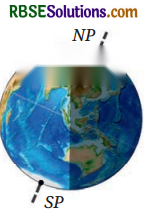
In Fig. 12.17, how many hours of sunlight do the north pole and the south pole receive during one rotation of the Earth?
Answer:
According to Fig. 12.17, there is more than 12 hours of sunlight can be seen on south pole and less than 12 hours of sunlight is received on north pole
Question 2.
Fill in the blanks.
(i) Stars rise in the ______ and set in the ______.
Answer:
east, west
(ii) Day and night are caused by the Earth’s ______
Answer:
rotation
(iii) When the Moon fully covers the Sun from our view, it is called a ______ solar eclipse.
Answer:
total
Question 3.
State whether True or False.
(i) Lunar eclipse occurs when the Sun comes between the Earth and the Moon.
(ii) Sunrise happens earlier in Gujarat than in Jharkhand.
(iii) In Chennai, the longest day occurs on the summer solstice.
(iv) We should watch the solar eclipse directly with our naked eve.
(v) Seasons occur due to the tilt of Earth’s axis of rotation and its spherical shape.
(vi) The Earth’s revolution around the Sun causes day and night.
Answer:
(i) False
(ii) False
(iii) True
(iv) False
(v) True
(vi) False
Question 4.
Padmashree saw the Orion constellation nearly overhead at 8 PM yesterday. When will she see Orion overhead today?
Answer:
Padmashree will see Orion constellation nearly overhead 4 minutes earlier than yesterday . It means she will see it at 7.56 PM today.
Question 5.
Nandhini saw a group of stars rising at midnight on 21 June. When will she see the same group of stars rising at midnight next year?
Answer:
The Earth completes its revolution in one y ear. Thus Nandhini will see the group of stars next year at same time (21 June, midnight).
Question 6.
Abhay noticed that when it was daytime in India, his uncle who was in LISA was generally sleeping as it was night-time there. What is the reason behind this difference?
Answer:
It is because of rotation of the Earth. When the Indian part of the Earth is in front of the Sun, then the American part of the Earth is behind or in dark. So there is day in India and night in America (U.S.).
Question 7.
Four friends used the following ways to see solar eclipse. Who among them was being careless?
(i) Ravikiran used a solar eclipse goggle
(ii) Jyothi used a mirror to project the Sun’s image
(iii) Adithya saw the Sun directly with his eyes
(iv) Aruna attended a programme arranged by a planetarium
Answer:
Adithya became careless because he saw the Sun directly with his eyes which is very dangerous.
Question 8.
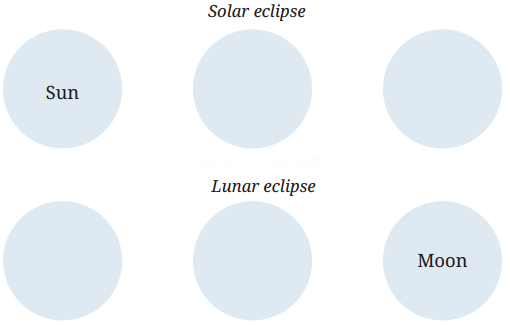
Fill in the circles in Fig. 12.18 appropriately with one of the following Sun, Moon, Earth.
Answer:
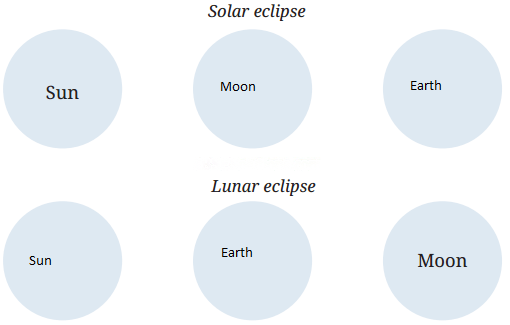
Question 9.
The Moon is much smaller than the Sun, yet it can block the Sun completely from our view during a solar eclipse. Why is it possible?
Answer:
Because Moon is closer to the Earth, whereas the Sun is at distance compared to the Moon. That is why the Moon completely block the light of Sun during a solar eclipse because their virtual sizes became same.
Question 10.
The Indian cricket team matches in Australia are often held in December. Should they pack winter or summer clothes for their trip?
Answer:
Australia is in southern hemisphere and in December there is summer season. So they pack summer clothes for their trip.
Question 11.
Why do you think lunar eclipses can be seen from a large part of the Earth when they happen, but total solar eclipse can be seen by only a small part of the Earth?
Answer:
It is because the shadow’ of the Moon, during solar eclipse shadow of the Moon falls on a very- small part of the Earth. Even though shadow of the Earth is larger than Moon’s size. So lunar eclipse can be seen from a large part.
Question 12.
If the Earth’s axis is not tilted with respect to the axis of revolution, explain what would be the effect on seasons?
Answer:
If the Earth’s axis is not tilted with respect to the axis of revolution then the rays of Sun will fall equally on all part of the Earth and the cycle of seasons would not exist and the same season will be whole year.
Earth Moon and the Sun Class 7 Questions and Answers (Intext)
(Page No. 172)
Question 1.
How day and night occur on the Earth due to its rotation?
Answer:
The cycle of day and night runs due to rotation of the Earth in west to east. On Earth, the part in front of the Sun have days and other have darkness or night.
(Page No. 174)
Question 2.
Since the Earth is rotating, shouldn’t the stars also appear to move in the sky like the Sun?
Answer:
Yes. because the Earth is rotating, so stars are also appeared to moving in the sky. it is only because the Earth is rotating on its axis.
(Page No – 175)
Question 3.
Why do different stars appear in the night sky over the course of a year?
Answer:
It is because the movement of the Earth. Because the Earth is revolving around the Sun also so whenever we see in different directions, changes also appear in the stars over the course of a year.
(Page No. 177)
Question 4.
We go through a cycle of seasons every year. Is it related to the revolution of the Earth around the Sun in some way?
Answer:
Yes. it is related with revolution around the Sun because the Earth’s axis of rotation is not upright with respect to the orbit, but is tilted. The Earth maintains this tilt as its orbit around the Sun. The tilt of the Earth’s axis and the spherical shape of the Earth gives rise to seasons.
(Page No. 179)
Question 5.
Could the light from the Sun get blocked by the two planets which are revolving between the Earth and the Sun?
Answer:
Planets like Mercury and Venus cannot block it but Moon can do this, this situation is called as solar eclipse. Even Mercury and Venus are larger than Moon but they are comparatively far from the Earth.