RBSE Class 7 Science Chapter 3 Question Answer The Electricity Circuits and Their Components
By tackling theseRBSE Solutions Class 7 Scienceand RBSE Class 7 Science Chapter 3 Electricity Circuits and Their Components Question Answer, students will build a solid foundation in the topic.
Electricity Circuits and Their Components Class 7 Question Answer
RBSE Class 7 Science Chapter 3 Electricity Circuits and Their Components Question Answer
Class 7 Science Curiosity Chapter 3 Question Answer (Exercise)
Let Us Enhance Our Learning
Question 1.
Choose the incorrect statement.
(i) A switch is the source of electric current in a circuit.
(ii) A switch helps to complete or break the circuit.
(iii) A switch helps us to use electricity as per our requirement.
(iv) When the switch is in ‘OFF position, there is an air gap between its terminals.
Answer:
(i) A switch is the source of electric current in a circuit.
Question 2.
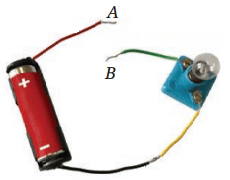
Observe Fig. 3.16. With which material connected between the end A and B, the lamp will not glow?
Answer:
If any material which is insulator of electricity is connected between the A and B. the lamp w ill not glow. Ex. : Wood, rubber, plastic glass etc.
Question 3.
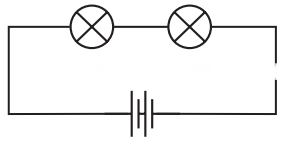
In Fig. 3.17, the filament of one of the lamps is broken, will the other glow? Justify your answer.
Answer:
These lamps are connected in series circuit, so the other lamp will not glow. If they are connected in parallel series then the other lamp continue to glow even the filament of other lamp is broken.
Question 4.
A student forgot to remove the insulator covering from the connecting wires while making a circuit. If the lamp and the cell are working properly, will the lamp glow?
Answer:
Even if the lamp and cell are working properly, the lamp will not glow because the insulator does not allow the passage of electric current. So the lamp will not glow.
Question 5.
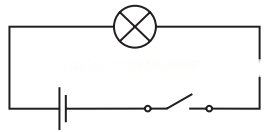
Draw a circuit diagram for a simple torch using symbols for electric components.
Answer:
Components – Cell, battery, switch, and lamp.
Question 6.
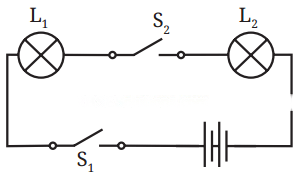
In Fig. 3.18:
(i) If S2is in ‘ON’ position, S( is in ‘OFF’ position, which lamp(s) will glow?
(ii) If S2is in ‘OFF’ position, S1is in ‘ON’ position, which lamp(s) will glow?
(iii) If S1and S2both are in ‘ON’ position, which lamp(s) will glow?
(iv) If both S1and S2are in ‘OFF’ position, which lamp(s) will glow?
Answer:
(i) If S2is ‘ON’ and S1is ‘OFF’, then both lamps will not glow.
(ii) If S2is ‘OFF’ and S1is ON then both lamps will not glow.
(iii) If S1and S2both are ‘ON’, then both L1and L2lamps will glow.
(iv) If both S1and S2are ‘OFF’ then none of the lamps will glow.
Question 7.
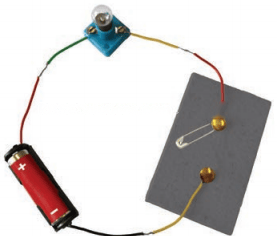
Vidyut has made the circuit as shown in Fig. 3.19. Even after closing the circuit, the lamp does not glow. What can be the possible reasons? List as many possible reasons as you can for this faulty operation. What will you do to Find out why the lamp did not glow?
Answer:
(i) Battery or cells are faulty or discharged.
(ii) Filament of lamp is broken.
(iii) Switch is not working.
(iv) Insulated covers are not removed.
(v) There is any loose or broken joint in connection.
(vi) Wire is broken from somewhere in circuit.
Methods to find out the fault
(i) Change all the components of circuit one by one. (cell, switch, wire, lamp)
(ii) Check with an alternative cell or lamp.
(iii) Check connection or wires with electric tester.
(iv) Check the switch by turning it ‘ON’ and ‘OFF’, that it is making connection or not.
Question 8.
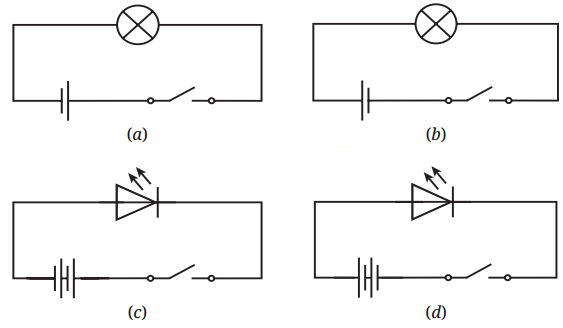
In Fig. 3.20, in which case(s) the lamp will not glow when the switch is closed?
Answer:
(c) Batteries are connected in opposite direction, so the current will not flow7 and the lamp will not glow.
Question 9.
Suppose the ‘+’ and symbols cannot be read on a battery. Suggest a method to identify the two terminals of this battery.
Answer:
In a battery a protruding metal cap is the positive terminal and flat disc on other side is negative terminal.
Question 10.
You are given six cells marked A, B, C, D, E, and F. Some of these are working and some are not. Design an activity to identify which of them are working.
(i) List the items that you require.
(ii) Write the procedure that you ill follow.
(iii) With the items, carry out the activity to identify the cells that are working.
Answer:
(i) Required items: A small bulb (lamp). Two pieces of wire. Bulb holder (if available). A testing board.
(ii) Method : Connect both ends of wire with the both terminals of cell and touch the ends of bulb wire there. On the cells, bulb gloss those are or king and on those cells bulb ill not glow, they are not working,
(iii) Check with all cells one by one, lamp will glow with the cells which are working.
Question 11.
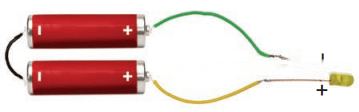
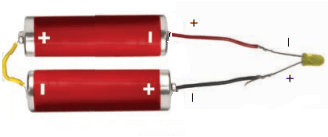
An LED requires two cells in series to glow. Tanya made the circuit as shown in Fig. 3.21. Will the lamp glow? If not draw the wires for correct connections.
Answer:
No. the lamp will not glow, because both ends of lamp wire are connected with positive ends of batters’. It is because in LE.D’s current can pass only in one direction When the positive terminal of LED. will be connected with positive end and negative terminal with negative then the lamp will glow. The correct drawing for wire’s connection is
Electricity Circuits and Their Components Class 7 Questions and Answers (Intext)
(Page No. 24)
Question 1.
Why does the torch lamp glow in one position of its switch?
Answer:
In one position which is the ON position, the electric circuit completed and the filament gets hot and glows to produce light.
(Page No. 32)
Question 2.
How does a switch turn on or off the torchlight?
Answer:
A switch is a simple device that either completes or break circuit, in its ON position it completes the circuit and help to glow the torchlight and in OFF position the switch breaks the electric circuit so the lamp in torchlight does not glow.
(Page No. 33)
Question 3.
Can we represent the circuits in a simpler manner?
Answer:
Yes, the electric circuits can be represented in a simpler manner as symbols e.g. In the symbol for an electric cell, the long line represents the positive terminal, while the short line represents the negative terminal.

(Page No. 34)
Question 4.
Why did we use metal wires for making electric circuits? Can we not use some other materials for wires?
Answer:
The materials through which electric current can flow easily are called good conductors or conductors of electricity and the materials through which current cannot pass are called insulators. That is why the metals are used as electric wires, because they are good conductors of electricity. And other materials like rubbers, plastics and ceramics are insulators, so cannot be used to make electric circuit.
Question 5.
Why are electric wires covered with plastic or rubber?
Answer:
Because rubber and plastic are insulators which does not allow electricity to flow through it and prevent us from electric shocks. So electric wires are covered with plastic or rubber.