RBSE Solutions for Class 7 Science Chapter 7 Heat Transfer in Nature
By tackling theseRBSE Solutions Class 7 Scienceand RBSE Class 7 Science Chapter 7 Heat Transfer in Nature Question Answer, students will build a solid foundation in the topic.
Heat Transfer in Nature Class 7 Question Answer
RBSE Class 7 Science Chapter 7 Heat Transfer in Nature Question Answer
Class 7 Science Curiosity Chapter 7 Question Answer (Exercise)
(Let Us Enhance Our Learning)
Question 1.
Choose the correct option in each case,
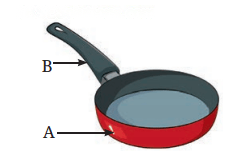
(i) Your father brought a saucepan made of two different materials, A and B, as shown in Fig. The materials A and B have the following properties :
(a) Both A and B are good conductors of heat
(b) Both A and B are poor conductors of heat
(c) A is a good conductor and B is a poor conductor of heat
(d) A is a poor conductor and B is a good conductor of heat
Answer:
(c) A is a good conductor and B is a poor conductor of heat. (Handle of saucepan is made of poor conductor to protect hands from warmth and body is made of good conductor)
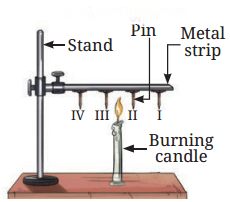
(ii) Pins are struck to a metal strip with wax and a burning candle is kept below the rod, as shown in Fig. Which of the following will happen?
(a) All the pins will fall almost at the same time
(b) Pins I and II will fall earlier than pins III and IV
(c) Pins I and II will fell later than pins III and IV
(d) Pins II and III will fell almost at the same time
Answer:
(d) Pins II and III will fall almost at the same time
(iii) A smoke detector is a device that detects smoke and sounds an alarm. Suppose you are fitting a smoke detector in your room. The most suitable place for this device will be :
(a) Near the floor
(b) In the middle of a wall
(c) On the ceiling
(d) Anywhere in the room
Answer:
(c) On the ceiling
(Because smoke rises up, so it will be helpful to know early.)
Question 2.
A shopkeeper serves you cold lassi in a tumbler. By chance, the tumbler had a small leak. You were given another tumbler by the shopkeeper to put the leaky tumbler in it. Will this arrangement help to keep the lassi cold for a longer time? Explain.
Answer:
Yes, this arrangement help to keep the lassi cold for a longer time. Due to layer of air between both tumbler heat transfer will be reduced, so lassi will remain cold for longer time.
Question 3.
State with reason(s) whether the following statements are True [T] or False [F].
(i) Heat transfer takes place in solids through convection.
Answer:
False: Heat transfer in solids take place through conduction.
(ii) Heat transfer through convection takes place by the actual movement of particles.
Answer:
True: In convection, heat transfer takes place by the actual movement of particles.
(iii) Areas with clay materials allow more seepage of water than those with sandy materials.
Answer:
False: Seepage is more in sandy materials than clay materials. Because space between their particles is more.
(iv) The movement of cooler air from land to sea is called land breeze.
Answer:
True: Land breezes moves in night from land to sea.
Question 4.
Some ice cubes placed in a dish melt into water after some time. Where do the ice cubes get heat for this transformation?
Answer:
Ice cubes placed in a dish melt into water after some time because they rccieve heat from the conduction from the dish and surrounding air, and it cause the ice to melt.
Question 5.
A burning incense stick is fixed, pointing downwards. In which direction would the smoke from the incense stick move? Show the movement of smoke with a diagram.
Answer:
Smoke will go upward because after getting heated warm air will rise up.
Img- 1
Question 6.
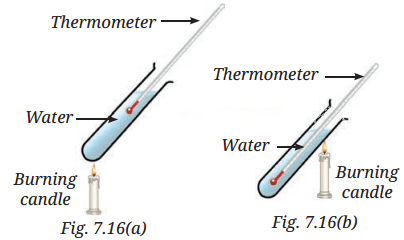
Two test tubes with water are heated by a candle flame as shown in Fig. 7.16. Which thermometers [Fig. 7.16 (a) or Fig. 7.16 (b)] will record a higher temperature? Explain.
Answer:
In Fig. (a) heat provided from the bottom of the test tube when the water (liq.) heated it will risen up due to convection and comes in contact with thermometer while in Fig. (b) heat is provided in the middle of the test tube, which will only heat the area which is in direct contact of thermometer. So, the thermometer in Fig. (a) will record higher temperature.
Question 7.
Why are hollow bricks used to construct the outer walls of houses in hot regions?
Answer:
Because these bricks have air in them which is an insulator of heat, so these walls prohibit heat to enter in the house and keeps the houses cool. That is why hollow bricks are used to construct the outer walls of houses in hot regions.
Question 8.
Explain how large water bodies prevent extreme temperature in areas around them?
Answer:
As we know land gets heated faster than water during the day it causes warm air above the land to rise. This causes the cooler air to move from water bodies towards the land. It is called sea breeze, hence in extreme temperature areas sea breezes relieves people from the heat. That is why, windows of the houses in coastal areas are placing facing the sea.
Question 9.
Explain how water seeps through the surface of the Earth and gets stored as groundwater.
Answer:
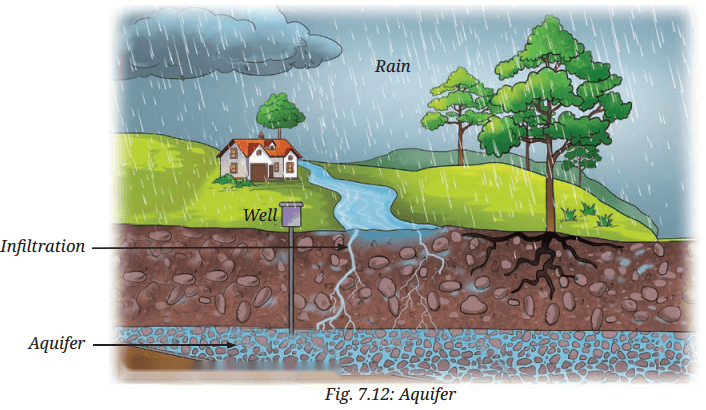
Rain water seeps through holes in soil and rocks and collected as groundwater, this is called infiltration. It is a natural process, which is also known as surface water recharging. Rain water dropped on land. Through the surface of the Earth rain water moved in rivers, ponds and pits and a part of it seeps downward slowly through particles of soil. This water reaches beneath the Earth slowly through porous layers of land. Somewhere water stored in soil, sand and rocks which are called aquifers. When water stored in these aquifers known as underground water. This water can be extracted from wells, tubewells etc. Which is utilised in dry season for drinking and irrigation.
Importance: This process is helpful to maintain underground water level through water storage and water recharging. Underground water remains available so helpful to get rid of water scarcity.
Question 10.
The water cycle helps in the redistribution and replenishment of water on the Earth. Justify the statement.
Answer:
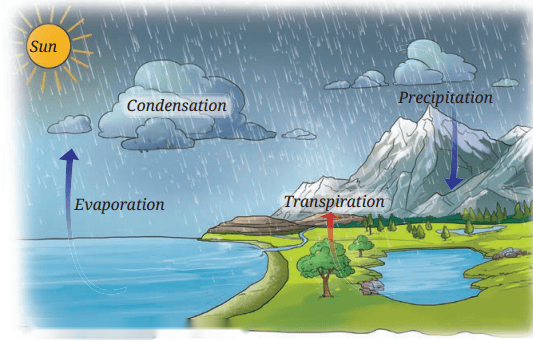
Water went through water evaporation, condensation, rain etc. many processes in water cycle and comes back to rivers, lakes, ocean and in the form of groundwater. Water cycle is helpful in redistribution and replenishment of water because it shows a constant and cyclic movement of water, through which water available again and again to climate and eco-system.
Process of Water-cycle : Water in the oceans, rivers, and lakes gets heated due to the Sun, and as a result, it evaporates from trees and plants through transpiration, water vapour rises up, it cools down and condenses to form clouds. From clouds water falls down to the Earth in the form of rain. A part of water comes back to rivers, lakes and oceans and another stored as ground water by seeping, which refills the groundwater resources. This process helps in redistribution and replenishment of water continous which prevents loss of water.
Heat Transfer in Nature Class 7 Questions and Answers (Intext)
(Page – 90)
Question 1.
How does heat get transferred in these materials?
Answer:
Heat is transferred through conduction in metal utensils. The particles got heated in this process transfers the heat to neighbouring particle and this process continued further even particles remains at their place.
(Page No. 91)
Question 2.
Why we generally use metal utensils for cooking, whereas we prefer clay and porcelain cups for drinking tea and coffee?
Answer:
Because metals are good conductors of heat, so it help to cook food soon and perfectly, and clay and porcelain are bad conductors of heat helps to keep our tea or coffee warm for long time.
(Page No. 92)
Question 3.
Why is the smoke going up?
Answer:
Smoke is going up because of conduction. Smoke is a mixture of hot gases and tiny solid particles, as it is warmer than surrounding air, rises up.
(Page No. 93)
Question 4.
How does heat transfer take place in liquids? Do liquids also rise up when heated like air?
Answer:
Heat transfer take place through conduction in liquids too. And when heated too much risen up converting in vapour.
(Page No. 96)
Question 5.
I wonder how heat from the fire reaches us?
Answer:
Heat from fire reaches through radiations. Radiation does not need any physical medium to transfer heat. Ex. : Sun’s heat on the Earth.
(Page No. 99)
Question 6.
How does water seep through the surface of the Earth?
Answer:
There are many blank places between particles of soil under the layer of the Earth. Through which water seeps and went under the depth.