India, a Home to Many Class 7 Questions and Answers SST Part 2 Chapter 5
Start practicing theExploring Society India and Beyond Class 7 Solutionsand Class 7 SST Part 2 Chapter 5 India, a Home to Many Question Answer to consolidate your knowledge effectively.
India and Her Neighbours Questions and Answers Class 7 SST Part 2 Chapter 5
India, a Home to Many Class 7 Question Answer
The Big Questions (Page 125)

Question 1.
What has made India a home for people from different parts of the world?
Answer:
India is a home for people from different parts of the world because-
- India welcomes people of different religions, languages and cultures, allowing them to live peacefully.
- Indian society was known for religious tolerance and cultural diversity.
- India provided a safer place to live.
- People can practise their faith, worship freely.
Question 2.
Why did oppressed or persecuted people from other countries seek refuge in India?
Answer:
- India had a long tradition of tolerance and acceptance of different religions and cultures.
- Indian rulers provided protection and shelter to people facing persecution.
- Indian society allowed freedom of worship and expression which attracted refugees.
Question 3.
What is it about the nature of Indian society that enables people to assimilate here?
Answer:
- Traditions like tolerance, non-violence are deeply rooted.
- It promotes mutual respect and coexistence.
- Indian culture allows people to retain their own identity while adopting local practices.
Think About It (Page 126)
Question 1.
Imagine this scenario-A stranger knocks at your door at midnight. It is raining heavily outside, and the stranger seeks shelter for the night claiming that his car broke down while he was driving in the vicinity. Your family goes into a huddle to discuss the pros and cons of letting a stranger into the house at night. Form two groups to discuss the arguments for and against in this scenario.
Answer:
Arguments for and against letting a stranger into the house.
Arguments for :
- Providing safety from severe weather conditions.
- Moral duty to help others.
- Compassion and empathy for someone in distress.
Arguments against :
- Uncertainty regarding the stranger’s true intentions.
- Security of family members.
- Significant personal risks.
Question 2.
Now extend this scenario to a country like India-when refugees seek shelter in India, will similar arguments apply?
Answer:
Yes. If we extend this scenario to a country like India, similar arguments will apply.
Think About It (Page 131)
Question 1.
What do you think dissolving the sugar in the milk without spilling it meant?
Answer:
- It showed mutual respect and harmony between the Parsis and the local peoples.
- The Parsis would blend into Indian society without disturbing it.
- It meant peaceful coexistence, assimilation without conflict.
Let’s Explore (Page 140)
Question 1.
Identify similar values in any story or local tradition etc. known to you. You could ask your guardians or relatives too. Collect these stories and create a class manuscript. You could include illustrations.
Answer:
Story: The sugar in the milk-Parsi settlement in India.
- When the Parsis came to India, the king showed them a jug full of milk.
- The Parsi leader added sugar to the milk without spilling it.
- This symbolised that the Parsis would blend into society peacefully.
- They promised to enrich the land without disturbing local culture.
- The king allowed them to settle in his kingdom.
India, a Home to Many Class 7 Solutions
Question 1.
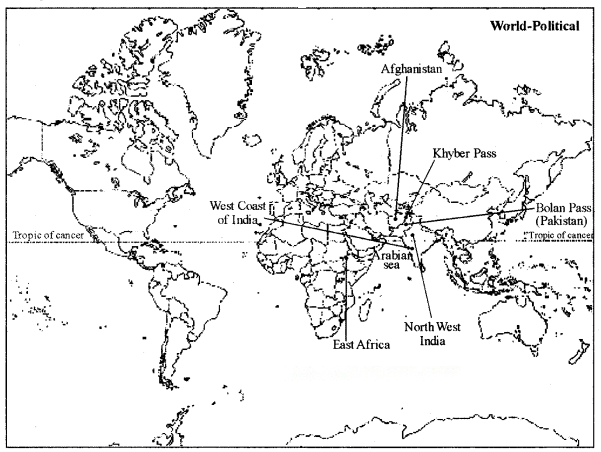
On the outline of a world map, try to trace the routes that the communities mentioned in this chapter may have used to reach India. What types of physical geographies did they have to negotiate?
Answer:
Communities used the following routes to reach India:
- From central Asia → Afghanistan → North-west India.
- Route was generally used by traders, invaders, etc.
Mountain passes :
- Khyber Pass
- Bolan Pass
Both the above routes were used to reach India.
- Sea Routes :East Africa → Arabian sea → West Asia → West coast of India.
Physical geographies they had to negotiate:
- High mountains-Hindu Kush and other ranges.
- Deserts-Thar desert and lack of water.
- Rivers-Indus and seasonal floods.
Note: Routes are marked on the political map of world.
Question 2.
What are the key values intrinsic to Indian culture that enable it to welcome people of different backgrounds?
Answer:
- A long tradition of hospitality and inclusiveness.
- Freedom to follow one’s own faith and traditions.
- Belief in peaceful co-existence.
- Acceptance to many languages, customs, traditions, cultures and food habits.
- Tolerance and respect for different religions and beliefs.
Question 3.
Homi Bhabha, Sam Maneckshaw, Ratan Tata, Fali Nariman, Nani Palkivala, and Cornelia Sorabji are a few names of Parsis who excelled in thier respective fields. Find out more about people from other communities that made India their home and their contributions.
Answer:
- Mother Teresa (Christian community)-Worked for poor and sick.
- Annie Besant-A British social reformer, was a prominent figure in the Indian freedom struggle. She promoted self-governance.
- Sister Nivedita-An Irish woman came to India. She worked for women’s education and helped to promote nationalist feelings among the youth.
- Dalai Lama (Tibetan community)Promoted peace and compassion in India.
- Jamsedji Tata (Parsi community)-Pioneer of Indian industry.
Question 4.
Take up a class project. Divide the class into groups. Each group takes a small project to study a little more about the communities that we have been listed here. Share what you have gathered with your classmates through one of these ways-drama, posters, song, painting, etc.
Answer:
Class project on communities in India (Såmple Answer) :
- The class can be divided into small groups.
- Each group will study one community mentioned in the chapter. Such as Parsi, Christian, Tibetan, etc.
- Students can find out about their culture, food habits, dances, festivals, fairs, etc.
- These findings can be presented through posters, paintings, songs or skits.