Understanding the Weather Class 7 Question Answer SST Chapter 2
Start practicing theRBSE Solutions Class 7 Social Scienceand Class 7 SST Chapter 2 Understanding the Weather Question Answer to consolidate your knowledge effectively.
Class 7 SST Chapter 2 Understanding the Weather Question Answer
Class 7 Social Science Chapter 2 Understanding the Weather Question Answer
Understanding the Weather Class 7 Questions and Answers
The Big Questions (Page No. 27)
Question 1.
How can we measure and monitor the weather around us?
Answer:
We can measure and monitor the weather around us by studying its elements, that is, by observing and measuring factors such as temperature, precipitation, humidity, air pressure, and wind; for example, whether the weather is cold or hot, or whether it is rainy or dry.
Question 2.
How do weather predictions help us prepare for events like heavy rain, storms, drought, and heat waves?
Answer:
Accurate weather forecasts help us prepare for such events. Forecasts also enable local governments to mobilise resources and prepare for any disasters. For example, if stormy weather is expected at sea, fishermen are warned about venturing out in their boats, or an entire coastal area might have to be evacuated if a cyclone is expected. Therefore, it is clear that weather predictions help us prepare for events like heavy rain, storms, drought, and heat waves.
Let’s Explore (Page No. 28)
Question 1.
What are some of the words in your local language that you use to describe the weather? Hot, cold, warm, chilly, crisp, pleasant, and so on are commonly used terms in English.
Answer:
We use words in our local language to describe the weather, such as garmi, thand, suhana mausam, baarish, umas.
Let’s Explore (Page No. 29)
Question 1.
What do you think could be some other reasons to measure the weather more precisely? (Hint: Think how knowing the weather a few hours or a few days in advance would help you plan some activities.)
Answer:
More accurate weather forecasts provide us with advanced information about weather conditions for the next few hours or days. This allows us to plan our daily and special activities, such as travel, agricultural work, school, or events, more effectively. It also helps us to be prepared for and mitigate potential losses from extreme weather conditions like rain, storms, or extreme heat.
Let’s Explore (Page No. 30)
Question 1.
Talk to elders in your neighbourhood and ask them how they predict the weather. What signs do they observe? Document any sayings in your regional language that refer to weather prediction.
Answer:
Elderly people predict the weather by observing signs in nature. They forecast the weather by observing the flying of birds, the behavior of ants, the sounds of frogs, the activities of squirrels, and changes in trees and plants. Based on these signs, the following sayings are also prevalent, which indicate the possibility of rain or a storm-
- Kali ghata chhayi, samjho varsha aayi!
- Chinti anda le jaaye, barish jaldi aaye!
- Suraj dhale lalima chhaye, agle din pani baras jaaye!
Don’t Miss Out (Page No. 32)
Question 1.
Can you think of a reason why rain arises from the sun?
Answer:
The sun’s heat causes water to evaporate and form clouds, and these clouds then release water back to the earth as rain. Thus, rain arises from the Sun.
Let’s Explore (Page No. 32)
Question 1.
Here’s a chart of the temperatures of a city in Madhya Pradesh. What is the maximum temperature recorded in the week shown here? What is the minimum? Calculate the range.
Date | Maximum Temperature (in°C) | Minimum Temperature (in°C) |
28.02.2025 | 29 | 16 |
01.03.2025 | 30 | 31 |
02.03.2025 | 15 | 17 |
03.03.2025 | 32 | 18 |
04.03.2025 | 30 | 17 |
05.03.2025 | 28 | 14 |
06.03.2025 | 29 | 15 |
Answer:
Maximum temperature recorded in the week is 32°C on 03.03.2025, whereas the minimum temperature recorded in the week is 14°C on 05.03.2025.
Temperature range = Maximum temperature – Minimum temperature = 32°C-14°C = 18°C
Therefore, the temperature range is 18 degrees Celsius.
Think About It (Page No. 35)
Question 1.
Why do you think it would be important to measure atmospheric pressure? Who are the people most likely to use such measurements?
Answer:
Measuring atmospheric pressure is important for reasons such as weather forecasting, preventing health problems at high altitudes, conducting government and meteorological studies, and providing warnings about natural disasters. Measurement of air pressure is used by pilots, engineers, meteorologists, scientists, etc.
Think About It (Page No. 35)
Question 1.
Have you seen seeds like these flying in the wind? What would happen to the seeds if there was no wind?
Answer:
If there were no wind, the dispersal of seeds would be very limited. Wind is the primary means of carrying seeds from one place to another, a process known as wind dispersal in geographical terms.
Major effects-
- Limited seed dispersal;
- Lack of development of new species; and
- Ecological imbalance.
Let’s Explore (Page No. 37)
Question 1.
Where do you think humidity is likely to be more, Kochi or Jaipur? You might guess that Kochi has higher humidity than Jaipur because it is located near the sea. But how will we know for sure? If we had to compare the humidity level between Kochi and Mangaluru, how would we do it? Discuss with your classmates.
Answer:
Humidity is likely to be more in Kochi because it is near the sea. To compare humidity between Kochi and Mangaluru, we can use a hygrometer to measure the percentage humidity.
Think About It (Page No. 38)
Question 1.
If the humidity in Delhi is at 52% while in Kochi it is 84%, in which of the two places are wet clothes likely to dry faster? And where are you likely to sweat more, assuming the temperature is the same in both places?
Answer:
Wet clothes will dry faster in Delhi because the humidity is lower. We are likely to sweat more in Kochi because the air is already full of moisture, and sweat doesn’t evaporate easily.
Class 7 Understanding the Weather Question Answer
Questions and Activities
Question 1.
Match the instrument with the weather element it measures.
Instrument used | Element of the Weather |
(1) Hygrometer | (a) Precipitation |
(2) Anemometer | (b) Atmospheric pressure |
(3) Barometer | (c) Wind direction and speed |
(4) Thermometer | (d) Humidity |
(5) Raingauge | (e) Temperature |
Answer:
Instrument used | Element of the Weather |
(1) Hygrometer | (d) Humidity |
(2) Anemometer | (c) Wind direction and speed |
(3) Barometer | (b) Atmospheric pressure |
(4) Thermometer | (e) Temperature |
(5) Raingauge | (a) Precipitation |
Question 2.
Jyotsna is deciding what clothes to pack for her school trip to Mumbai in June. She looks at the weather forecast, which predicts 29°C and 84% humidity. What would be your advice to her?
Answer:
Mumbai in June is likely to be warm with high humidity. Jyotsna should pack clothes that are light and comfortable. She should pack cotton clothes. She should also carry an umbrella or a raincoat because June is the monsoon season in Mumbai.
Question 3.
Imagine that a small group of students is setting up a rain gauge. Here are some options for the site.
1. The school vegetable garden.
2. The terrace of the school building.
3. Open ground with elevated platform.
4. Compound wall of school.
5. Verandah of the school laboratory.
Answer:
The best option to set up the rain gauge is- Open ground with a elevated platform. Reason-Open ground ensures that rain gauge is not disturbed by trees or any other structure. Elevated platform ensures that the rain gauge is above the ground. It prevents soil particles from interfering with the measurement of rainfall.
Question 4.
Below is a chart taken from IMD, Jammu and Kashmir. Looking at the data available, write a short script to report the weather conditions in different parts of Jammu and Kashmir on the date shown. (Hint: Cover the temperature range, maximum and minimum temperatures, humidity, precipitation, etc.)
Daily Weather Parameters
Jammu & Kashmir (EVENING)
DATE: 01-02-2024
Note: ACT means actual; NOR means normal; DEP is departure from normal; RIF is rainfall; S/N is snowfall; TR means trace amount.
Answer:
Weather report based on the Jammu and Kashmir data (date 01-02-2024)
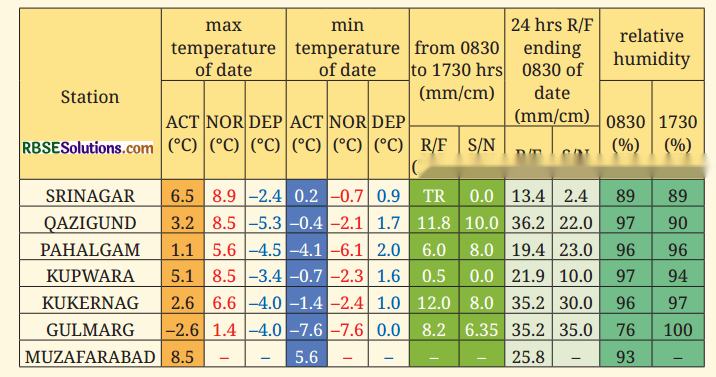
- Srinagar-Temperature Maximum 6.5°C, and Minimum 0.2°C, trace rainfall, 89% humidity.
- Qazigund-Temperature Maximum 3.2°C, Minimum 0.4°C, 11.8 mm rain, 22cm snow, 97% humidity.
- Pahalgam-Temperature Maximum 1.1 °C, Minimum 4.1°C, 6.0 mm rain, 23cm snow, 96% humidity.
- Kupwara-Temperature Maximum 5.1°C, Minimum 0.7°C, slight rain, 10 cm snow, and 97% humidity.
- Kukernag-Temperature Maximum 2.6°C, Minimum 1.4°C, 12 mm rain, 30 cm snow, and 97% humidity.
- Gulmarg-Temperature Maximum 2.6°C, Minimum 7.6°C, 8.2 mm rain, 35 cm snow, and 100% humidity.
- Muzaffarabad-Temperature Maximum 8.5°C, Minimum 5.6°C, 25.8 mm rain, and 93% humidity.