Climates of India Class 7 Question Answer SST Chapter 3
Start practicing theRBSE Solutions Class 7 Social Scienceand Class 7 SST Chapter 3 Climates of India Question Answer to consolidate your knowledge effectively.
Class 7 SST Chapter 3 Climates of India Question Answer
Class 7 Social Science Chapter 3 Climates of India Question Answer
Climates of India Class 7 Questions and Answers
The Big Questions (Page No. 45)
Question 1.
What makes India’s climate so diverse?
Answer:
India’s climate is diverse due to-
- Different latitudes from north to south.
- High mountains like the Himalayas.
- Coastal areas influencing temperature.
- Various landforms such as plains, plateaus, hills, deserts, etc.
- Monsoon winds and so on.
Question 2.
What are the monsoons? How are they formed?
Answer:
The monsoon is a pattern associated with seasonal winds, primarily characterized by seasonal rainfall.
- In summer, warm land pulls moist air from the ocean and causes rainfall. It is southwest monsoon.
- As winter approaches, the winds reverse and blows from the land to the ocean, passing over the Bay of Bengal, collect moisture and cause rainfall in South India. This is northwest monsoon.
Question 3.
What is the effect of climate on economy, culture and society?
Answer:
Climate has a profound impact on agriculture, food, clothing, festivals, and livelihoods. The success of failure of the monsoon affects agricultural production, water availability, and the economy. Climate-related festivals and traditions are an important part of Indian culture.
Question 4.
How can understanding the climate help us to prepare for natural disasters?
Answer:
Understanding the climate helps us to predict about disasters like floods, cyclones, droughts etc. The Indian Meteorological Department keeps track of disasters to protect people. This helps to reduce the loss of life, property, plants, animals, etc.
Question 5.
What is climate change? What are its consequences?
Answer:
Climate change refers to long-term changes in temperature, precipitation, and weather patterns. Its consequences are rising temperatures, disruptions to seasonal cycles, and an increase in the intensity of extreme weather events and natural disasters, which affect both human and natural life.
Let’s Explore (Page No. 45)
Question 1.
Udhagamandalam (Ooty) and Coimbatore are almost at the same latitude. The range of summer temperatures in Ooty is 10-25° while that in Coimbatore is 25-38°. Why do you think there is such a difference in temperature between these two places?
Answer:
Udhagamandalam (Ooty) is situated at a higher altitude, while Coimbatore is located at a relatively lower altitude in a plain area. As altitude increases, temperature decreases. This is why, despite being at the same latitude, Ooty has a lower temperature (10-25° Celsius), and Coimbatore has a higher temperature (25-38° Celsius). This shows that the temperature of a place does not depend only on its latitude, but also on geographical factors such as altitude.
Let’s Explore (Page No. 60)
Question 1.
Have you seen or read about floods? Look at the physical map of India. Discuss in pairs why you think floods occur in the areas mentioned above.
Answer:
Yes, we have seen and read about floods. Floods are primarily caused by excessive rainfall. In states like Assam, Bihar, and Uttar Pradesh, heavy rainfall causes rivers to overflow their banks, leading to flooding. In Kerala and Andhra Pradesh, heavy rainfall during the monsoon season also puts immense pressure on rivers and drainage systems, resulting in floods. Thus, the main cause of floods in these states is excessive rainfall and the resulting increase in the volume of water in the rivers.
Class 7 Climates of India Question Answer
Questions and Activities
Question 1.
Match the climatic factors with their effects-
Column A | Column B |
(1) Latitude | (a) Brings wet air to India during Summer |
(2) Altitude | (b) Creates different climates in the north and south |
(3) Proximity to the ocean | (c) Keeps higher places cooler |
(4) Monsoon winds | (d) Moderates the temperature |
Answer:
Column A | Column B |
(1) Latitude | (b) Creates different climates in the north and south |
(2) Altitude | (c) Keeps higher places cooler |
(3) Proximity to the ocean | (d) Moderates the temperature |
(4) Monsoon winds | (a) Brings wet air to India during Summer |
Question 2.
Answer the following questions-
(a) What is the difference between weather and climate?
Answer:
Weather is the condition that we experience day to day, such as strong winds, rain, heat, or cold, while climate refers to the weather patterns found in a particular region over a long period, typically several decades.
(b) Why do places near the ocean have milder temperatures than places far away from it?
Answer:
The sea acts as a moderator for the temperature, therefore temperatures in coastal areas do not vary much. As we move inland from the coast, the temperatures get more extreme-summer temperatures will be higher and winter temperatures lower. This is because land absorbs and releases heat quickly, Vvhile the sea absorbs and releases heat slowly.
(c) What role do monsoon winds play in affecting India’s climate?
Answer:
Monsoon winds bring seasonal rainfall to India, due to which rivers fill up the soil is soaked with water, crops grow. In summers, warm land pulls moist air from the ocean and causes rainfall. In winters, winds reverse and blow from the land to the ocean, passing over the Bay of Bengal, collect moisture and cause rainfall in South India.
(d) Why is Chennai warm or hot throughout the year, while Leh is cold?
Answer:
Chennai remains warm almost all year round because it is located near the equator, where the Sun’s rays fall almost vertically. On the other hand, Leh is situated at a high altitude, where atmospheric pressure and air density decrease with increasing altitude, resulting in cooler temperatures.
Question 3.
Look at a map of India given at the end of this book. Identify the climate for these cities: Leh, Chennai, Delhi, Panaji and Jaipur.
Is the place near the sea, in the mountains, or in the desert?
How do these factors affect the climate there?
Answer:
Leh-This city is located at a high altitude in the Himalayas and experiences an alpine climate. Due to its location, the temperature here remains below the freezing point, and there is very little rainfall because the monsoon winds do not reach this region.
Chennai-This city is located near the sea and has a tropical climate. Its proximity to the sea moderates the temperature, resulting in moderately warm and humid weather throughout the year, with mild winters.
Delhi-This city is located in the northern plains, far from the sea, and experiences a subtropical climate due to its inland location. Delhi experiences extreme heat in the summer and cold in the winter, resulting in a large temperature range.
Panaji-This city is located on the western coastal strip, close to the sea. and experiences a tropical humid climate. Its proximity to the sea moderates the temperature, and heavy rainfall occurs during the monsoon months.
Question 4.
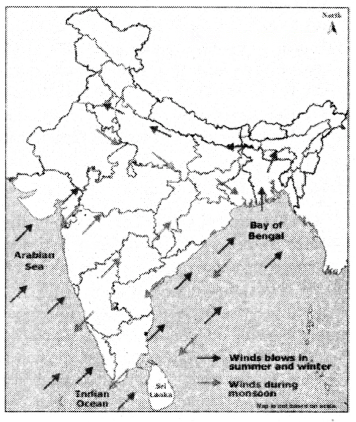
Draw the monsoon cycle in summers and winters on a map of India.
Label where the winds blow in summer and winter.
Show the direction of winds during the monsoon.
Answer:
Question 5.
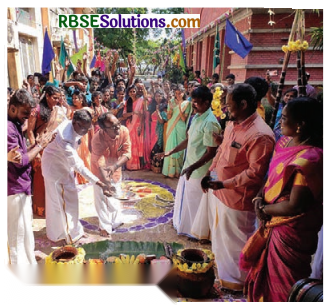
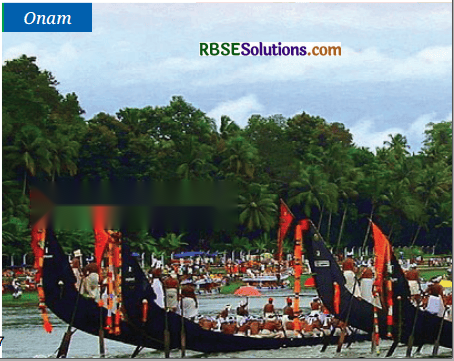
Make a colourful poster showing festivals in India linked to farming and weather (e.g., Baisakhi, Onam). Add pictures or drawings of these festivals.
Answer:
Pongal-It is an important four-day harvest festival of South India, primarily celebrated in the state of Tamil Nadu. During this festival, gratitudes are given to the Sun God, rain, and livestock for a bountiful harvest.
Makar Sankranti-Makar Sankranti is a seasonal festival primarily celebrated on January 14th or 15th, associated with the sun and harvest. Jt marks the end of winter, the days becoming longer (Uttarayana), and the arrival of new crops.
Baisakhi-Baisakhi is a major cultural, religious, and agricultural festival of North India, particularly Punjab and Haryana, celebrated annually on April 13th or 14th. For farmers, it is a day of joy as it marks the ripening and beginning of the harvest of the Rabi crop.
Onam-It is a major and big annual harvest festival of Kerala, celebrated in the month of Chingam according to the Malavalam calendar. It symbolizes the beginning of the new harvest season and the agricultural cycle.


Question 6.
Imagine you are a farmer in India. Write a short diary entry about how you would prepare for the rainy season.
Answer:
Diary – June 15, 2025
This morning I went to the field. The sky is cloudy; it looks like the rains will start soon. I repaired the field embankments so that the water would be retained and the crops wouldn’t be damaged. I also cleaned the irrigation channels so that the water would spread evenly.
I have stored the rice and millet seeds in a safe place; I will start sowing when the first rains arrive. I gave the oxen extra fodder and cleaned their enclosure so they would be safe during the rain. At home, I covered the grain storage with a tarpaulin and brought the firewood inside so it wouldn’t get wet.
The rainy season is a time of hard work, but if the weather cooperates, there will be a good harvest. Tomorrow I will sharpen the plow and other tools. I hope the fields will yield a golden harvest this time.
Question 7.
Identify a natural disaster (e.g., cyclone, flood, landslide, or forest fire) and write a short essay that includes the causes and impacts. Suggest actions that individuals, communities and the government can take to reduce the impact.
Answer:
Essay: Landslides Introduction-A landslide is one of the natural disasters in which rocks, soil, or debris suddenly slide down a slope. This phenomenon usually occurs in hilly and mountainous regions. Heavy rainfall, earthquakes, and deforestation are the main causes.
Cause of Landslides-
- Intense or prolonged rainfall
- Earthquakes
- Deforestation
- Unstable construction on slopes Impacts of Landslides—
- Loss of lives
- Destruction of roads, bridges and houses
- Disruption of transportation and communication.
- Soil erosion and change in landscape
- Increased risk of flooding in nearby areas.
Actions to Reduce Impact-
- At the individual level, individuals can avoid construction on unstable slopes and participate in tree plantation.
- At the community level, communities can create awareness about early warning systems and disaster preparedness.
- At the government level, governments must enforce proper land use planning, afforestation and build retaining walls and drainage systems in vulnerable areas.
- Conclusion: Landslides are dangerous, but with proper planning and cooperation, we can reduce their impact and protect both people and the environment.